Key points
- Chinese Academy of Sciences researchers completed the nicotine biosynthesis pathway for the first time in a study published in Cell.
- The research reconstructed nicotine production systems in non-tobacco plants and yeast, suggesting nicotine biosynthesis may become increasingly transferable across engineered biological platforms.
- Scientists identified a membrane-associated “metabolon” that spatially organizes nicotine synthesis and transport inside plant cells.
- The findings are drawing attention across nicotine and reduced-risk product sectors because they point toward a longer-term shift from extraction-based production toward engineerable biological systems.
- Regulatory specialists say emerging nicotine biosynthesis technologies could eventually complicate existing frameworks built around tobacco-derived nicotine definitions.
- Researchers and industry observers stress that the work remains early-stage science and far from near-term commercial-scale production.
2Firsts
May 7, 2026
A study published in Cell on April 30 by researchers at the Chinese Academy of Sciences is drawing attention across the nicotine industry after scientists reconstructed nicotine biosynthesis in non-tobacco plants and yeast systems, highlighting how advances in synthetic biology could eventually reshape future nicotine production technologies.
A Scientific Breakthrough Begins Raising Industry Questions
For decades, scientists understood the molecular building blocks involved in nicotine formation but lacked a complete explanation for how the final biosynthetic steps were organized inside plant cells.
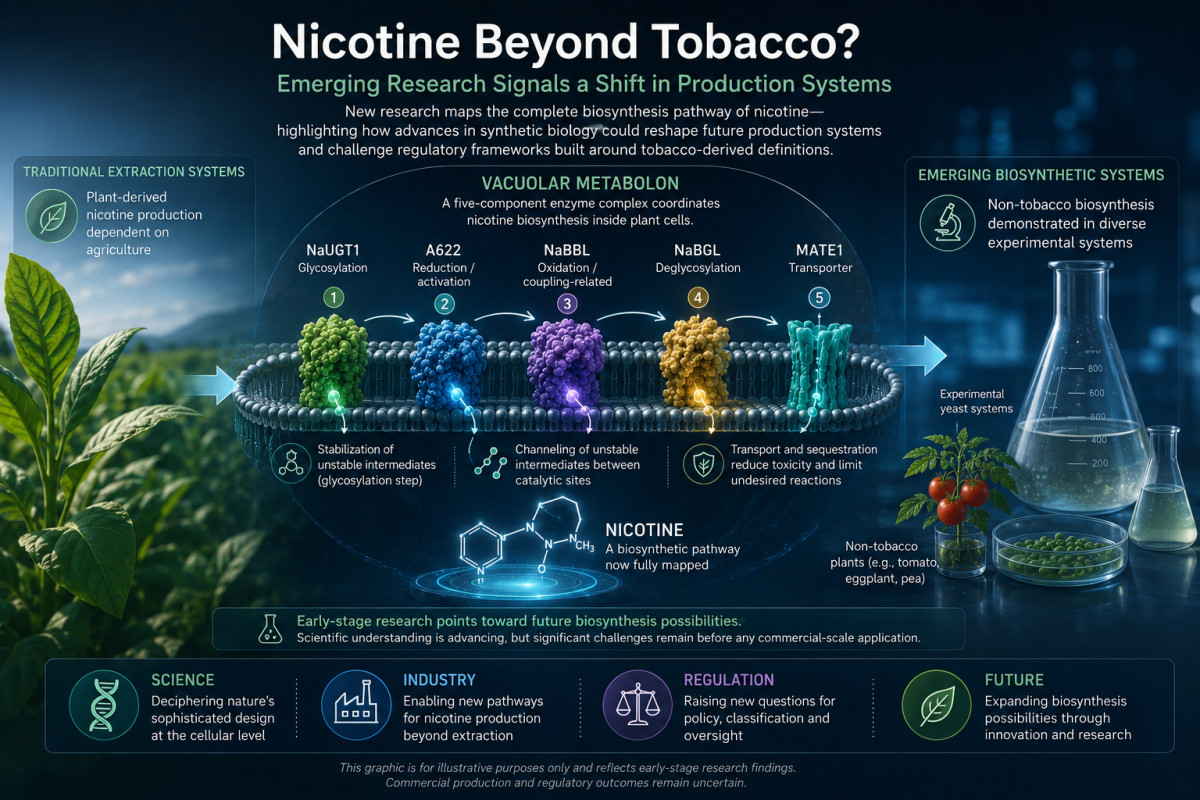
Researchers said the findings help explain how tobacco plants assemble nicotine through a coordinated multi-enzyme complex located on vacuolar membranes, allowing unstable intermediate compounds to be processed efficiently while limiting cellular toxicity.
While the research remains at an early stage and far from commercial-scale application, the work is drawing attention across the nicotine and reduced-risk product sectors because it suggests nicotine biosynthesis may eventually become transferable across engineered biological systems.
The study comes as global tobacco and nicotine companies continue exploring alternatives to conventional tobacco-dependent production models amid broader shifts toward smoke-free and reduced-risk products.
Inside the Biological System That Produces Nicotine
For decades, scientists understood that nicotine is formed from two separate molecular building blocks, but the final biochemical steps connecting those structures had remained unresolved.
Several intermediate compounds involved in nicotine synthesis are highly unstable, complicating efforts to fully reconstruct the pathway experimentally.
The CAS-led team said its study identified a previously overlooked glycosylation step that appears to stabilize these intermediates during synthesis.
The study also found that enzymes and transport proteins form a membrane-associated complex that channels unstable intermediates between catalytic sites.
Rather than occurring randomly inside plant cells, the study suggests nicotine biosynthesis is spatially organized through what researchers describe as a vacuolar five-component “metabolon” — a coordinated biochemical assembly line that channels synthesis and transport while limiting unwanted reactions.
The findings may also have broader implications for understanding how plants produce other structurally complex natural compounds.
Nicotine Production May No Longer Depend Entirely on Tobacco Plants
Beyond its scientific significance, the study is drawing attention because it suggests nicotine biosynthesis may eventually become transferable across engineered biological systems rather than remaining tied exclusively to tobacco plants.
The researchers demonstrated nicotine production pathways not only in tobacco, but also in non-tobacco plants including tomato, eggplant and pea, as well as in yeast systems. The results indicate that nicotine biosynthesis could potentially be reconstructed in alternative biological platforms under controlled conditions.
Industry observers say the findings do not suggest commercial-scale production is imminent. Significant challenges remain in areas including yield optimization, fermentation efficiency, purification, scalability and regulatory review.
Still, the research is being closely watched across nicotine and reduced-risk product sectors because it points toward a broader shift — from conventional extraction-based systems toward increasingly engineerable biological platforms.
For major tobacco and nicotine companies, the study’s importance may lie less in how nicotine is produced today than in whether nicotine biosynthesis may be entering a more modular and programmable phase.
The membrane-associated “metabolon” identified in the study could also have implications beyond nicotine itself, particularly for future synthetic biology approaches involving complex natural compounds that require coordinated transport and spatially organized metabolism.
Emerging Nicotine Technologies Could Test Existing Regulatory Frameworks
The study may also raise longer-term regulatory questions as nicotine production technologies evolve beyond traditional tobacco extraction systems.
The findings come as regulators in both the United States and Europe are already struggling to adapt tobacco-era frameworks to rapidly evolving nicotine products.
In the United States, tobacco regulation has historically been closely tied to whether nicotine is derived from tobacco. Advances in engineered biosynthesis could eventually complicate how future nicotine products are classified and regulated.
The study itself does not address commercial applications or regulatory frameworks. However, scientists demonstrated nicotine biosynthesis in non-tobacco plants and yeast systems, developments that some regulatory observers say could contribute to future debates over how biologically produced nicotine should be categorized.
Industry analysts note that key questions could emerge around whether nicotine produced through engineered microbial or plant systems would fall under existing “tobacco product” definitions, and whether current review pathways are designed to evaluate such products.
In Europe, where policymakers are already reviewing broader nicotine regulation under ongoing discussions surrounding the Tobacco Products Directive (TPD), the findings may further highlight the growing gap between traditional tobacco-based definitions and the expanding range of nicotine-containing products entering the market.
Regulatory specialists say future oversight may increasingly focus not only on nicotine source, but also on manufacturing methods, impurity profiles and overall product risk characteristics.
For now, researchers and industry observers alike stress that the study remains early-stage scientific research rather than a near-term commercial production roadmap.
From Tobacco Extraction to Engineered Nicotine Production Systems
The study was led by Dapeng Li at the Chinese Academy of Sciences’ Center for Excellence in Molecular Plant Sciences in Shanghai, a research center focused on plant metabolism, chemical ecology and synthetic biology.
Li previously trained at the Max Planck Institute for Chemical Ecology in Germany and has focused much of his research on how plants produce and spatially organize defensive chemical compounds. The paper’s co-authors also include Ian T. Baldwin, a prominent plant biologist widely recognized for his work on plant-insect interactions and nicotine-related defense mechanisms in wild tobacco species.
The findings extend beyond nicotine itself and may help scientists better understand how plants assemble structurally complex natural products through coordinated metabolic systems.
While the work remains far from altering global nicotine supply chains, it signals a broader technological direction increasingly emerging across biotechnology and nicotine science: the gradual shift from extraction-based systems toward more engineerable biological production platforms.
For the broader nicotine and reduced-risk product sectors, the study may matter less because it changes current production methods than because it suggests future nicotine production systems could become progressively less dependent on traditional tobacco-based supply chains.
(Cover Image:AI-generated conceptual illustration of emerging nicotine biosynthesis systems and non-tobacco production pathways.)
Disclaimer
This article is provided solely for professional research, industry discussion, and informational purposes. Any references to brands, companies, products, technologies, or policies are made for factual reporting and analytical purposes only, and do not constitute endorsement, recommendation, promotion, or advertising by 2Firsts.
Nicotine-containing products, including but not limited to cigarettes, e-cigarettes, heated tobacco products, and nicotine pouches, carry significant health risks. Readers are responsible for complying with all applicable laws and regulations in their respective jurisdictions, including age restrictions and access limitations.
The information contained in this article should not be regarded as investment, legal, medical, regulatory, or commercial advice. While 2Firsts strives to ensure the accuracy and reliability of its content, it does not assume liability for any direct or indirect loss arising from errors, omissions, inaccuracies, or reliance on the information contained herein.
This article is not intended for individuals below the legal age for accessing tobacco or nicotine-related information in their jurisdiction.
Copyright Notice
This article is either original content produced by 2Firsts or content reproduced, translated, summarized, or adapted from third-party sources with attribution where applicable. The intellectual property rights of the original content remain with 2Firsts or the respective original rights holders.
No individual or organization may copy, reproduce, distribute, republish, modify, translate, or otherwise use this content without prior authorization. Any unauthorized use may result in legal action.
For copyright-related inquiries, corrections, or removal requests, please contact: info@2firsts.com.
AI-Assisted Translation and Editing Notice
Portions of this article may have been translated, edited, or reviewed with the assistance of artificial intelligence tools to improve efficiency and readability. Due to the limitations of AI-assisted translation and editing, discrepancies, omissions, or inaccuracies may exist when compared with the original source.
Where applicable, readers are advised to refer to the original source for the most complete and accurate information. If you identify any errors or believe that any content infringes upon your rights, please contact us at info@2firsts.com, and we will review and address the matter promptly.