Key Points
- NielsenIQ data show smokeless grew over 8%.
- Cigarettes still account for nearly 70% of sales.
- Grand View sees pouch CAGR near 25%.
- FDA has authorized ZYN and on! PLUS products.
2Firsts
June 23, 2026
According to C-Store Dive, as cigarette use and sales continue to decline in the United States, smokeless nicotine products are gaining more attention in the convenience-store channel, with nicotine pouches becoming one of the fastest-growing and most closely watched segments.
Smokeless Products Keep Growing
The report said the smokeless category includes products such as chewing tobacco, snuff, snus and nicotine pouches. Nicotine pouches have become a particular focus for the convenience-store industry. According to Grand View Research, U.S. nicotine pouch sales are expected to grow at a compound annual growth rate of nearly 25% through 2033.
However, smokeless products are still not the largest part of the U.S. nicotine business. NielsenIQ and Goldman Sachs data showed that in the 52 weeks ended May 30, U.S. cigarette sales fell 2.4% year over year, but cigarettes still accounted for nearly 70% of total nicotine category sales.
Smokeless nicotine products were the second-largest segment of the nicotine category. C-Store Dive said smokeless products were also the only major nicotine category to record growth over the past year, with full-year sales up more than 8%. By comparison, cigar sales fell about 1%, cigarette sales declined by more than 2%, and vape sales recorded a double-digit reduction.
The shift shows that the nicotine backbar in convenience stores is changing. Cigarettes remain dominant, but growth momentum is moving gradually from combustible tobacco toward smokeless products, especially modern oral nicotine products.
Three Companies Lead the Market
C-Store Dive reported that Altria Group, British American Tobacco and Swedish Match, a division of Philip Morris International, together account for more than 90% of the smokeless nicotine category.
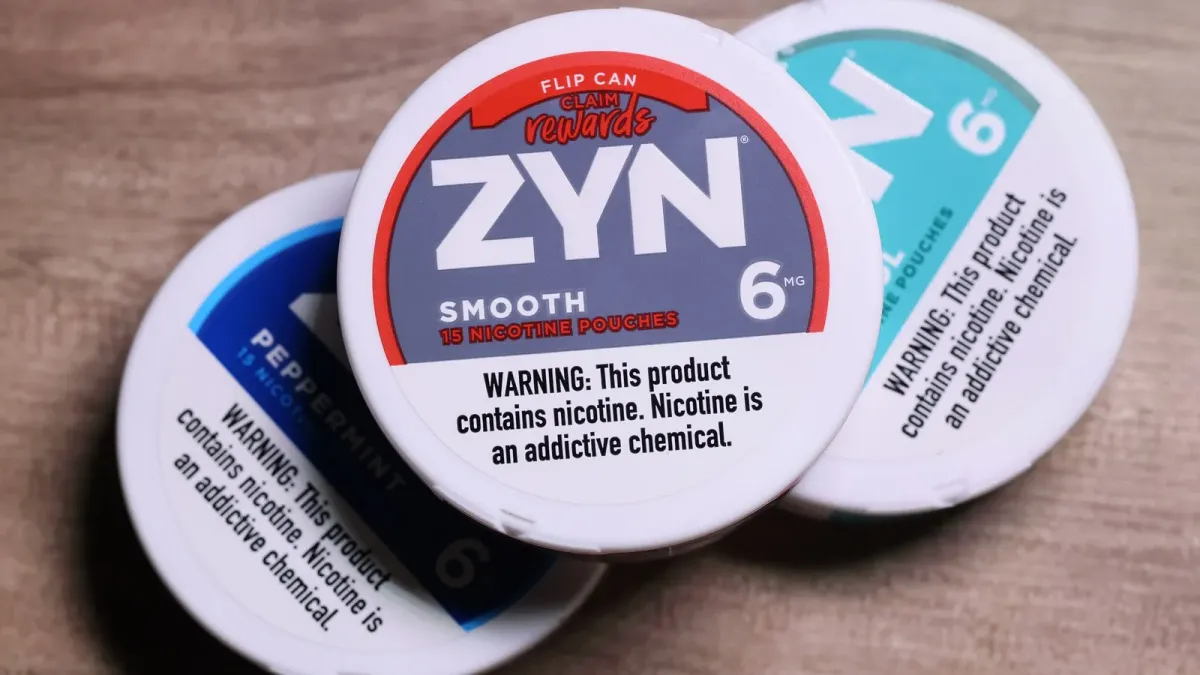
Altria has a U.S. smokeless portfolio that includes traditional smokeless tobacco and modern oral products, including Copenhagen, Skoal and on!. British American Tobacco competes through traditional smokeless brands such as Grizzly and modern oral products. Swedish Match, now owned by Philip Morris International, has expanded rapidly in the U.S. market through ZYN nicotine pouches.
The report said Altria Group still leads in annual sales, but Swedish Match is catching up. ZYN has been available for longer, and the popularity of its nicotine pouches is reflected in year-over-year sales data. on! PLUS entered wider distribution only in March 2026, so the Goldman Sachs data did not list its year-over-year sales change.
For convenience stores, nicotine pouch growth means shelf allocation and category management are changing. As traditional cigarette sales decline, retailers need to rebalance display space and promotional resources across cigarettes, vapes, traditional smokeless tobacco and nicotine pouches.
FDA Authorizations Raise Compliance Focus
Regulatory attention on nicotine pouches is also increasing. In January 2025, the U.S. Food and Drug Administration (FDA) authorized the marketing of 20 ZYN nicotine pouch products through the premarket tobacco product application (PMTA) pathway. It was the first time the FDA had authorized products commonly referred to as nicotine pouches.
In December 2025, the FDA authorized six on! PLUS nicotine pouch products, including mint, wintergreen and tobacco flavors in 6 mg and 9 mg nicotine strengths. The applications were submitted by Altria’s Helix Innovations. The FDA said the authorizations were the first decisions under its nicotine pouch PMTA pilot program, which is intended to improve review efficiency while maintaining scientific standards.
FDA marketing authorization does not mean a product is “safe” or “FDA approved.” The agency generally says an authorization means a product meets the statutory “appropriate for the protection of public health” standard based on a specific application and regulatory conditions, while companies must still comply with marketing, age-restriction and post-market requirements.
For the U.S. convenience-store industry, the authorizations for ZYN and on! PLUS carry market signals. On one hand, nicotine pouches may offer adult tobacco or nicotine users a non-combustible alternative. On the other hand, regulators continue to scrutinize youth use, flavor appeal, marketing practices and labeling compliance.
From an industry perspective, the growth of smokeless nicotine products is reshaping competition in the U.S. nicotine market. Convenience stores still depend heavily on cigarettes for sales scale, but future category growth is more likely to come from modern oral products such as nicotine pouches. As more products move through PMTA review and authorization pathways, compliance status, brand concentration and channel execution will become key competitive factors in the smokeless nicotine market.
(Cover Image source: C-Store Dive)
Disclaimer
This article is provided solely for professional research, industry discussion, and informational purposes. Any references to brands, companies, products, technologies, or policies are made for factual reporting and analytical purposes only, and do not constitute endorsement, recommendation, promotion, or advertising by 2Firsts.
Nicotine-containing products, including but not limited to cigarettes, e-cigarettes, heated tobacco products, and nicotine pouches, carry significant health risks. Readers are responsible for complying with all applicable laws and regulations in their respective jurisdictions, including age restrictions and access limitations.
The information contained in this article should not be regarded as investment, legal, medical, regulatory, or commercial advice. While 2Firsts strives to ensure the accuracy and reliability of its content, it does not assume liability for any direct or indirect loss arising from errors, omissions, inaccuracies, or reliance on the information contained herein.
This article is not intended for individuals below the legal age for accessing tobacco or nicotine-related information in their jurisdiction.
Copyright Notice
This article is either original content produced by 2Firsts or content reproduced, translated, summarized, or adapted from third-party sources with attribution where applicable. The intellectual property rights of the original content remain with 2Firsts or the respective original rights holders.
No individual or organization may copy, reproduce, distribute, republish, modify, translate, or otherwise use this content without prior authorization. Any unauthorized use may result in legal action.
For copyright-related inquiries, corrections, or removal requests, please contact: info@2firsts.com.
AI-Assisted Translation and Editing Notice
Portions of this article may have been translated, edited, or reviewed with the assistance of artificial intelligence tools to improve efficiency and readability. Due to the limitations of AI-assisted translation and editing, discrepancies, omissions, or inaccuracies may exist when compared with the original source.
Where applicable, readers are advised to refer to the original source for the most complete and accurate information. If you identify any errors or believe that any content infringes upon your rights, please contact us at info@2firsts.com, and we will review and address the matter promptly.