Key Points
- RLX Technology was removed from the FTSE All-World Index, effective September 21, 2026. FTSE Russell's public materials do not specify the reason for the deletion.
- FTSE Russell records show RLX was already included in its global equity index universe by 2022, when its ADRs were classified as China Large Cap securities.
- RLX traded about 44.77 million shares on September 18, compared with about 1.91 million on the previous trading day.
- Second-quarter revenue was RMB1.0105 billion ($148.9 million), up 14.8% year over year, with international operations representing 68.5%.
- First-quarter revenue was RMB1.5858 billion, with international operations accounting for 72.3%. RLX said Q1 included a one-time benefit related to a change in export regulation.
- In July, RLX acquired a 51% equity interest and board control in one of Western Europe's largest distributors of next-generation smoke-free and FMCG products.
Editor’s Note
This article is compiled from publicly available information from FTSE Russell, S&P Capital IQ, RLX Technology, filings with the U.S. Securities and Exchange Commission (SEC), and public market data. Statements concerning the reasons for index changes, trading activity and potential market effects are limited to what can be established from publicly available information; no inference is made where the underlying information has not been disclosed. Share-price, trading-volume and index data may change over time.
This article focuses on developments involving the tobacco and nicotine industry, corporate operations and related capital-market activity. It is provided for news and industry-information purposes only and does not constitute a recommendation or advice to buy, sell or hold any security or investment product, or any other form of investment advice.
2Firsts
September 22, 2026
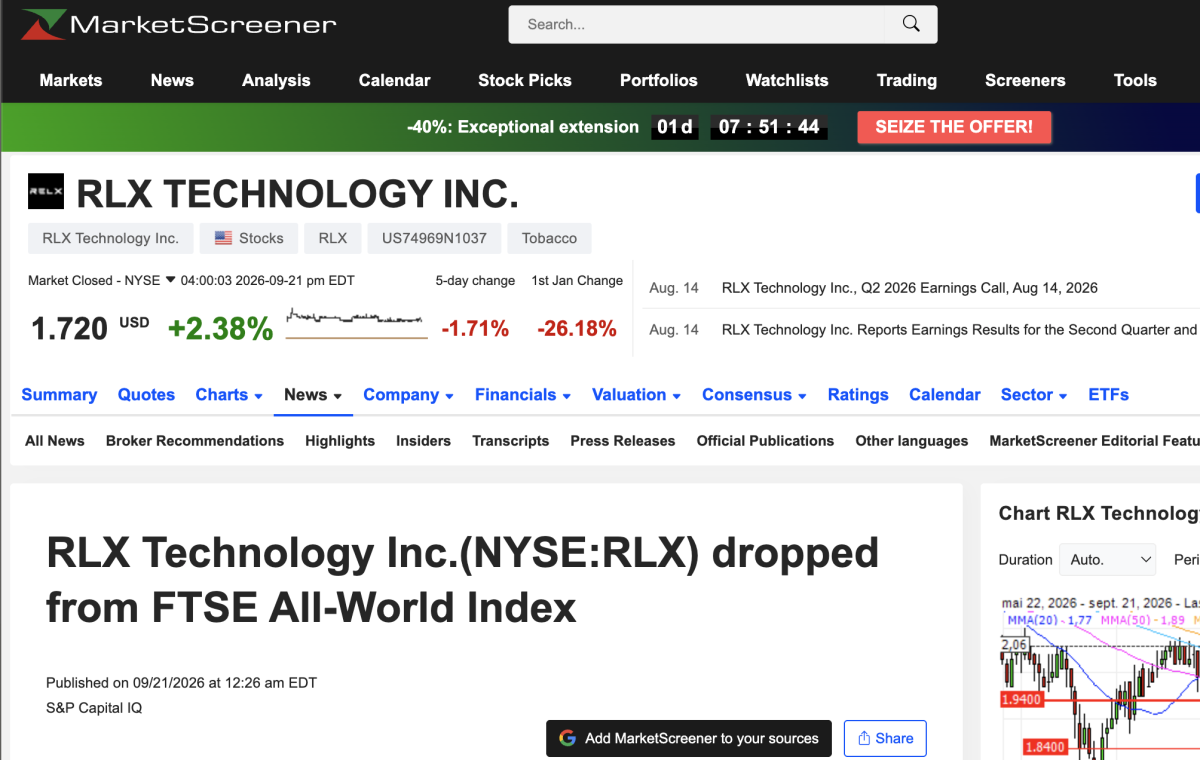
According to S&P Capital IQ on September 21, RLX Technology (NYSE: RLX) was removed from the FTSE All-World Index. The change occurred during FTSE Russell's September 2026 semi-annual review of its Global Equity Index Series, with the rebalance implemented after the September 18 close and effective from the start of trading on September 21.
FTSE Russell's publicly available materials do not specify the reason for RLX's removal or state whether the company moved from Mid Cap to Small Cap or exited because of another eligibility criterion.
RLX Was in FTSE's Global Equity Universe by 2022
Public FTSE Russell records show that RLX Technology was already included in its global equity index universe by 2022.
A FTSE Russell document published that year in connection with the Holding Foreign Companies Accountable Act listed RLX Technology's American depositary receipts as China securities and classified them as Large Cap.
Subsequent public fund disclosures show RLX remained in portfolios tracking the FTSE All-World Index. An Invesco FTSE All-World UCITS ETF holding report still listed RLX Technology in June 2024, while an HSBC FTSE All-World Index Fund disclosure continued to include RLX in November 2025.
FTSE All-World Covers About 90% to 95% of Global Investable Market Capitalization
The FTSE All-World Index is one of FTSE Russell's major global equity benchmarks, covering about 4,200 large- and mid-cap stocks across more than 45 developed and emerging markets and representing approximately 90% to 95% of global investable market capitalization.
The index is part of the FTSE Global Equity Index Series and consists of Large Cap and Mid Cap securities, excluding the Small Cap segment.
During semi-annual reviews, FTSE Russell ranks eligible companies within regional universes and applies size thresholds alongside free-float, foreign-ownership, liquidity and other investability screens. The September review uses data from the end of June to establish the regional universe.
RLX was removed during that scheduled review cycle, but FTSE Russell has not publicly identified the specific criterion behind the deletion.
Trading Volume Jumps to About 44.77 Million Shares
RLX trading volume increased sharply on the final trading day before the index change took effect.
On September 18, RLX closed at $1.68, down 2.33%, with approximately 44.77 million shares traded.
Volume was about 1.91 million shares on September 17, around 1.67 million on September 16 and 1.38 million on September 15.
September 18 was also the closing implementation date for the FTSE review.
Public market data do not identify individual trading counterparties, making it impossible to determine how much of that day's volume came directly from FTSE-tracking funds or other index-related rebalancing.
On September 21, the first trading session after the index change became effective, RLX closed at approximately $1.72, up about 2.4%.
International Business Accounts for 68.5% of Q2 Revenue
RLX reported second-quarter 2026 net revenue of RMB1.0105 billion ($148.9 million) on August 14, up 14.8% from RMB880.0 million in the same period a year earlier.
International operations represented 68.5% of total quarterly revenue. RLX attributed the year-over-year revenue increase primarily to international expansion and contributions from an acquisition completed in May 2025.
Gross profit increased 47.8% to RMB357.8 million ($52.7 million), while gross margin rose to 35.4% from 27.5% a year earlier. The company attributed the margin improvement mainly to a more favorable revenue mix and further supply-chain optimization.
U.S. GAAP income from operations rose 234.7% to RMB130.4 million, while U.S. GAAP net income increased 1.6% to RMB222.0 million ($32.7 million).
Second-quarter revenue, however, was below the first-quarter level.
RLX reported RMB1.5858 billion ($229.9 million) in first-quarter revenue, up 96.2% year over year, with international operations accounting for 72.3%.
Chief Financial Officer Chao Lu said in the second-quarter earnings release that revenue and gross profit moderated from the first quarter as expected because Q1 included a one-time benefit related to a change in China's export-related regulation.
Gross margin was 31.8% in Q1 before rising further to 35.4% in the second quarter.
RLX Holds $2.05 Billion in Cash, Deposits and Investment Assets
As of June 30, RLX held a combined RMB13.8834 billion ($2.0462 billion) in cash and cash equivalents, restricted cash, short-term bank deposits, short-term investments, long-term bank deposits and long-term investment securities.
That compared with RMB14.5297 billion at the end of March.
Net cash used in operating activities was RMB63.2 million ($9.3 million) during the second quarter.
RLX reported total assets of RMB16.8512 billion and total liabilities of RMB1.2250 billion as of June 30.
RLX Takes 51% Stake in Major Western European Distributor
RLX is also putting capital into overseas distribution.
The company disclosed that in July it acquired a 51% equity interest and board control in one of Western Europe's largest distributors of next-generation smoke-free and fast-moving consumer goods.
RLX did not disclose the name of the acquired company or the transaction value in its second-quarter results.
According to RLX, the distributor operates a multi-channel logistics network, an extensive offline distribution footprint and a proprietary B2B digital ordering platform serving retail merchants across key European markets.
RLX said it plans to combine its global supply-chain capabilities and capital resources with the distributor's local route-to-market network, including efforts to optimize costs and pursue cross-selling.
The acquired company's financial results are scheduled to be consolidated into RLX Technology's accounts beginning in the third quarter of 2026.
The company said its European strategy combines organic expansion with strategic investments in major local partners.
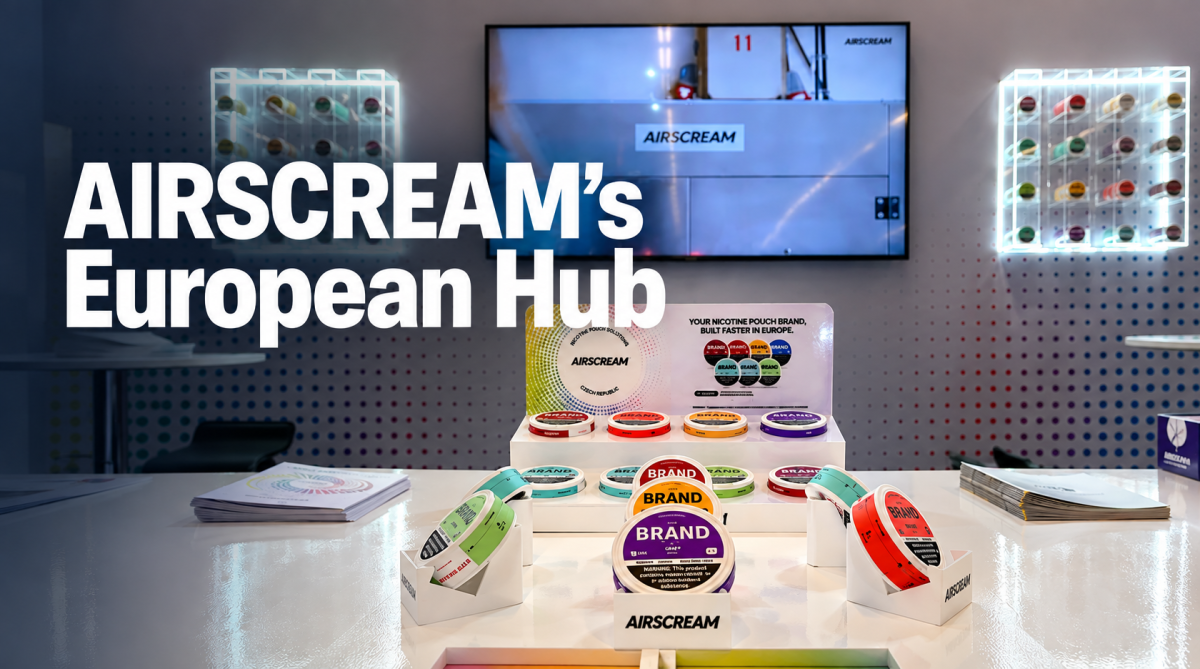
Expanding Beyond E-Vapor Into Modern Oral Nicotine Pouches
RLX is also broadening its product portfolio beyond e-vapor.
Chief Executive Ying “Kate” Wang said in the second-quarter earnings announcement that the company is expanding into a wider portfolio of smoke-free products as the industry matures.
RLX said it is scaling its newly launched modern oral nicotine pouches and building its presence in other smoke-free categories.
The company did not disclose the pouch brand, sales contribution, market share or specific country footprint in its second-quarter results.
RLX continues to describe itself as a global branded e-vapor company. International operations accounted for 68.5% of second-quarter revenue, its July Western European distribution investment is scheduled to begin contributing to consolidated results in the third quarter, and modern oral nicotine pouches and other smoke-free products are becoming part of its overseas portfolio.
Follow 2Firsts for timely updates on global tobacco and nicotine industry developments, corporate strategy and market trends.
Cover Image: S&P Capital IQ / MarketScreener
Disclaimer
This article is provided solely for professional research, industry discussion, and informational purposes. Any references to brands, companies, products, technologies, or policies are made for factual reporting and analytical purposes only, and do not constitute endorsement, recommendation, promotion, or advertising by 2Firsts.
Nicotine-containing products, including but not limited to cigarettes, e-cigarettes, heated tobacco products, and nicotine pouches, carry significant health risks. Readers are responsible for complying with all applicable laws and regulations in their respective jurisdictions, including age restrictions and access limitations.
The information contained in this article should not be regarded as investment, legal, medical, regulatory, or commercial advice. While 2Firsts strives to ensure the accuracy and reliability of its content, it does not assume liability for any direct or indirect loss arising from errors, omissions, inaccuracies, or reliance on the information contained herein.
This article is not intended for individuals below the legal age for accessing tobacco or nicotine-related information in their jurisdiction.
Copyright Notice
This article is either original content produced by 2Firsts or content reproduced, translated, summarized, or adapted from third-party sources with attribution where applicable. The intellectual property rights of the original content remain with 2Firsts or the respective original rights holders.
No individual or organization may copy, reproduce, distribute, republish, modify, translate, or otherwise use this content without prior authorization. Any unauthorized use may result in legal action.
For copyright-related inquiries, corrections, or removal requests, please contact: info@2firsts.com.
AI-Assisted Translation and Editing Notice
Portions of this article may have been translated, edited, or reviewed with the assistance of artificial intelligence tools to improve efficiency and readability. Due to the limitations of AI-assisted translation and editing, discrepancies, omissions, or inaccuracies may exist when compared with the original source.
Where applicable, readers are advised to refer to the original source for the most complete and accurate information. If you identify any errors or believe that any content infringes upon your rights, please contact us at info@2firsts.com, and we will review and address the matter promptly.