Key Points
● PMTA and harm reduction: CTP is increasingly linking product review efficiency with a broader goal of helping adults who smoke access scientifically reviewed alternatives while maintaining youth protections.
● More category-specific review: Lessons from the nicotine-pouch pilot are being applied more broadly, with CTP using category-specific filing questions and tailored review tools rather than a strictly one-size-fits-all approach.
● Greater predictability: Pending PMTAs have fallen sharply, CTP is working toward more end-to-end timeline tracking, and officials discussed a longer-term goal of a 180-day review period from a complete application.
● Life-cycle regulation: The sPMTA pilot is placing more emphasis on product modifications, bridging, alternate suppliers and complete upfront submissions, making regulatory planning increasingly important beyond the initial authorization.
● Capacity remains a constraint: CTP has only nine PMTA scientific review teams and continues to face significant backlogs and hiring limitations, even as it pushes for a more efficient review system.
2Firsts
WASHINGTON, D.C., October 7, 2026
The U.S. tobacco and nicotine market has entered a period of notable regulatory change in 2026. In September, Bret Koplow was formally appointed director of FDA’s Center for Tobacco Products after serving as acting director since 2025. The agency has also issued new policy and enforcement measures, accelerated efforts to improve product review, and granted new marketing orders across both e-cigarette and nicotine-pouch categories. Together, those developments have begun to reshape expectations around which products can reach the legal market and how FDA intends to regulate them.
Against that backdrop, 2Firsts traveled to the United States for a closer, on-the-ground examination of the changing market and regulatory environment, reporting from the New Approaches Summit in New York on September 25 and the Food and Drug Law Institute’s Tobacco and Nicotine Products Regulation and Policy Conference in Washington on October 6.
Between those two meetings came another significant regulatory development. On September 28, the U.S. Food and Drug Administration said it would evaluate changes to the Premarket Tobacco Product Application, or PMTA, regulatory framework, including possible new rulemaking to replace the current framework. FDA said a modernized system should better reflect market realities and provide greater clarity and predictability.
At the New Approaches Summit, FDA Center for Tobacco Products Director Bret Koplow described four current priorities for CTP: preventing youth initiation; helping adults who smoke quit or completely switch to products posing meaningfully lower health risks; improving understanding of relative risk among consumers and healthcare professionals; and reducing the prevalence of unauthorized tobacco products.
Koplow also said the PMTA pathway is “predicated on tobacco harm reduction.”
Three days later, FDA announced that the PMTA framework itself would be reconsidered.
Then, on October 6 in Washington, Koplow and senior officials from CTP’s Office of Science spent much of the day discussing how the agency is approaching product review as it pursues those broader public-health goals.
The approach emerging from those public remarks is not a retreat from the statutory “appropriate for the protection of the public health,” or APPH, standard. CTP has not announced a move away from product-specific authorization.
Instead, officials are describing a system with more attention to the characteristics of individual product categories, greater use of accumulated scientific knowledge and standards, tighter focus on evidence needed for regulatory decisions, more predictable review processes and more workable pathways for changes to products that have already been authorized.
At the same time, CTP is using public forums to explain its own limitations — including staffing shortages, application backlogs and hiring constraints — while placing more responsibility on manufacturers to invest in science, submit stronger applications, engage earlier with FDA and plan beyond the initial marketing authorization.

From Harm Reduction to a Regulated Market
Koplow’s September 25 remarks in New York provide the clearest starting point for understanding the direction CTP is now describing.
He framed the agency’s task not simply as deciding which tobacco products should be authorized, but as creating a regulated marketplace that protects youth while giving adults who smoke access to alternatives that may expose them to lower health risks.
“No tobacco product is safe,” he said, and complete cessation remains the healthiest outcome.
But for adults who continue to smoke after repeated attempts to quit, Koplow said, completely switching away from cigarettes to a lower-risk alternative that has received FDA marketing authorization can meaningfully reduce health risks.
“A regulated marketplace protects youth and helps adults,” he said.
The four priorities Koplow outlined at NAS fit around that idea: youth prevention, adult cessation or switching, better understanding of relative risk and reducing unauthorized products.
Koplow has repeatedly pointed to the scale of the unauthorized e-cigarette market. At FDLI, citing data based on Circana-tracked convenience and grocery channels, he said unauthorized products were estimated to account for almost 70% of U.S. e-cigarette sales in those channels as of December 2025.
He argued that adults trying to move away from cigarettes may encounter authorized and unauthorized alternatives on the same shelf, with limited ability to distinguish between them. A failed switching attempt, he said, can send a consumer back to cigarettes.
Koplow has also highlighted a sharp deterioration in public understanding of relative risk.
The proportion of U.S. adults who perceived e-cigarettes as less harmful than cigarettes fell from about 51% in 2012 to under 17% in 2022, according to data cited in his FDLI remarks.
At the same time, he has continued to emphasize that tobacco harm reduction does not displace youth protection.
At FDLI, Koplow cited 2025 National Youth Tobacco Survey data showing that about 2 million U.S. middle and high school students still reported current use of a tobacco product, despite recent declines in youth use.
Device-access technology is one example of how CTP is trying to balance the two objectives.
Koplow discussed systems using ID verification, smartphone pairing and periodic biometric checks to restrict access to adults aged 21 and over. Where technology can meaningfully reduce youth-access risk, he said, “the risk calculus around flavors changes.”
He did not present device-access restrictions as the only route for a non-tobacco-flavored product. Such a product could still potentially meet the public-health standard if the evidence showed that benefits to adults who smoke outweighed risks to youth.
That emphasis on the role of authorization in a functioning regulated market was echoed later at FDLI by Matthew Farrelly, director of CTP’s Office of Science.
“When we as an office and as a center authorize a product, we take pride in that,” Farrelly said.
The comment did not amount to a target for more authorizations. It did, however, frame authorization as an affirmative APPH judgment rather than simply the completion of an administrative process.
FDA Reconsiders the PMTA Framework
FDA’s September 28 announcement moved the discussion from broad regulatory goals to the framework governing product review itself.
At FDLI, Koplow said the existing PMTA rule was finalized before FDA had accumulated substantial practical experience reviewing millions of applications.
Both industry and the agency, he said, went through a learning curve.
Many early applications lacked basic information needed for scientific review, including ingredient data, toxicological assessments and evidence showing a meaningful benefit to adults who smoke. Those were fundamental elements needed for a public-health determination, he said.
Koplow said potential revisions to the PMTA framework should provide greater clarity and predictability, improve efficiency and reduce unnecessary administrative burdens on both CTP scientists and applicants.
The current PMTA rule remains in effect while FDA considers future changes.
Changing the rule alone, however, would not solve CTP’s review problem.
The center currently has only nine scientific review teams handling PMTAs.
“I would like to see us more than double the number of scientific review teams that we have,” Koplow told the FDLI audience.
He linked the staffing problem in part to CTP’s hiring authorities.
Other FDA centers can use the Title 21 Alternative Pay and Personnel System, which provides greater flexibility in recruiting and compensating scientific and technical staff, while CTP currently cannot, Koplow said.
Addressing that difference would ultimately require congressional action, he said.
PMTA reform is therefore both a regulatory-design problem and a capacity problem.
“One Size Doesn’t Necessarily Fit All”
One of the clearest themes running from New York to Washington is a move toward more category-specific review practices.
At the New Approaches Summit, Koplow said that “for scientific review, one size doesn’t necessarily fit all.”
At FDLI, he used CTP’s nicotine-pouch pilot as the most developed example.
Nicotine pouches, he said, are a relatively homogeneous category compared with products such as e-cigarettes. They do not contain batteries or heating elements, and the scientific questions they raise differ from those presented by ENDS.
“The review process should reflect that,” Koplow said.
CTP authorized 23 products through the nicotine-pouch pilot, and Koplow described the program as “a model we want to build on where it’s appropriate to do so.”
Office of Science officials later said lessons from the pilot had already been incorporated into aspects of ENDS review, including streamlined internal review templates intended to keep reviewers focused on information most relevant to the regulatory decision. They also stressed that not everything learned from nicotine pouches can be transferred to e-cigarettes because the categories differ materially.
Later in the afternoon, Cristi Stark, associate director of CTP’s Office of Science, offered an even more concrete example.
Discussing filing review, Stark said CTP had “started looking at that from a category perspective.”
“We have category-specific questions for our team for filing,” she said.
At least at the filing stage, CTP is therefore using questions tailored to particular product categories rather than applying precisely the same set of questions in the same way across all products.
That remains different from category-based authorization.
Todd Cecil, deputy director of regulatory management in the Office of Science, said broader reliance on category-level knowledge becomes more reasonable only after CTP has accumulated a sufficiently stable scientific understanding of that category.
He cautioned that ENDS still encompass a wide range of products and cannot simply be treated as having uniform health effects.
Category-specific tools are entering review practice, but the final APPH judgment remains tied to the evidence supporting an individual application.
What Does CTP Actually Need to See?
A second theme at FDLI went directly to one of industry’s longstanding concerns: how much evidence is really necessary for FDA to make a decision?
Cecil summarized the issue in one sentence.
“What do you need to see?” he said. “And not just what do you want to see — what do you need to see.”
He described that distinction as part of the streamlining industry has been asking for.
Farrelly described a similar shift in how he manages the Office of Science regulatory-science portfolio.
Research proposals, he said, should have a clear line of sight to product review, applicant needs, regulatory decisions or communication of those decisions.
“When we are done with this, how will it be used?” he said.
The aim is not necessarily to require less evidence, but to identify more clearly which evidence is needed for a regulatory decision.
One tool CTP is looking to use more effectively is consensus-based scientific standards.
“The consensus-based standards is where we want to play, it’s where we can play,” Cecil said, adding that CTP wants to engage in development of such standards.
Later, discussing mechanisms used elsewhere in FDA to recognize or rely on voluntary consensus standards, Cecil said CTP was “working on one like that,” although he declined to provide further details.
“It is something that we are very interested in pursuing,” he said.
The form, scope and formal status of that mechanism remain unclear. CTP has not announced a tobacco-specific voluntary consensus standards guidance.
Farrelly also expressed openness to validated modeling.
Modeling, he said, can be attractive because it may draw information from multiple studies and improve efficiency. Greater reliance on it would require sufficient scientific validation and could not compromise the scientific standard applied in review.
The remarks point toward greater use of accumulated scientific knowledge, validated methods and category experience, rather than requiring every review question to be approached entirely from scratch.
Standardization does not, however, mean there is only one acceptable scientific path.
“If it’s not in a regulation, it is not a requirement,” Stark said.
Where guidance describes a preferred method of validating data or conducting testing, an applicant may propose a different scientifically justified approach and explain why it is appropriate.
CTP appears to be seeking greater consistency in what reviewers need while retaining flexibility in how applicants may answer those scientific questions.
Predictability Is Becoming an End-to-End Measure
“Predictability” has been one of the most frequently repeated words in CTP’s recent public remarks.
At FDLI, officials put numbers and process details behind it.
At the beginning of 2025, CTP had approximately 450,000 pending PMTAs, Stark said.
By the beginning of September 2026, that number had fallen to about 135,000 — a decline of roughly 70%.
Applications awaiting an acceptance determination fell from approximately 26,000 to 30,000 at the beginning of 2025 to around 600 by September 1, 2026.
The improvement at the acceptance stage does not mean the entire review system is now predictable.
CTP officials said queues remain between review stages.
A filing-stage target begins when CTP actually starts filing review, not immediately after an application is accepted. Likewise, the current Phase 3 scientific-review timeframe begins when substantive scientific review starts.
Asked whether CTP could eventually reach a 180-day timeline beginning with a complete application, Stark said:
“Yes, from a complete application, I see us getting there.”
She said the agency is still working toward that point.
CTP is also looking to change how it measures time.
Stark said the center plans to track when review cycles begin and end, how long applications remain in queues, whether those queues are shrinking and the total time from the beginning of an application through completion of review.
She called the latter “cradle-to-grave” tracking.
For an applicant, that may be more meaningful than an internal statistic showing how many days a scientific review team actively worked on a file.
CTP is also using artificial-intelligence tools to support some review work, Koplow said at FDLI.
He did not identify the specific tasks or stages involved, but said the technology is being used to improve efficiency while protecting the security and integrity of applicant submissions. Regulatory decisions, he stressed, remain with CTP staff.
AI may improve efficiency, but it does not remove the more basic capacity constraint: CTP still has only nine PMTA scientific review teams.
After Authorization: The Rise of Product Life-Cycle Review
Another important shift involves what happens after a product receives a marketing granted order.
Koplow used the supplemental PMTA, or sPMTA, pilot to illustrate the issue.
For an already authorized product, he said, certain changes should not necessarily require the same level of review as an entirely new product.
A more proportionate pathway could reduce burdens on applicants while freeing CTP scientists to focus on submissions requiring more extensive review.
Office of Science officials later added detail.
They stressed that an sPMTA remains subject to the same APPH standard as a full PMTA. The pathway may allow an applicant to rely on information from an already authorized product where the applicant can justify why that information remains relevant to the modified product.
During the final panel of the day, Stark said the current pilot is sorting supplemental modifications into three broad buckets: minor, moderate and complex.
The examples she gave were not presented as a rigid regulatory table, but the structure shows that CTP is testing a way to align review more closely with the nature and complexity of a modification.
The pilot also changes how applicants should think about deficiency cycles.
Stark said current sPMTA reviews generally use one review cycle and that CTP has generally not issued deficiency letters that would give applicants another round to address missing information.
Applicants therefore should not assume they will have a second opportunity during review to fill gaps in the submission. CTP expects sufficient supporting information upfront, including an explanation of why data from an already authorized product can appropriately be bridged to the modified product.
“What we’re trying to do is bring predictability to this,” Stark said.
That places greater responsibility on manufacturers before submission.
CTP officials repeatedly encouraged applicants to engage earlier, particularly when planning changes to suppliers, components or other product characteristics.
In the first Office of Science session, officials said manufacturers should consider alternate suppliers before a supply disruption occurs, not after.
Stark later said that where manufacturers can foresee alternate suppliers, different container-closure systems or different sizes for otherwise similar products, they should consider including those possibilities in the original application so CTP can evaluate them in advance.
The long review queue can also create a life-cycle problem before a product is ever authorized.
Stark described the case of applications submitted in 2020 for products whose supply chains have since changed. If a supplier change results in a modified product, she said, the applicant cannot simply substitute the changed product into the pending application.
“That’s a modification that requires a new application,” Stark said.
She acknowledged the practical difficulty this can create for applications that have already spent years in the system, adding that CTP was open to suggestions and was “trying to be creative” in addressing the issue.
Officials also cautioned that nicotine-related changes can affect whether previously reviewed data can be bridged to a modified product.
Changes in nicotine concentration, nicotine salt, nicotine source or pH can affect product characteristics and, in some cases, nicotine delivery or pharmacokinetics.
The same life-cycle questions can extend to devices and flavors.
Stark said that adding age-gating technology to an already authorized device, together with a characterizing flavor change, could in some circumstances be appropriate for consideration through a complex sPMTA pathway.
She did not say such a product would be authorized. Her comments addressed whether the modification could be considered through the supplemental pathway, not whether it would ultimately satisfy APPH.
That discussion also intersects with Koplow’s broader argument that robust age-restriction technology can alter the youth-risk calculation around flavors.
For manufacturers, the practical implication is broader than any single example.
PMTA strategy is increasingly difficult to treat as a one-time exercise focused only on obtaining the first marketing order. Supply chains, product iterations and expected future modifications may need to be incorporated into regulatory planning much earlier.
CTP Is Also Explaining Its Own Constraints
FDLI did not function only as a forum for CTP to tell industry what it expects.
It also gave senior officials an unusually concentrated opportunity to explain the center’s own constraints.
The nine scientific review teams are one example.
Another is the continuing backlog in the Substantial Equivalence, or SE, pathway.
As of the beginning of September, CTP had more than 50,300 pending SE reports. Officials said they were grouping large numbers of similar applications through what they described as a “mega-bundle” approach rather than processing small batches sequentially.
CTP has sharply reduced the PMTA acceptance backlog, but large workloads remain elsewhere in the system.
The SE discussion also produced a more immediate procedural message for applicants responding to deficiency letters.
Stark said CTP is willing to consider extension requests when laboratory capacity or other practical constraints make it difficult to respond within the allotted period, but such extensions are considered case by case.
She urged applicants not to wait until the end of the 90-day response window.
“Engage with us in that first week,” Stark said.
Applicants seeking additional time should explain how the extension would be used, provide a concrete testing and response plan, and show how the plan would address the identified deficiencies.
Stark also acknowledged that CTP’s existing systems were not originally designed for the number of applications eventually received or for the queues that developed between review stages.
Officials acknowledged shortcomings in communication as well.
During the second afternoon panel, Farrelly said CTP “could do better and should do better” in pre-submission communication.
But he drew a clear line around the agency’s role.
“We’re not your consultant,” he said.
FDA cannot design an applicant’s studies or guarantee in advance that a particular study design will answer every review question, officials said. CTP can, however, try to communicate earlier and more clearly about the scientific issues that matter most.
FDLI therefore became an important policy-communication window between the regulator and the industries it oversees.
CTP used the discussions to explain what it is changing, where it believes it has made progress, where it remains constrained and what it expects manufacturers to do differently.
CTP Is Changing — and Asking Industry to Change
Across the two conferences, CTP’s message to industry has been relatively consistent.
The center says it wants to provide greater clarity, more predictable review, earlier communication and processes that better reflect the characteristics of different tobacco-product categories.
Manufacturers, in turn, are being told to invest in stronger science, engage earlier, submit more complete applications, anticipate future supply-chain and product changes, comply with authorization requirements and market responsibly.
Koplow’s advice in New York was direct:
“Invest in the science.”
“The bar is high. It should be. But it’s achievable,” he said.
He has also repeatedly tied industry conduct to credibility.
At FDLI, Koplow told companies they are responsible not only for what they put into their products but also for how and to whom those products are marketed.
At the same time, he acknowledged that many companies have invested in science, youth-access controls and regulatory compliance, and said CTP wants to work with companies that follow the rules.
CTP is publicly committing itself to a more workable review process while making clear that improved process does not relieve applicants of the burden of producing credible science or operating responsibly after authorization.
What Has Not Changed
The discussion around pilots, category-specific tools and review efficiency can make the current period look more radical than it is.
Several boundaries remain clear.
The APPH standard has not changed.
Youth protection remains part of every population-level evaluation of a new tobacco product.
CTP has not announced a category-based authorization system.
And streamlining does not mean lowering the scientific standard.
The second FDLI panel, in particular, did not establish that FDA had adopted category-based review, abandoned product-by-product PMTA review or decided to replace existing evidence requirements with modeling or consensus standards.
What is changing is the machinery around that legal standard.
CTP is increasingly asking whether different product categories can be reviewed using more tailored questions; whether accumulated scientific knowledge can be used more effectively; whether applicants and reviewers can focus more closely on decision-relevant evidence; whether authorized products can follow more proportionate pathways when modified; and whether the agency can give applicants a clearer view of the time between submission and decision.
From New York on September 25, to FDA’s September 28 PMTA framework announcement, to a full day of CTP discussions in Washington on October 6, those elements are beginning to form a more coherent regulatory picture.
The objective is not simply faster review.
It is to make the legal tobacco-product market work more effectively under the existing public-health standard: protecting youth, reducing the role of unauthorized products, and giving adults who continue to smoke better access to scientifically reviewed alternatives that may reduce the harms associated with continued smoking.
Whether CTP can deliver that outcome will depend not only on pilot programs, review tools and future rulemaking, but also on staffing, institutional authority, the quality of industry submissions and whether the improvements now being described can withstand the pressure of large application volumes.
2Firsts will continue to report on developments in the U.S. tobacco and nicotine market and regulatory policy, bringing further on-the-ground coverage from the United States.
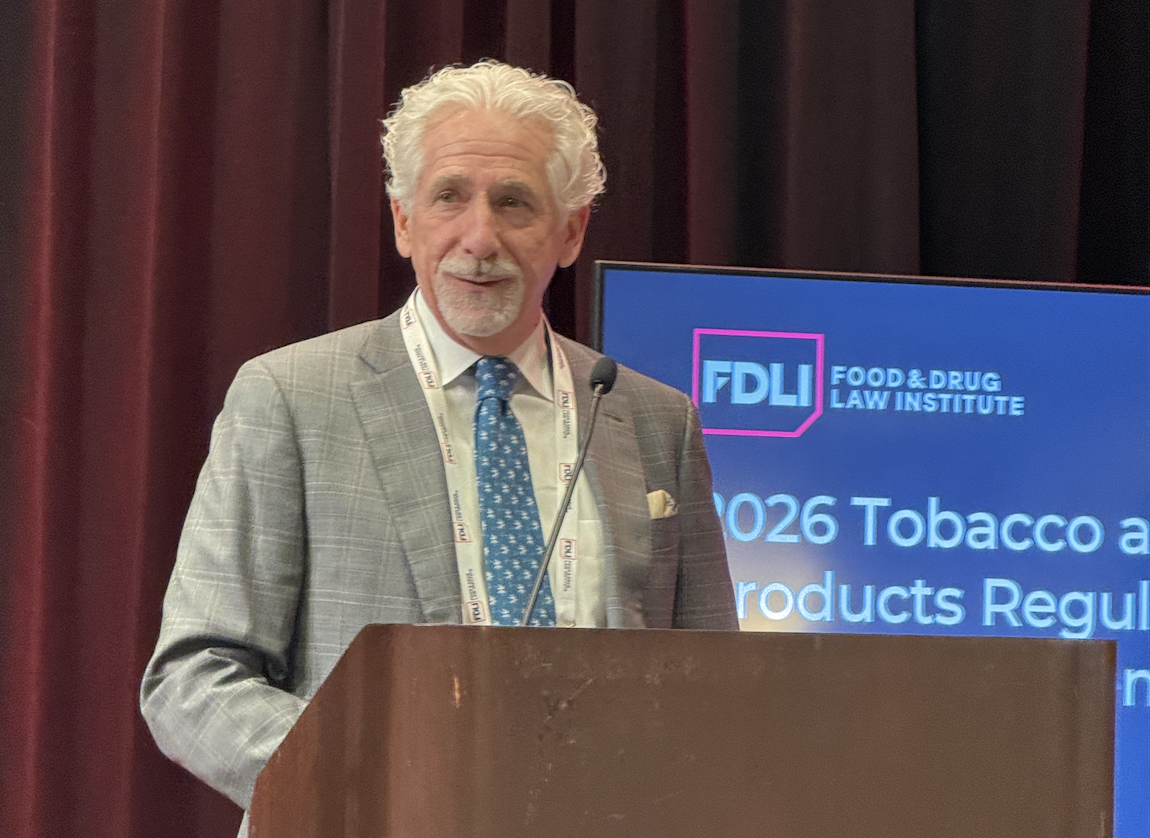
Bret Koplow, Director of the FDA Center for Tobacco Products (CTP), waits to take the stage at the 2026 FDLI Tobacco and Nicotine Products Regulation and Policy Conference in Washington, D.C. Photo by 2Firsts.


Disclaimer
This article is provided solely for professional research, industry discussion, and informational purposes. Any references to brands, companies, products, technologies, or policies are made for factual reporting and analytical purposes only, and do not constitute endorsement, recommendation, promotion, or advertising by 2Firsts.
Nicotine-containing products, including but not limited to cigarettes, e-cigarettes, heated tobacco products, and nicotine pouches, carry significant health risks. Readers are responsible for complying with all applicable laws and regulations in their respective jurisdictions, including age restrictions and access limitations.
The information contained in this article should not be regarded as investment, legal, medical, regulatory, or commercial advice. While 2Firsts strives to ensure the accuracy and reliability of its content, it does not assume liability for any direct or indirect loss arising from errors, omissions, inaccuracies, or reliance on the information contained herein.
This article is not intended for individuals below the legal age for accessing tobacco or nicotine-related information in their jurisdiction.
Copyright Notice
This article is either original content produced by 2Firsts or content reproduced, translated, summarized, or adapted from third-party sources with attribution where applicable. The intellectual property rights of the original content remain with 2Firsts or the respective original rights holders.
No individual or organization may copy, reproduce, distribute, republish, modify, translate, or otherwise use this content without prior authorization. Any unauthorized use may result in legal action.
For copyright-related inquiries, corrections, or removal requests, please contact: info@2firsts.com.
AI-Assisted Translation and Editing Notice
Portions of this article may have been translated, edited, or reviewed with the assistance of artificial intelligence tools to improve efficiency and readability. Due to the limitations of AI-assisted translation and editing, discrepancies, omissions, or inaccuracies may exist when compared with the original source.
Where applicable, readers are advised to refer to the original source for the most complete and accurate information. If you identify any errors or believe that any content infringes upon your rights, please contact us at info@2firsts.com, and we will review and address the matter promptly.