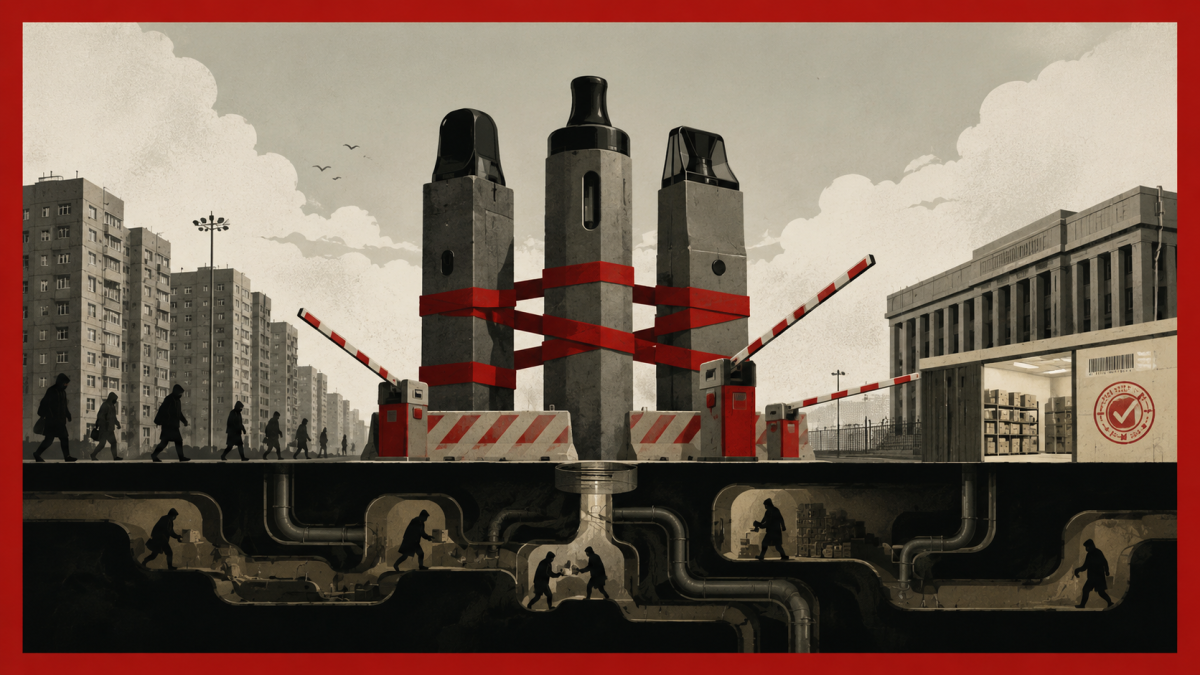
Cover image gengerated by AI.
Key Points
Azerbaijan's Vape Ban: A nationwide prohibition took effect on April 1, 2026, raising concerns over enforcement and illicit sales.
Black-Market Risks: Reports of online sales and pre-existing smuggling have raised questions about the effectiveness of prohibition.
Armenia's Regulatory Approach: The country is tightening technical requirements and introducing revised excise tax rates for tobacco and nicotine products from February 2027.
Georgia's Tobacco Policy: Public-health advocates are seeking tougher vape restrictions, while domestic cigarette manufacturers benefit from preferential excise rates.
Mixed Tax Results: Georgia's Tobacco Control Alliance reported rising domestic cigarette sales alongside declining revenues from that segment in the first half of 2026.
By Vladislav Vorotnikov, 2Firsts
November 3, 2026
Azerbaijan's decision to ban e-cigarettes has turned the South Caucasus into another test case for competing approaches to vape regulation. While Baku has opted for outright prohibition and Yerevan is tightening controls without a blanket ban, Tbilisi is avoiding similarly sweeping restrictions. Fears that the Azerbaijani ban could fuel an underground market have sparked a broader debate over whether prohibition can deliver better results than regulation.
Azerbaijan bans vapes, risking black-market growth
Azerbaijan introduced a nationwide ban on e-cigarettes effective April 1, 2026, prohibiting their import, export, production, storage, sale and use, as well as the import and sale of their components. The ban covers both nicotine-containing and nicotine-free vapes, but excludes heated tobacco products, which are classified separately under the law.
The ban drew complaints almost immediately. In a statement distributed to local press on April 3, Free Consumers Public Union, a consumer rights protection organization, warned that authorities reportedly began fining people for using heated tobacco devices, even though these products remained legal and were not covered by the e-cigarette ban.
The penalties for violating the new rules are steep by regional standards. Individuals caught using vapes on streets or in public places face a fine of 30 manats (about $18), while individuals involved in illegal trade or storage for sale can be fined 350–500 manats ($206–294).
But the bigger question is what the ban will mean in the long run. According to a June 5 report by Axar, some vape products removed from official storefronts have moved to online platforms such as Telegram and Instagram, where they are reportedly being sold illegally.
E-cigarette smuggling has been a longstanding issue in Azerbaijan, with official customs records documenting seizures of undeclared vapes and local media reporting confiscations of specialized nicotine liquids at the country's borders well before the ban took effect on April 1, 2026.
Local observers argue that the emergence of a black market was an almost inevitable consequence of the ban. For example, Natig Jafarli, an independent economic analyst, told Axar, a local news outlet, that sweeping bans imposed while domestic demand persists inevitably give rise to a black market. In Azerbaijan, he warned, illicit supplies could increasingly come from Russia and Georgia. The key question is what the government plans to do about that.
"The State Customs Committee and the Ministry of Internal Affairs should work together to prevent illicit products of unknown origin and composition, which pose a greater risk to young people's health, from entering the domestic market. Enforcement should focus not only on fining ordinary citizens caught using vapes in the street, but also on dismantling the supply chains behind the illegal trade," Jafarli said.
A blanket ban was not initially seen as the most likely outcome of discussions about the future of Azerbaijan's vape market. During parliamentary debates on the draft bill, the prevailing view in public opinion was that a complete prohibition would simply drive the problem "underground" rather than address it at its root, Axar said.
Ultimately, the effectiveness of law enforcement will determine whether Azerbaijan's vape ban succeeds in curbing the market or simply drives it underground, the publication said.
Armenia turns to taxes
After lengthy public debates, neighboring Armenia has chosen a markedly different path: raising taxes, potentially boosting state revenues while making vapes less affordable for consumers, rather than banning them outright.
In July 2026, Armenia's parliament approved amendments to its Tax Code, establishing revised excise tax rates for tobacco and nicotine products for 2027–29. The new rates are scheduled to take effect from February 1, 2027, with different rates and measurement units applying to different product categories.
Armenian Deputy Finance Minister Arman Poghosyan said that excise rates are regularly revised to account for inflation and Armenia's commitments under the Eurasian Economic Union framework.
Armenia has not followed Azerbaijan's example in regulating its vape market, Artashes Petrosyan, an associate lawyer with HAP, a Yerevan-based law firm, commented, adding that blanket bans are not currently on the country's agenda.
"However, regulation of vape and nicotine products is becoming more detailed and restrictive," Petrosyan said, suggesting businesses should constantly monitor changes to existing regulations.
Over the past few years, Armenia has significantly tightened the technical regulations governing its vape market. Updated technical requirements took effect in September 2026, extending the regulatory framework to a broader range of nicotine-containing and nicotine-free products.
In particular, the applicable technical requirements set limits on product specifications, including cartridge capacity and maximum nicotine concentration, Petrosyan said. Cartridges must contain no more than 2 ml of liquid, and the maximum permitted nicotine concentration is 20 mg/cm³. Certain ingredients and additives are also restricted.
"This means that some products or flavors may be non-compliant if they contain prohibited ingredients or additives. However, there is currently no blanket ban on flavored vapes," Petrosyan said.
"For businesses, the key areas to monitor are product specifications, nicotine levels, ingredients and flavorings, labeling, excise taxation and correct product classification. Companies should review their product portfolios and compliance documentation to ensure they meet the applicable requirements," Petrosyan added.
Georgia resists the urge to crack down on vapes
By contrast, Georgia has refrained from sweeping changes to vape regulation in recent years, although it has introduced changes to cigarette taxation.
In January 2026, Georgia's Tobacco Control Alliance called for a major tightening of the country's tobacco regulations, warning about a sharp rise in e-cigarette and heated tobacco use over the previous three years.
Among other things, it proposed banning all vape flavors except tobacco, extending plain-packaging and advertising restrictions to nicotine-free e-cigarettes, and raising the legal age for purchasing tobacco products from 18 to 21. Going further, the Alliance also advocated a lifetime ban on tobacco purchases for people born after 2015 and high penalties for violations.
"According to the 2025 survey, 75% of the population supports these changes. This is a direct public mandate," the Tobacco Control Alliance said.
So far, there has been little public indication that the government plans to act on the Tobacco Control Alliance's proposals.
Contrary to public-health advocates' calls for tougher controls, the Georgian government has moved to support domestic cigarette manufacturers, granting them preferential excise rates from January 1, 2026. The measure sets a fixed excise tax of GEL 1.30 (about $0.48) per pack, plus a 15% ad valorem tax, for up to 35 million packs of locally produced cigarettes annually.
The reform itself has been accompanied by mixed results, with sales of locally made cigarettes rising but budget revenues from this segment falling. According to the Tobacco Control Alliance, as reported by BP.ge, in the first half of 2026, domestic cigarette sales rose 26%, while budget revenues from these products fell 13.8%. Overall budget revenues from tobacco products increased by a nominal 3.9% to GEL 750.4 million (about $278 million), but declined in real terms after adjusting for inflation.
Despite the mixed results of the tax reform, Georgia continues to take a less restrictive approach to vaping than Azerbaijan, while maintaining a different excise policy on cigarettes.
For more news and analysis on tobacco and nicotine markets across Eastern Europe and the former Soviet Union, follow 2Firsts.
Disclaimer
This article is provided solely for professional research, industry discussion, and informational purposes. Any references to brands, companies, products, technologies, or policies are made for factual reporting and analytical purposes only, and do not constitute endorsement, recommendation, promotion, or advertising by 2Firsts.
Nicotine-containing products, including but not limited to cigarettes, e-cigarettes, heated tobacco products, and nicotine pouches, carry significant health risks. Readers are responsible for complying with all applicable laws and regulations in their respective jurisdictions, including age restrictions and access limitations.
The information contained in this article should not be regarded as investment, legal, medical, regulatory, or commercial advice. While 2Firsts strives to ensure the accuracy and reliability of its content, it does not assume liability for any direct or indirect loss arising from errors, omissions, inaccuracies, or reliance on the information contained herein.
This article is not intended for individuals below the legal age for accessing tobacco or nicotine-related information in their jurisdiction.
Copyright Notice
This article is either original content produced by 2Firsts or content reproduced, translated, summarized, or adapted from third-party sources with attribution where applicable. The intellectual property rights of the original content remain with 2Firsts or the respective original rights holders.
No individual or organization may copy, reproduce, distribute, republish, modify, translate, or otherwise use this content without prior authorization. Any unauthorized use may result in legal action.
For copyright-related inquiries, corrections, or removal requests, please contact: info@2firsts.com.
AI-Assisted Translation and Editing Notice
Portions of this article may have been translated, edited, or reviewed with the assistance of artificial intelligence tools to improve efficiency and readability. Due to the limitations of AI-assisted translation and editing, discrepancies, omissions, or inaccuracies may exist when compared with the original source.
Where applicable, readers are advised to refer to the original source for the most complete and accurate information. If you identify any errors or believe that any content infringes upon your rights, please contact us at info@2firsts.com, and we will review and address the matter promptly.