Updated March 17, 2026
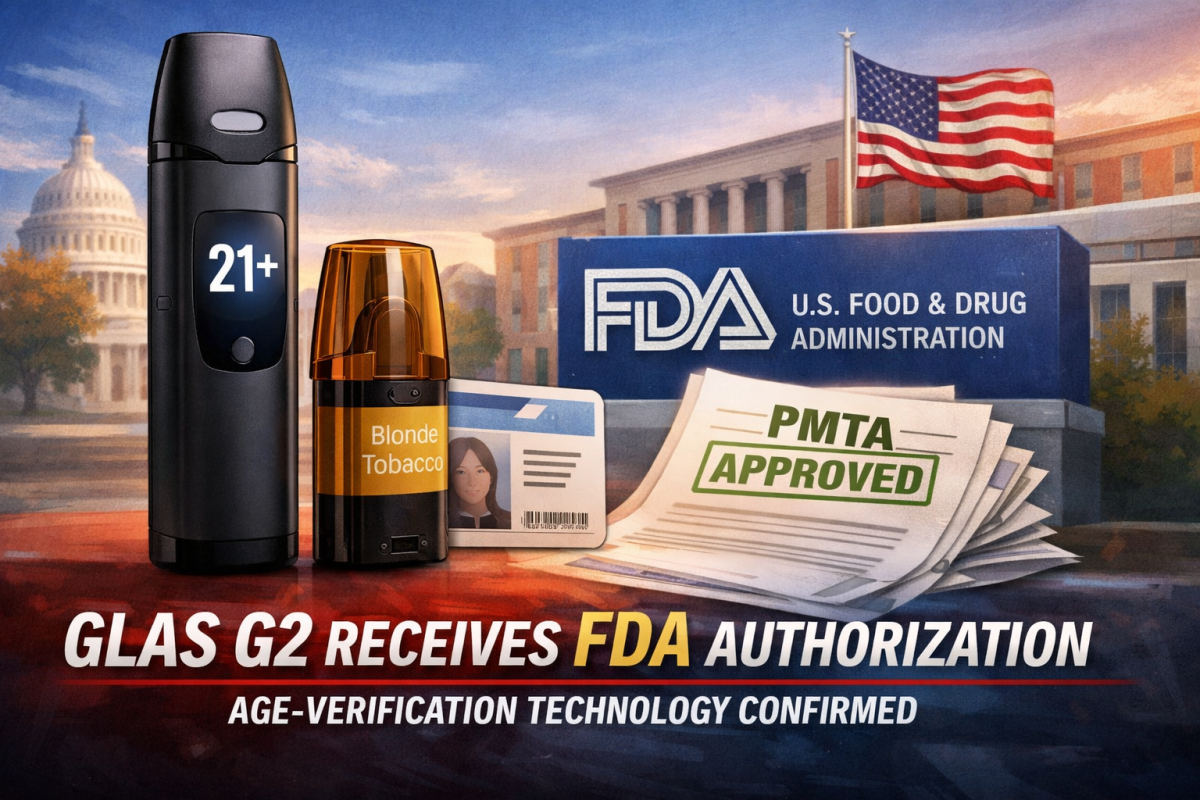
Glas has confirmed to 2Firsts that its G2 device, which received a FDA Marketing Granted Order (MGO), incorporates age-gating technology. Based on currently public information, this means the FDA has granted an MGO to the first ENDS product confirmed to incorporate age-gating technology, validating 2Firsts’ earlier inference.
Key Points
- FDA Update: The U.S. FDA revised the authorized device name for Glas’s PMTA approval from “Glas G Device” to “Glas G² Device” and published the associated Order Letter.
- Regulatory Details: Newly released documents provide additional insight into the scientific review, APPH determination and marketing restrictions attached to the authorization.
- Age-Verification Technology: If confirmed, the Glas G² platform may incorporate device-level age-verification technology, potentially making it the first ENDS device with such safeguards to receive an FDA MGO.
- Youth Protection Measures: The FDA’s order letter places particular emphasis on strict marketing and distribution restrictions aimed at preventing youth access, including age-verification requirements for online sales, limits on digital advertising audiences and ongoing monitoring to reduce underage exposure.
- Flavor Outlook: Glas executives signaled optimism that menthol and other flavored pod variants could receive marketing authorization in the future.
2Firsts
Shenzhen, March 14, 2026
The U.S. Food and Drug Administration (FDA) has updated public records tied to the marketing authorization of vape manufacturer Glas Inc., revising the device name associated with the approval, publishing the order letter behind the decision and adding new entries to its tobacco product database.
The updates follow the agency’s March 12, 2026 authorization (U.S. Eastern Time; March 13 Beijing Time) of a Glas electronic nicotine delivery system (ENDS) device and a BLONDE TOBACCO 50 MG/ML pod under the Premarket Tobacco Product Application (PMTA) pathway.
The newly published records provide additional detail about the authorized products, including the scientific review referenced in the order letter and the marketing restrictions attached to the authorization. Glas executives have also indicated that menthol and flavored pod variants could potentially receive authorization in the future.
At the same time, the revision of the device name from “Glas G Device” to “Glas G² Device” has drawn industry attention. If the authorized device is ultimately confirmed to include device-level age-verification technology, the case could suggest that the FDA is beginning to recognize technological approaches aimed at restricting youth access to ENDS products. If confirmed, such a development could mark a milestone in the evolution of U.S. ENDS regulation.

The image above shows the product listing published by the FDA on March 13 (Beijing Time), while the image below shows the listing updated on March 14 (Beijing Time), in which the device name was revised.| Source: Screenshot from the FDA website.
FDA revises Glas device name in authorized products list, marking a second “update” related to the company
One of the most visible changes involved the product name associated with the authorization.
When the authorization first appeared on the FDA’s website, the device was listed as “Glas G Device.” In a later update observed on March 14 Beijing Time, the listing was revised to “Glas G² Device,” also shown in certain database records as “Glas G2 DEVICE.”
However, the order letter issued as part of the PMTA decision still refers to the product as “Glas G DEVICE” in its appendix.
The revision appears to represent the second “update” to publicly available information related to Glas.
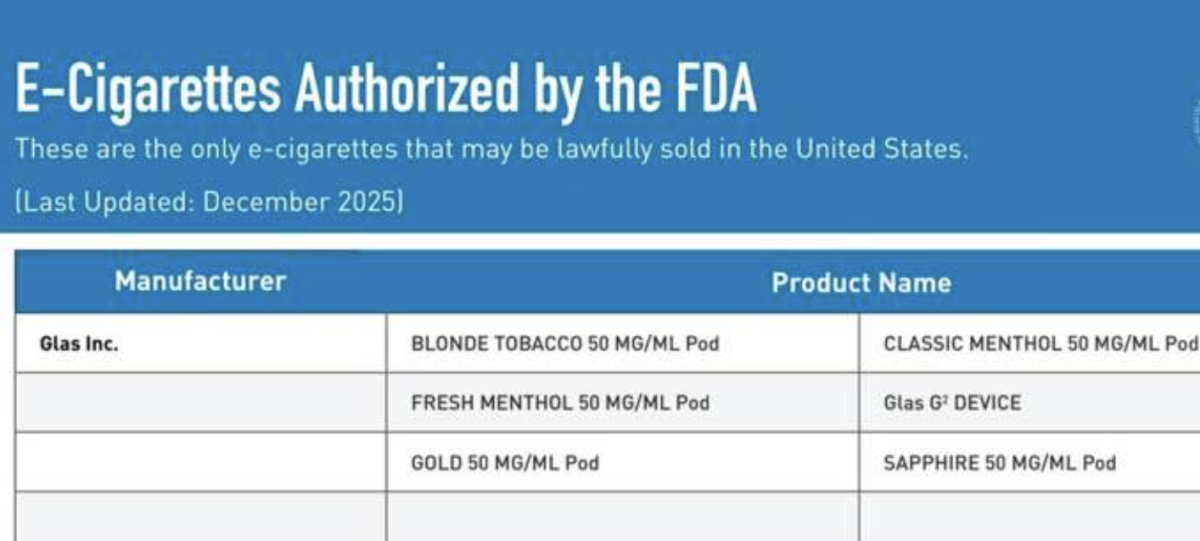
In December 2025, an image circulated on social media that appeared to reflect a version of the product list displayed on the FDA webpage titled “E-Cigarettes, ‘Vapes’ and Other Electronic Nicotine Delivery Systems (ENDS) Authorized by the FDA,” and included Glas-related products. The image listed one Glas device (Glas G² Device) along with five pod variants — Blonde Tobacco, Fresh Menthol, Classic Menthol, Gold and Sapphire. The regulatory status of the products shown in the image, however, was never confirmed by the FDA.
On the same webpage, the FDA stated that on Dec. 20, 2025 (U.S. Eastern Time; Dec. 21 Beijing Time) it experienced a web error affecting the page displaying authorized tobacco products. The agency said the issue did not change the official list of authorized products.
Could Glas G² be the first age-verification ENDS authorized by the FDA?
The naming update has also drawn attention to a possibility previously discussed in 2Firsts’ earlier reporting on Glas.
In its initial coverage of the authorization, 2Firsts noted that the FDA listing referred to the product simply as “Glas G Device,” rather than the “G2” platform previously described by the company in industry interviews.
After the FDA subsequently updated the name to “Glas G² Device,” the designation now aligns more closely with the G2 platform previously described by Glas. According to information the company earlier provided to 2Firsts, the platform was designed to incorporate technological mechanisms intended to restrict youth access to the product.
If confirmed, the authorization could represent the first FDA marketing granted order (MGO) for an ENDS device incorporating device-level age-verification technology.
If later confirmed, such a development would mark a milestone in U.S. e-cigarette regulation and could signal growing regulatory interest in hardware-based safeguards aimed at preventing youth access.
If the authorized device is confirmed to include such technology, the case could attract wider industry attention by suggesting that hardware-enabled access controls may become more relevant in future ENDS submissions.
However, based on currently available public documents, neither the FDA nor Glas has explicitly confirmed whether the authorized device includes device-level age-verification functionality.
FDA database updates reveal additional regulatory records
The FDA has also updated its Searchable Tobacco Products Database, adding entries for the newly authorized Glas products and publishing the associated marketing granted order letter.
As of March 14 Beijing Time, the database lists the Glas device and the Blonde Tobacco pod alongside the order letter.
Several documents commonly associated with PMTA authorizations — including the Decision Summary, Environmental Assessment (EA) and Finding of No Significant Impact (FONSI) — had not yet appeared in the database at the time of writing. These materials often become public after the initial order letter is released.
Another detail concerns the hosting location of the order letter.
For the 39 PMTA-authorized products approved prior to the Glas decision, the corresponding authorization letters are typically stored within the FDA’s Searchable Tobacco Products Database directory (accessdata.fda.gov). In contrast, the Glas order letter is currently hosted through the agency’s general document system (fda.gov/media).
Inside the FDA’s order letter
The order letterprovides the formal legal basis for the authorization and offers several additional insights into how the FDA evaluated the Glas application.
Review process lasted nearly five years
According to the order letter, the PMTA associated with the authorization was submitted on July 21, 2021, and the marketing granted order was issued on March 12, 2026, indicating a review process lasting nearly five years.
Stability evidence cited in the scientific review
The FDA said its review considered scientific data submitted by the company, including chemical and microbial stability testing supporting product stability for approximately 32 weeks.
The agency concluded that the available evidence did not raise stability concerns under the conditions evaluated during the review.
Decision based on the APPH standard
As with all PMTA decisions, the FDA determined that marketing the products would be “appropriate for the protection of the public health” (APPH).
Under this statutory standard, the agency evaluates the overall population-level impact of a product, considering both potential benefits for adult smokers and risks such as youth initiation.
Strict marketing limits aimed at youth protection
The order letter also details a series of marketing and distribution restrictions intended to prevent youth access.
Among the measures outlined are requirements that Glas implement robust age-verification systems for online sales and digital communications, including the use of third-party age- and identity-verification services for e-commerce transactions.
According to the company’s marketing plan referenced in the order letter, Glas said it intends to restrict direct email marketing to age-verified adults 21 and older, require age verification for access to its e-commerce website, and require retail partners to apply similar controls.
The plan also includes limiting social media marketing to Instagram users aged 25–54, restricting digital advertising to age-gated platforms, and applying targeting based on first- or second-party age-verified data, rather than inferred audience profiles alone.
For broadcast and radio advertising, the order requires audience compositions of at least 85% adults above the federal minimum age of sale, while youth audience indices must remain 99 or lower for both ages 2–11 and 12–17.
The order also requires ongoing digital monitoring designed to detect and prevent advertising impressions being delivered to underage audiences.
Taken together, the provisions offer one of the clearest public views to date of the operational marketing controls expected for newly authorized ENDS products.
Glas executive signals path for menthol and flavored G2 pods
On the day following the authorization (U.S. Eastern Time), Kevin Higgins, Chief Operating and Financial Officer of Glas Inc., referred to the newly authorized product as the “Glas G2 ENDS” in a LinkedIn post. Higgins published the post during the early hours of March 14 Beijing Time (the afternoon of March 13 U.S. Eastern Time), and it also cited earlier reporting by 2Firsts.
Higgins described the authorization as a milestone for the company and said the device forms part of a platform incorporating technology-enabled safeguards intended to reduce youth access.
He also said the FDA had completed the scientific review of the company’s PMTA in the fourth quarter of 2025, although that timeline has not been independently confirmed in FDA documents.
Higgins added that the scientific evidence submitted by Glas aligns with — and may have helped inform — the standards outlined in the FDA’s recently released draft guidance for flavored ENDS PMTAs.
He also expressed optimism that additional pod variants, including menthol and other flavored pods, could receive marketing authorization in the future.
Four Pods Absent From the Current Authorization
Prior to the Glas authorization, the company and some industry observers had focused on a potential regulatory pathway combining age-verification technology with flavored products as a way to address the FDA’s youth protection concerns. However, the authorization announced by the FDA included only the Blonde Tobacco pod and did not extend to menthol or other flavored variants.
The previously circulating image listed one Glas device and five pod variants. Among those six products, the Glas G² Device and the Blonde Tobacco pod are the two items that have now received authorization.
The remaining four pods shown in the image were Fresh Menthol, Classic Menthol, Gold and Sapphire.
In his LinkedIn post following the authorization, Kevin Higgins, Chief Operating and Financial Officer of Glas Inc., said the company was optimistic that additional menthol and other flavored pods could receive marketing authorization in the future.
In terms of naming, the menthol category mentioned by Higgins appears consistent with the Fresh Menthol and Classic Menthol pods listed in the earlier image, while the flavored category could plausibly correspond to the Gold and Sapphire variants.
If additional authorizations are granted in the future, these four pods may represent potential candidates.
2Firsts will continue to monitor developments in the U.S. PMTA process.
Background: Key documents in a PMTA authorization
Several regulatory documents are typically associated with an FDA PMTA marketing order:
Order Letter
The formal legal document granting marketing authorization. It specifies the authorized products and outlines conditions governing how they may be marketed.
Decision Summary
A scientific overview explaining the FDA’s evaluation of the product under the APPH standard.
Environmental Assessment (EA)
An analysis evaluating whether marketing the product could have significant environmental impacts.
Finding of No Significant Impact (FONSI)
A determination concluding that the product is not expected to produce significant environmental effects.
According to information published by the FDA, documents associated with a PMTA marketing authorization are not always released in full at the time an order is issued. The agency must first redact trade secrets and confidential commercial information (CCI) and ensure that documents posted on its website meet accessibility requirements.
For this reason, the full Decision Summary, Environmental Assessment and Finding of No Significant Impact (FONSI) may be posted sometime after the marketing order is issued.
In the interim, the FDA typically releases redacted versions of the Order Letter and the “Executive Summary” section of the Decision Summary to explain the public health basis for authorizing the products.
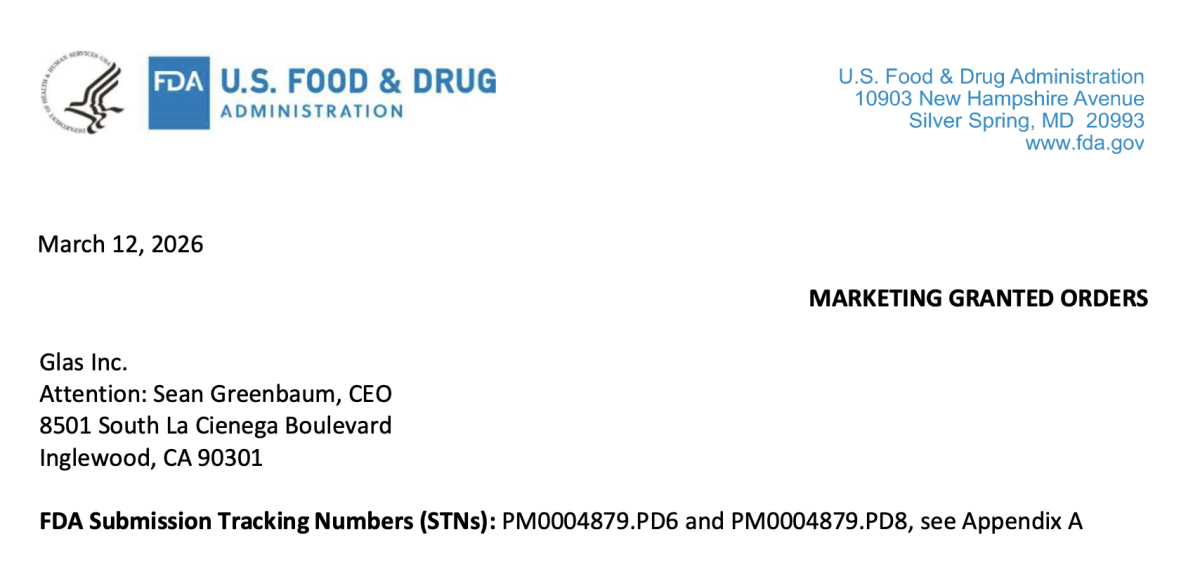
The cover image shows a screenshot of the Glas Order Letter.| Source: FDA Order Letter (PM0004879.PD6 and PM0004879.PD8)