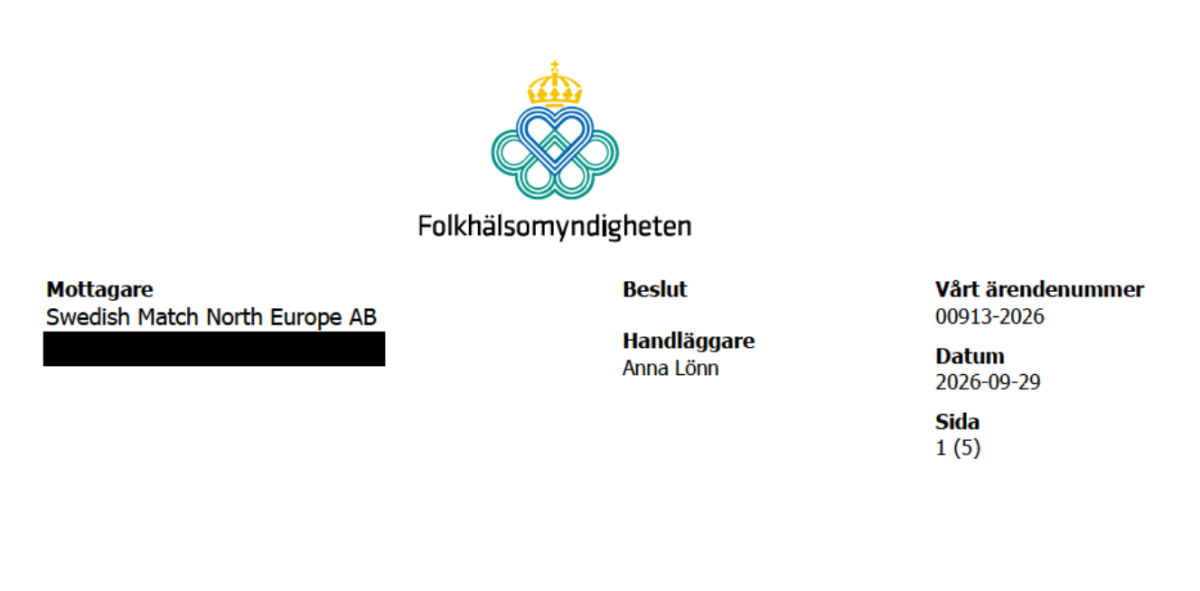
Cover image: Screenshot of the Swedish Public Health Agency's September 29, 2026 regulatory decision concerning Swedish Match. Source: Public Health Agency of Sweden / 2Firsts.
Key Points
● Regulatory Scope: Documents obtained by 2Firsts show that Sweden's labeling order extends beyond five inspected ZYN products to tobacco-free nicotine products subsequently manufactured by Swedish Match for the Swedish market.
● Ingredient Discrepancies: Inspected packages listed 10–13 ingredients or categories, compared with 11–42 ingredients in regulatory submissions. The dispute centers on the generic term "aromer" (flavorings).
● Legal Dispute: Swedish Match cited trade-secret protection and other arguments to defend its labeling practices. The agency maintained that all ingredients must be individually disclosed, with no trade-secret exemption.
● Conditional Penalty: The company has 60 days after the decision becomes legally final to comply. Noncompliance could lead to a conditional penalty of SEK 2 million per month. No recall is required under the order.
● Appeal and Wider Implications: Swedish Match said it intended to appeal, but the agency had received no appeal as of October 22. The case could draw regulatory attention beyond Sweden.
2Firsts
SHENZHEN, October 22, 2026
Sweden's Public Health Agency has ordered Philip Morris International (PMI) subsidiary Swedish Match North Europe AB to revise ingredient labels on tobacco-free nicotine products it manufactures for the Swedish market, according to a regulatory decision obtained by 2Firsts. The order extends beyond the five ZYN products examined during the investigation.
On October 21,Swedish financial newspaper Dagens industri reported that Swedish Match faced a conditional penalty of SEK 2 million per month over ingredient labeling on ZYN nicotine pouches. The company disputed the regulator's interpretation and said it intended to appeal.
Following its coverage of the case, 2Firsts contacted the Public Health Agency of Sweden (Folkhälsomyndigheten) to request the original regulatory decision. On October 22, the agency provided a redacted copy of its September 29 decision, case number 00913-2026. It also confirmed that the decision had been formally served on Swedish Match on October 5 and that no appeal had been received as of October 22.

Five ZYN Products Examined, but the Order Goes Further
The Public Health Agency began inspecting Swedish Match North Europe AB's activities as a manufacturer of tobacco-free nicotine products on February 27, 2026.
According to the decision, the company had notified the agency of more than 160 tobacco-free nicotine products intended for the Swedish consumer market.
Before visiting the company's manufacturing facility in Gothenburg on May 5, inspectors reviewed selected regulatory product notifications and purchased five different ZYN products. Additional spot checks were conducted on products stored at the company's warehouse during the visit.
The agency found that ingredient declarations on all products reviewed listed fewer ingredients than the corresponding regulatory submissions. Packaging labels contained 10 to 13 individually named ingredients or ingredient categories, while product notifications identified between 11 and 42 ingredients.
Several flavoring substances were grouped under the Swedish term "aromer," meaning flavorings, rather than being identified separately.
The agency concluded that these declarations did not comply with Section 11 of Sweden's Ordinance (2022:1263) on Tobacco-Free Nicotine Products, which requires all ingredients to be listed in descending order by weight.
The resulting order was not limited to the five ZYN products purchased during the investigation. Swedish Match North Europe AB was directed to ensure that tobacco-free nicotine products it subsequently manufactures for the Swedish market carry ingredient declarations identifying all ingredients individually, without using collective category designations.
Although the company had notified regulators of more than 160 products, the decision did not establish that every notified product had been individually examined or found noncompliant.
Timeline of the Case
● February 27, 2026: The Public Health Agency begins inspecting Swedish Match North Europe AB.
● May 5: Inspectors visit the company's Gothenburg manufacturing facility after reviewing product notifications and purchasing five ZYN products.
● June 1: Swedish Match submits written objections to the agency's interpretation of the ingredient-labeling requirements.
● September 29: The agency issues its corrective order, backed by a conditional monthly penalty of SEK 2 million.
● October 5: The decision is formally served on Swedish Match, according to the agency's subsequent confirmation to 2Firsts.
● October 21: Dagens industri reports the case and Swedish Match's intention to appeal.
● October 22: Following a request from 2Firsts, the agency supplies the regulatory decision and confirms that no appeal has been received.
Swedish Match and the Regulator Disagree Over Flavoring Disclosure
The central dispute concerns whether manufacturers can use a collective designation such as "aromer" on consumer packaging instead of identifying every individual flavoring ingredient.
In its June 1 submission, as recorded in the regulatory decision, Swedish Match argued that Swedish law neither expressly prohibits the use of the collective term nor specifically requires every flavoring substance to be named separately.
The company maintained that regulatory product notifications and consumer-facing ingredient labels serve different purposes. Product notifications are intended to give authorities comprehensive information about product composition, while packaging labels should present information to consumers in a clear, understandable format.
Swedish Match also argued that requiring manufacturers to identify all flavoring substances individually could compromise commercially sensitive formulations.
The company cited Section 6 of the ordinance, under which the agency publishes product notification information that does not constitute trade secrets. Swedish Match argued that this protection supported the use of collective flavoring descriptions on consumer packaging.
Its objections also cited the limited space available on nicotine pouch packaging, the difficulty consumers might face in interpreting lengthy ingredient lists, Swedish legislative preparatory materials and related European Union regulations.
The Public Health Agency acknowledged that regulatory notifications and consumer labels serve different purposes. However, it said its finding was based on whether the packaging declaration itself complied with Section 11, rather than on a comparison with the company's regulatory submissions.
The agency concluded that "aromer" is a collective term covering multiple ingredients, not an individual ingredient. Grouping substances under such a designation prevents consumers from identifying the actual components and determining their order by weight.
It also found that Section 11 contains no exemption for commercially sensitive ingredients. In the agency's interpretation, the protection of trade secrets in the publication of regulatory product notification information does not remove the separate statutory obligation to disclose ingredients on consumer packaging.
Swedish Match had also referred to other EU regulatory frameworks, including the Classification, Labelling and Packaging (CLP) Regulation.
The agency responded that tobacco-free nicotine product regulation has not been harmonized at EU level and that the case must be assessed under the applicable Swedish legislation.
According to Dagens industri, Swedish Match communications director Robert Noord said the company considered its existing labels compliant with Swedish law, disagreed with the regulator's interpretation and intended to appeal.
SEK 2 Million Monthly Penalty Remains Conditional
The company has 60 days after the decision becomes legally final to ensure compliance with the labeling requirement and report the measures taken to the Public Health Agency.
A recurring conditional penalty of SEK 2 million per month is attached to the labeling requirement for each month of noncompliance. The amount does not represent a fine that has already been ordered for payment or collected.
Under Sweden's Act on Conditional Fines (1985:206), enforcement of such a penalty generally requires a separate decision by an administrative court following an application from the responsible authority.
The agency said it determined the amount by considering the company's financial circumstances and other factors, particularly its relatively large share of Sweden's tobacco-free nicotine product market.
The decision specifies that the order applies only to products manufactured after it becomes legally final. It therefore does not require Swedish Match to recall products already placed on the market.
Under the appeal instructions accompanying the decision, the company may challenge the order before the Administrative Court in Stockholm. Any appeal must first be submitted to the Public Health Agency within three weeks of the company's receipt of the decision.
In its October 22 response to 2Firsts, the agency confirmed that the decision had been served on Swedish Match on October 5 and that it had received no appeal as of October 22. The three-week appeal period had not yet expired.
ZYN Labeling Dispute Raises Questions Beyond Sweden
Sweden has played an important role in the development of modern tobacco-free nicotine pouches, while ZYN, developed by Swedish Match, has become a major international brand. PMI said on October 21 that ZYN was available in 62 international markets.
The case brings competing approaches to ingredient disclosure into focus: Swedish Match argues that its flavor formulations warrant trade-secret protection, while the Swedish regulator maintains that all ingredients must be identified on consumer packaging. Although the decision does not establish an EU-wide standard and remains open to legal challenge, the dispute may draw attention from regulators elsewhere in Europe and beyond as nicotine pouch markets expand.
2Firsts will continue to follow developments in this case and regulatory changes affecting nicotine pouches worldwide.
Disclaimer
This article is provided solely for professional research, industry discussion, and informational purposes. Any references to brands, companies, products, technologies, or policies are made for factual reporting and analytical purposes only, and do not constitute endorsement, recommendation, promotion, or advertising by 2Firsts.
Nicotine-containing products, including but not limited to cigarettes, e-cigarettes, heated tobacco products, and nicotine pouches, carry significant health risks. Readers are responsible for complying with all applicable laws and regulations in their respective jurisdictions, including age restrictions and access limitations.
The information contained in this article should not be regarded as investment, legal, medical, regulatory, or commercial advice. While 2Firsts strives to ensure the accuracy and reliability of its content, it does not assume liability for any direct or indirect loss arising from errors, omissions, inaccuracies, or reliance on the information contained herein.
This article is not intended for individuals below the legal age for accessing tobacco or nicotine-related information in their jurisdiction.
Copyright Notice
This article is either original content produced by 2Firsts or content reproduced, translated, summarized, or adapted from third-party sources with attribution where applicable. The intellectual property rights of the original content remain with 2Firsts or the respective original rights holders.
No individual or organization may copy, reproduce, distribute, republish, modify, translate, or otherwise use this content without prior authorization. Any unauthorized use may result in legal action.
For copyright-related inquiries, corrections, or removal requests, please contact: info@2firsts.com.
AI-Assisted Translation and Editing Notice
Portions of this article may have been translated, edited, or reviewed with the assistance of artificial intelligence tools to improve efficiency and readability. Due to the limitations of AI-assisted translation and editing, discrepancies, omissions, or inaccuracies may exist when compared with the original source.
Where applicable, readers are advised to refer to the original source for the most complete and accurate information. If you identify any errors or believe that any content infringes upon your rights, please contact us at info@2firsts.com, and we will review and address the matter promptly.