Study Reveals Vuse’s Social Media Marketing: Using F1 and Influencers to Circumvent Advertising Bans through Entertainment Marketing

Aug.19.2025
Study Reveals Vuse’s Social Media Marketing: Using F1 and Influencers to Circumvent Advertising Bans through Entertainment Marketing
A new study reveals that BAT-owned Vuse leverages global social media accounts for marketing, expanding its influence through F1 partnerships and influencer-driven entertainment placements to circumvent advertising bans. The study highlights insufficient compliance transparency and calls for strengthened unified global regulation.

Key Points:

  • Leveraging F1 Events: Vuse expanded its brand exposure from 17,000 followers to nearly 14 million through its partnership with the McLaren racing team, with racing videos becoming its most-viewed content.
  • Embedding in Trendy Scenes: By featuring in music festivals and “Get Ready With Me” videos, Vuse strongly associates itself with nightlife, fashion, and young female audiences.
  • Opaque Influencer Collaborations: Out of nearly 700 partnership tags, only 14 disclosed the label #ad, showing a lack of compliance and transparency.
  • Exploiting Regulatory Loopholes: The global account bypasses UK and Instagram advertising bans through branded content, maintaining entertainment-driven and cross-border dissemination.
  • Cross-national Regulatory Challenges: The study calls for a unified global regulatory framework for social media, stronger enforcement, and tighter restrictions on e-cigarette brands targeting youth.


The Australian media platform THE CONVERSATION studied the marketing activities of Vuse, an e-cigarette brand owned by British American Tobacco (BAT), across its global social media accounts.

The research team analyzed all content posted by @Vuse.Worldwide on Instagram between August 2023 and August 2024, uncovering the strategies used for brand promotion.


Expanding Influence through F1 Collaboration


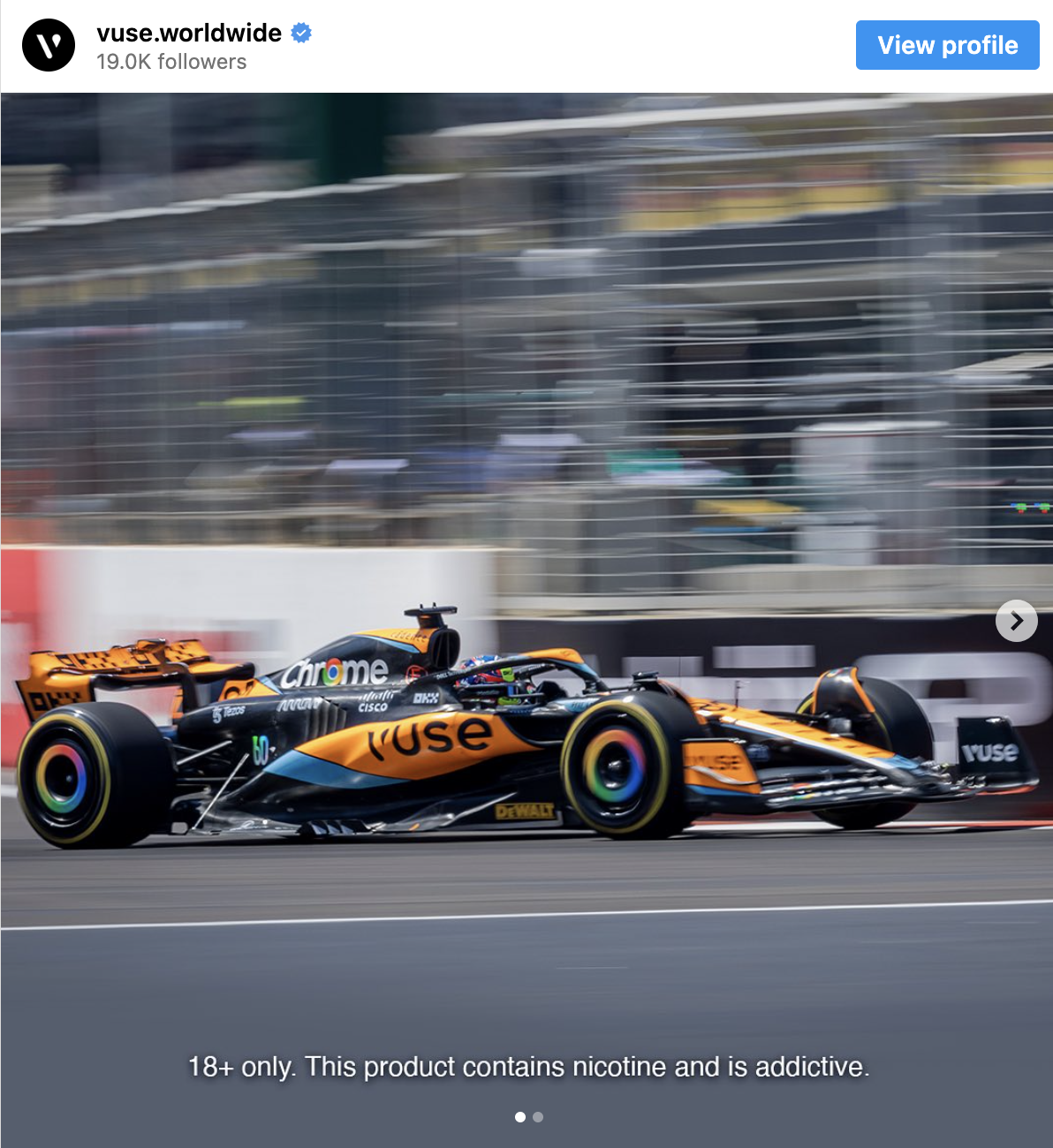
One of Vuse’s core marketing strategies is its partnership with the McLaren F1 racing team. The Vuse logo appears on the racing cars and is widely disseminated across global social media.

Through cross-promotion with McLaren’s official account, Vuse was able to extend its reach from around 17,000 followers to McLaren’s vast audience of nearly 14 million.

The study found that four of the most popular videos were related to racing collaborations, with one exceeding 225,000 views.
 

Study Reveals Vuse’s Social Media Marketing: Using F1 and Influencers to Circumvent Advertising Bans through Entertainment Marketing
@Vuse.Worldwide announced their collaboration with F1 on Instagram | Image source: Instagram


Leveraging Music and Lifestyle Scenes


Beyond motorsports, Vuse has deeply engaged in marketing through music festivals, fashion, and social settings. The study found that among the brand’s ten most popular posts, four were short videos in the trending “Get Ready With Me” style. These videos, often created by young female influencers, casually placed e-cigarettes into daily routines such as makeup or outfit choices, thereby strongly associating the brand with lifestyles of “trendiness, entertainment, and nightlife.”


In addition, Vuse collaborated with DJs, artists, and social media influencers to co-create content. However, out of nearly 700 tags involving brands or individuals, only 14 disclosed #ad or paid partnerships, revealing a significant lack of transparency in compliance.

 

Study Reveals Vuse’s Social Media Marketing: Using F1 and Influencers to Circumvent Advertising Bans through Entertainment Marketing
Collaboration between @Vuse.Worldwide and internet celebrities | Image source: Instagram


Exploiting Policy Loopholes to Maintain Exposure


According to the report, under UK advertising standards, corporate social media accounts are only permitted to publish “factual” content and are prohibited from using entertainment-driven or influencer-based promotions. However, Vuse’s global accounts effectively bypassed this restriction by posting “brand-associated” content, thereby evading the advertising ban. Instagram’s policies also contain loopholes: while the platform prohibits paid ads and influencer endorsements, it does not cover brand-owned content on corporate accounts.


The research team pointed out that this strategy enables Vuse to maintain high-frequency exposure within youth-oriented environments, while cross-border content remains difficult to regulate under the laws of a single market.


Research Conclusion


The researchers called for the establishment of a more unified global regulatory framework for social media, along with stronger cross-border enforcement, in order to truly limit the potential impact of e-cigarette companies using social platforms to target younger audiences.


We welcome news tips, article submissions, interview requests, or comments on this piece.

Please contact us at info@2firsts.com, or reach out to Alan Zhao, CEO of 2Firsts, on LinkedIn


Notice

1.  This article is intended solely for professional research purposes related to industry, technology, and policy. Any references to brands or products are made purely for objective description and do not constitute any form of endorsement, recommendation, or promotion by 2Firsts.

2.  The use of nicotine-containing products — including, but not limited to, cigarettes, e-cigarettes, nicotine pouchand heated tobacco products — carries significant health risks. Users are responsible for complying with all applicable laws and regulations in their respective jurisdictions.

3.  This article is not intended to serve as the basis for any investment decisions or financial advice. 2Firsts assumes no direct or indirect liability for any inaccuracies or errors in the content.

4.  Access to this article is strictly prohibited for individuals below the legal age in their jurisdiction.


Copyright


This article is either an original work created by 2Firsts or a reproduction from third-party sources with proper attribution. All copyrights and usage rights belong to 2Firsts or the original content provider. Unauthorized reproduction, distribution, or any other form of unauthorized use by any individual or organization is strictly prohibited. Violators will be held legally accountable.

For copyright-related inquiries, please contact: info@2firsts.com


AI Assistance Disclaimer


This article may have been enhanced using AI tools to improve translation and editorial efficiency. However, due to technical limitations, inaccuracies may occur. Readers are encouraged to refer to the cited sources for the most accurate information.

We welcome any corrections or feedback. Please contact us at: info@2firsts.com

Product | IVG Launches NEXiO Prefilled Pod System, Expanding Beyond Disposable Vapes
UK vape brand IVG has launched the NEXiO reusable prefilled pod system, expanding its product portfolio beyond disposable vape products. The device features a 1,000mAh rechargeable battery, prefilled pods with a refill reservoir structure and a claimed capacity of up to 10,000 puffs. Officially launched in the UK on July 9, 2026, NEXiO debuted with 17 flavor options, reflecting IVG’s move into reusable pod formats.
Aug.19
South Korea Constitutional Court Upholds Volume-Based E-Liquid Tax, With Challenged Rates at KRW 370 and KRW 628 per Milliliter
South Korea's Constitutional Court has upheld fixed taxes on nicotine-containing e-cigarette liquids based on solution volume, ruling that challenged provisions imposing KRW 370 per milliliter in individual consumption tax and KRW 628 per milliliter in tobacco consumption tax do not violate the Constitution. The cases stemmed from historical disputes involving importers that reported nicotine as being extracted from tobacco stems rather than leaves. South Korea has since broadened its tobacco definition to include synthetic nicotine, while current tax laws provide reduced rates for certain products not derived from tobacco.
Sep.18
Cochrane 2026 Update Adds Nine Trials, Keeps High-Certainty Finding That Nicotine E-Cigarettes Improve Quit Rates Over NRT
Cochrane’s 2026 update of its living review on electronic cigarettes for smoking cessation included 80 randomized controlled trials involving 29,861 adult smokers, with nine trials added in this update. The review retained its high-certainty conclusion that nicotine e-cigarettes increase smoking cessation rates compared with nicotine replacement therapy. In absolute terms, about 10 in 100 people using nicotine e-cigarettes may quit smoking for at least six months, compared with about 6 in 100 using NRT. The review found no clear difference in serious adverse event rates between the two groups, while longer-term safety and the relative effectiveness of newer device types remain less certain.
Sep.07
U.S. Ninth Circuit Upholds FDA Denial of MH Global’s Flavored Vape PMTA Applications
The U.S. Court of Appeals for the Ninth Circuit upheld the FDA’s denial of MH Global LLC’s applications to market flavored electronic nicotine delivery systems (ENDS). The court ruled that FDA’s comparative-efficacy framework, which requires applicants to show that flavored products provide greater cessation or switching benefits than tobacco-flavored alternatives, is consistent with the Tobacco Control Act’s “appropriate for the protection of the public health” standard. The court also found that FDA was not required to establish the framework through notice-and-comment rulemaking.
Aug.26
Reynolds Seeks to Join Altria Lawsuit Challenging FDA PMTA Rule and Calculation of 180-Day Deadline
Three R.J. Reynolds companies are seeking to intervene in a lawsuit filed by Altria subsidiaries Helix Innovations and NJOY challenging the FDA's 2021 PMTA final rule. The companies dispute how the agency uses Acceptance and Filing reviews and completeness determinations to establish when the Tobacco Control Act's 180-day decision period begins. Reynolds has also linked prolonged PMTA reviews to competition from unauthorized vaping products. The FDA, meanwhile, has been accelerating reviews and reducing its backlog.
Sep.14
EU Trade Department Faces Scrutiny Over Contacts With Tobacco Industry
European Ombudswoman Teresa Anjinho has opened an inquiry into how the European Commission’s Directorate-General for Trade handles interactions with the tobacco industry. The case follows a complaint from a civil society organisation that alleges regular, unnecessary and non-transparent contacts between DG TRADE and tobacco industry representatives, raising questions over compliance with the EU’s obligations under the WHO Framework Convention on Tobacco Control. The inquiry remains ongoing, and the Ombudswoman has not reached any finding of maladministration.
Aug.24