Key Points
- The Wall Street Journal reports that the FDA is preparing to revisit its 2021 PMTA final rule and may streamline some scientific evidence and review requirements for e-cigarettes and nicotine pouches.
- No formal FDA rule change has yet been announced, and the statutory appropriate for the protection of the public health, or APPH, standard remains in place.
- The FDA's nicotine pouch pilot produced its first marketing decisions after roughly three months of scientific review.
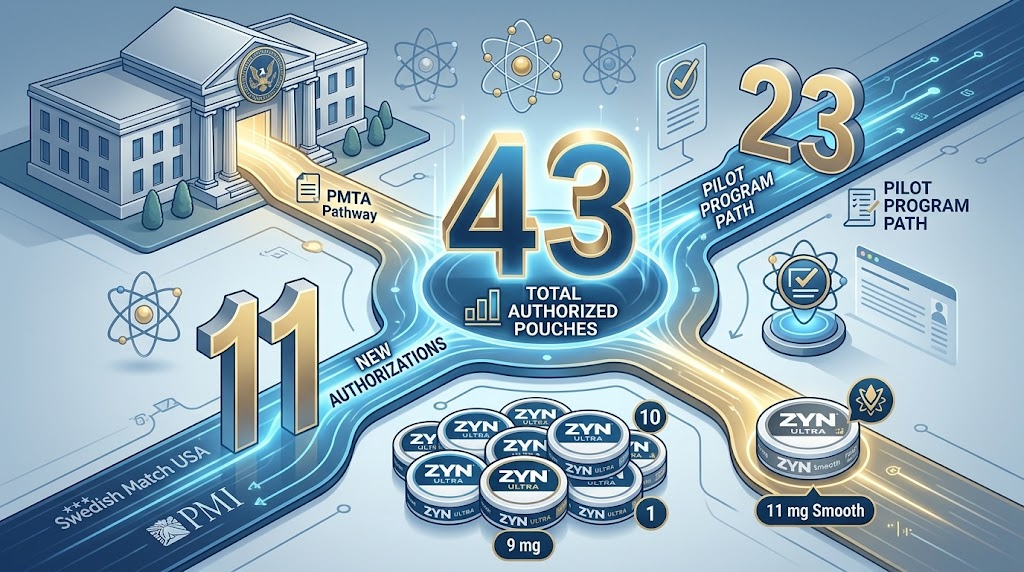
- As of August 2026, the FDA had authorized 43 nicotine pouch products and 48 e-cigarette products, including 23 pouches reviewed through the pilot program.
- The FDA is also shifting PMTA submissions toward its CTP Portal NextGen platform and plans to phase out eSubmitter for PMTA and SE submissions in November.
2Firsts
September 24, 2026
According to The Wall Street Journal on September 23, the U.S. Food and Drug Administration is expected to announce plans in the coming days to accelerate market authorization reviews for e-cigarettes and nicotine pouches, including a reconsideration of its 2021 premarket tobacco product application, or PMTA, final rule.
The report, citing people familiar with the matter, said the FDA may simplify some scientific study requirements, shorten review times and provide greater flexibility in reviewing applications for noncombustible nicotine products.
As of September 24, the FDA had not formally announced a rule change or published a new PMTA policy implementing the reported measures.
FDA May Revisit 2021 PMTA Framework
PMTA is one of the primary regulatory pathways for new tobacco and nicotine products seeking lawful market access in the United States.
Under Section 910 of the Federal Food, Drug, and Cosmetic Act, the FDA must determine whether marketing a new tobacco product would be appropriate for the protection of the public health, or APPH.
The assessment considers the risks and benefits to the U.S. population as a whole, including whether existing tobacco users may switch to potentially lower-risk products and the likelihood that youth or non-users may begin using the product.
The 2021 PMTA final rule established requirements governing application content, format, scientific information and recordkeeping.
The changes reported by The Wall Street Journal concern how parts of that application and evidentiary framework may be administered. Based on information currently available, they do not change the statutory APPH standard.
FDA Has Already Been Accelerating PMTA Reviews
The FDA has been working to increase PMTA efficiency for more than a year.
In September 2025, the agency launched a pilot program designed to streamline review of nicotine pouch PMTAs through more frequent communication with applicants, earlier identification of information gaps and faster resolution of deficiencies.
In December 2025, the FDA authorized six on! PLUS nicotine pouch products manufactured by Altria-owned Helix Innovations through the pilot.
The FDA said the scientific review was completed in roughly three months, setting a record for PMTA review speed.
In May 2026, the Center for Tobacco Products said it would incorporate lessons from the pilot into reviews of all nicotine pouch PMTAs and expand successful practices to other parts of its product-review program.
The FDA said real-time communication allowed applicants to begin compiling missing information earlier and reduced delays associated with traditional deficiency-letter exchanges.
23 Nicotine Pouches Reviewed Through Pilot
As of August 21, 2026, the FDA had authorized 43 nicotine pouch products.
Of those, 23 were reviewed through the pilot program.
In August, the agency authorized four additional on! products made by Helix Innovations and 11 ZYN ULTRA products made by Swedish Match USA.
The FDA said the pilot reduced the time required to resolve issues, respond to deficiencies and complete scientific reviews.
Marketing authorization does not mean the products are safe or “FDA approved.” It means the FDA determined, based on product-specific evidence, that marketing the products met the APPH legal standard.
FDA Has Also Expanded ENDS Authorizations
Changes are also evident in the agency's review of electronic nicotine delivery systems, or ENDS.
In May 2026, the FDA authorized four products from Glas Inc., including Gold and Sapphire pods.
The action marked the FDA's first PMTA authorizations for ENDS products with flavors other than tobacco or menthol.
In March, the agency also issued draft guidance for flavored ENDS PMTAs addressing youth-risk considerations and scientific evidence, saying the recommendations were intended in part to improve application and review efficiency.
On August 28, the FDA authorized the JUUL2 device, along with tobacco- and menthol-flavored JUUL2 pods.
FDA's current authorized-product list shows 48 e-cigarette products with marketing authorization as of August 2026.
FDA Upgrades PMTA Submission Infrastructure
The FDA is simultaneously changing the electronic infrastructure used to submit tobacco applications.
The agency launched its CTP Portal Next Generation, or CTP Portal NextGen, in 2025 for electronic tobacco-product submissions.
In July 2026, the FDA announced additional functions including folder and subfolder uploads, direct document labeling and reusable applicant contact information.
The agency said the changes were designed to improve consistency and efficiency while reducing applicants' data-entry burden.
By November 14, 2026, applicants are expected to use web-based forms in CTP Portal NextGen for PMTA and substantial equivalence, or SE, submissions. After that date, eSubmitter will no longer be available for PMTA and SE submissions.
The agency's current efficiency effort therefore extends to both application submission infrastructure and scientific review processes.
U.S. Law Sets a 180-Day PMTA Review Timeline
Review delays have long been a point of dispute in U.S. tobacco regulation.
Section 910 states that the FDA should act on a qualifying PMTA as promptly as possible and, in general, no later than 180 days after receipt of the application.
In practice, amendments, requests for additional information and complex scientific reviews have resulted in some applications remaining under review much longer.
Altria's NJOY business and Reynolds-related companies have previously brought legal challenges involving prolonged PMTA reviews and the statutory 180-day timeline.
There is no public evidence that those lawsuits directly triggered the changes reported by The Wall Street Journal, but review timelines, application backlogs and access to the authorized market have become persistent regulatory issues for the FDA.
Faster Review Comes Alongside Enforcement
The FDA's recent policy direction has not been limited to expanding product access.
In May 2026, the agency issued updated enforcement priorities for unauthorized ENDS and nicotine pouch products, focusing on counterfeit products, misdeclared imports and products marketed without required premarket authorization.
The FDA has said its approach seeks both to remove unlawful products and to provide adults who use tobacco with access to scientifically reviewed alternatives that may present lower risks than cigarettes.
If formally adopted, the changes reported by The Wall Street Journal would broaden the FDA's existing review-efficiency initiatives beyond the nicotine pouch pilot and other targeted reforms.
Key details remain unresolved, including which scientific requirements could be simplified, which product categories would be covered, and whether the agency will pursue formal rulemaking, guidance changes or internal review-process revisions.
Until the FDA publishes formal changes, the existing PMTA regulations and APPH statutory standard remain in effect.
Follow 2Firsts for updates on U.S. e-cigarette and nicotine pouch market authorization, FDA policy and global next-generation nicotine regulation.
Cover Image generated by AI
Disclaimer
This article is provided solely for professional research, industry discussion, and informational purposes. Any references to brands, companies, products, technologies, or policies are made for factual reporting and analytical purposes only, and do not constitute endorsement, recommendation, promotion, or advertising by 2Firsts.
Nicotine-containing products, including but not limited to cigarettes, e-cigarettes, heated tobacco products, and nicotine pouches, carry significant health risks. Readers are responsible for complying with all applicable laws and regulations in their respective jurisdictions, including age restrictions and access limitations.
The information contained in this article should not be regarded as investment, legal, medical, regulatory, or commercial advice. While 2Firsts strives to ensure the accuracy and reliability of its content, it does not assume liability for any direct or indirect loss arising from errors, omissions, inaccuracies, or reliance on the information contained herein.
This article is not intended for individuals below the legal age for accessing tobacco or nicotine-related information in their jurisdiction.
Copyright Notice
This article is either original content produced by 2Firsts or content reproduced, translated, summarized, or adapted from third-party sources with attribution where applicable. The intellectual property rights of the original content remain with 2Firsts or the respective original rights holders.
No individual or organization may copy, reproduce, distribute, republish, modify, translate, or otherwise use this content without prior authorization. Any unauthorized use may result in legal action.
For copyright-related inquiries, corrections, or removal requests, please contact: info@2firsts.com.
AI-Assisted Translation and Editing Notice
Portions of this article may have been translated, edited, or reviewed with the assistance of artificial intelligence tools to improve efficiency and readability. Due to the limitations of AI-assisted translation and editing, discrepancies, omissions, or inaccuracies may exist when compared with the original source.
Where applicable, readers are advised to refer to the original source for the most complete and accurate information. If you identify any errors or believe that any content infringes upon your rights, please contact us at info@2firsts.com, and we will review and address the matter promptly.