Key Points
● First global report: WHO released its first dedicated report on nicotine pouches ahead of World No Tobacco Day 2026.
● Market growth: WHO says global retail sales exceeded 23 billion units in 2024, up more than 50% year on year.
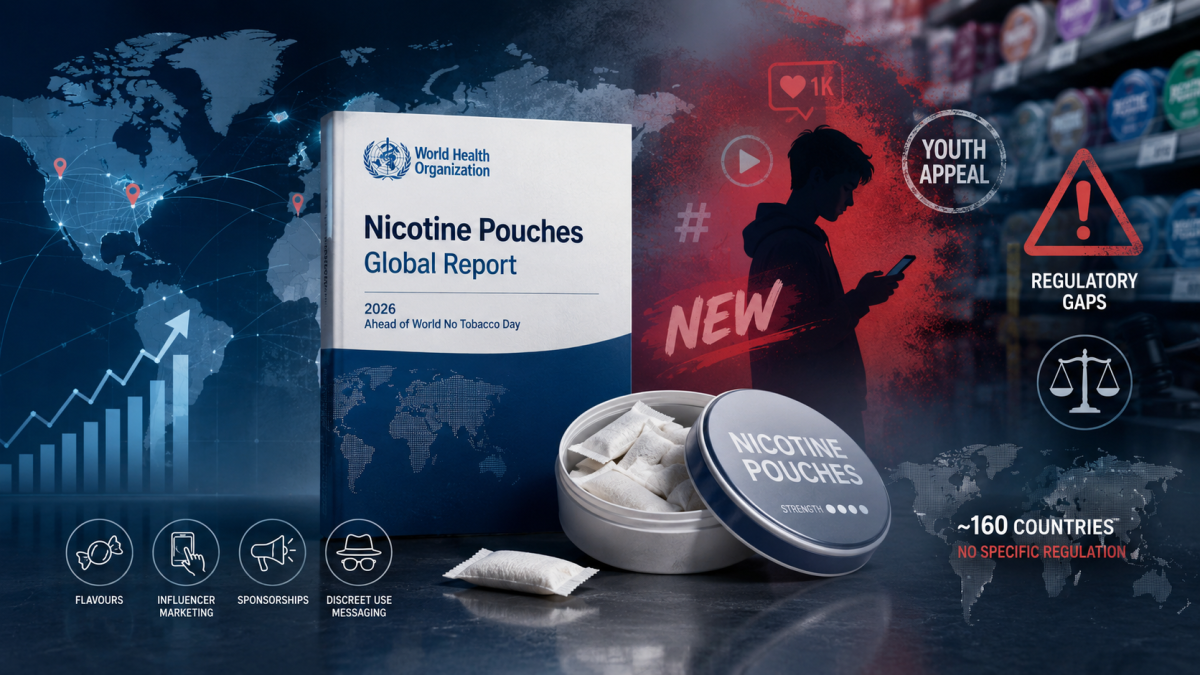
● Regulatory gaps: Around 160 countries have no specific rules for nicotine pouches, according to WHO.
● Youth appeal: The report focuses on flavours, social media, influencer marketing, sponsorships and discreet-use messaging.
● 2Firsts view: The report is an important warning, but not a complete risk assessment; harm reduction, adult switching and illicit-market risks remain unresolved.
2Firsts
May 17, 2026
The World Health Organization on May 15 released its first global report on nicotine pouches, days before World No Tobacco Day 2026, warning that the fast-growing category is spreading while regulation in many countries remains limited or absent.
The 154-page report, Exposing marketing tactics and strategies driving the global growth of nicotine pouches, examines the market for nicotine pouches, nicotine content and labelling, flavours, advertising themes, influencer marketing, sponsorship, retail promotion, dual marketing with cigarettes and regulation. Its core argument is that nicotine pouches are often marketed as “modern,” “discreet” and “tobacco-free,” while their appeal to adolescents and young adults raises public health concerns.

WHO issued the report ahead of World No Tobacco Day on May 31, which this year focuses on tobacco and nicotine addiction and industry tactics. In a press release, WHO said nicotine pouch products are being aggressively marketed to adolescents and young people, while regulation in many countries has not kept pace.
The report moves nicotine pouches further into the centre of the global nicotine policy debate. A category once discussed mainly in North America, Nordic markets and parts of Europe is now being treated by WHO as a global regulatory issue involving youth protection, product safety, marketing controls and the future boundaries of tobacco control.
1.Key data and market signals
Sales surge past 23 billion units
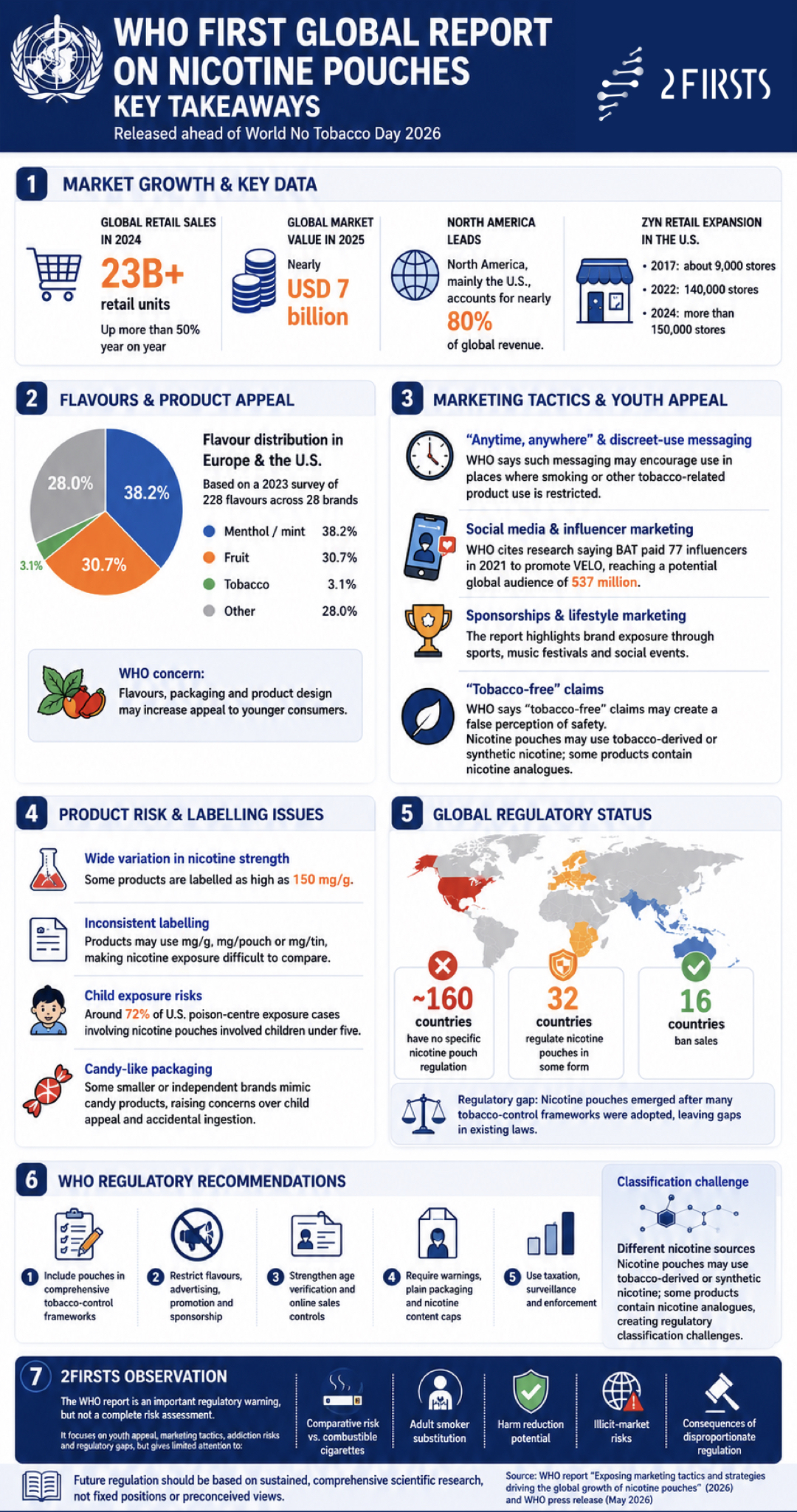
WHO said global retail sales of nicotine pouches reached more than 23 billion units in 2024, an increase of more than 50% from the previous year. It also said the global market was worth nearly $7 billion in 2025.
(2Firsts note: The WHO report does not further define “units” in this context. Based on the reported global market value and common packaging formats in the category, the figure is more likely to refer to individual pouches or “pouch-equivalent” units, rather than can/tin-level retail packs.)
The report gives a more precise estimate, citing global retail sales of 23.462 billion units in 2024, up 50.5% year on year. It says North America, mainly the United States, accounted for almost 80% of global revenue. In the United States, a major nicotine pouch brand expanded from about 9,000 retail stores in 2017 to 80,000 in 2020, 140,000 in 2022 and more than 150,000 in 2024.
Around 160 countries lack specific rules
The regulatory picture is much less developed. WHO says around 160 countries have no specific regulation for nicotine pouches. Sixteen countries ban their sale, while 32 regulate them in some form. Among those, five restrict flavours, 26 restrict sales to minors and 21 ban advertising, promotion and sponsorship.
The report says nicotine pouches were introduced after most tobacco-control frameworks had already been adopted, leaving them outside the scope of many existing laws. WHO describes this as a regulatory gap frequently exploited by tobacco and nicotine companies.
Youth and young adult use draws scrutiny
WHO cites U.S. data indicating that nicotine pouch use among people aged 13 to 20 and 21 to 27 nearly quadrupled between 2022 and 2025. Among U.S. middle- and high-school students, nicotine pouches rose from the sixth most commonly used tobacco or related product in 2023 to the second in 2024. WHO said about 480,000 U.S. adolescents used nicotine pouches in 2024, an increase of 80,000 from 2023.
In the United Kingdom, WHO cites Smoking Toolkit Studies showing that current nicotine pouch use among people aged 16 to 24 rose from 0.7% in January 2022 to 4.0% in March 2025, while there was no meaningful change among people aged 35 and older.
Flavours and nicotine strength feature prominently
Flavours are a major focus. WHO cites a 2023 survey of 228 nicotine pouch flavours across 28 brands in Europe and the United States, finding that menthol or mint variants accounted for 38.2% and fruit flavours 30.7%, while tobacco flavour accounted for 3.1%.
The report also says nicotine concentration varies widely, with some products labelled as high as 50–150 mg/g. Because nicotine may be labelled as mg/g, mg/pouch or mg/tin, the actual amount a consumer receives per pouch can be difficult to compare. WHO notes that nicotine-replacement gums and lozenges commonly contain 2 mg or 4 mg of nicotine, while some nicotine pouch products are marketed in strength tiers such as “beginners,” “advanced” users or “experts.”
WHO also raises accidental exposure risks. Some nicotine pouch packaging, especially among smaller or independent brands, mimics candy products and may contain high nicotine levels. The report says that between April 2022 and March 2025, about 72% of nicotine pouch exposure cases reported to U.S. poison centres involved children under five.
2.WHO’s main arguments
WHO frames pouches as a public-health risk
WHO’s central argument is that market growth, youth appeal and regulatory gaps are converging.
The report says major transnational tobacco companies have added nicotine pouches to portfolios that already include cigarettes, heated tobacco and e-cigarettes. It argues that nicotine pouches are being positioned as modern lifestyle products rather than addictive products carrying health risks.
Report focuses on marketing, not only product chemistry
Marketing is the report’s strongest theme. WHO says nicotine pouch advertising uses flavours, sleek packaging, digital media, social media promotion, influencer marketing and sponsorships to appeal to young people. It compares nicotine pouch advertising to the tobacco industry’s long-standing marketing “playbook,” including lifestyle marketing, identity marketing, modern and high-tech imagery, and claims that products can both energize and relax users.
The report also highlights promotion around discreet use. It says slogans such as “Anytime, anywhere,” “No smoke, no vapour,” and “More convenient, less noticeable” may encourage use in places where smoking or vaping is restricted. WHO argues this can promote dual use, hinder cessation and undermine smoke-free policies.
Influencer marketing is treated as part of the same pattern. WHO cites research stating that in 2021, BAT paid 77 influencers to promote VELO nicotine pouches to a potential global audience of 537 million. It also says social media influencer posts often fail to clearly disclose paid endorsement, which can blur the line between advertising and ordinary user-generated content.
WHO also cites sponsorships. It says Philip Morris International and British American Tobacco have sponsorship agreements with Formula 1 racing teams and together spent an estimated $40 million on Formula 1 sponsorship in 2022.
WHO questions “tobacco-free” messaging
WHO argues that “tobacco-free” messaging can be misleading. The report distinguishes nicotine pouches from snus because pouches do not contain parts of the tobacco plant. But it says nicotine pouches may contain tobacco-derived nicotine, synthetic nicotine or nicotine analogues, and that products may contain trace contaminants introduced through ingredients, nicotine extraction or manufacturing processes. WHO says such claims can create a false perception of safety and may help products evade tobacco-control rules, especially where laws apply only to tobacco-derived nicotine.
WHO calls for tighter controls where products remain legal
On regulation, WHO urges governments to implement comprehensive tobacco-control frameworks covering all tobacco, non-therapeutic nicotine and related products, including nicotine pouches. Where commercialization is not prohibited, WHO recommends strong restrictions on flavours, advertising, promotion and sponsorship; robust age verification; restrictions on online sales and free samples; health warnings; plain packaging; nicotine caps; taxation; surveillance; and enforcement.
WHO does not call only for a universal global ban. Its recommendations include different pathways: countries that ban commercialization should enforce bans strongly, while countries that permit commercialization should regulate tightly to reduce appeal and population harm.
3.WHO’s recommended regulatory path
WHO urges governments to adopt comprehensive tobacco-control frameworks that cover all tobacco, non-therapeutic nicotine and related products, including nicotine pouches. The report says regulatory systems should be “future proof” and should close loopholes that could be exploited through product modification, design changes or marketing practices.
For countries that ban the commercialization of nicotine pouches as consumer products, WHO recommends strong implementation, including monitoring and surveillance, restrictions on advertising, promotion and sponsorship, including digital marketing, and effective enforcement.
For countries that permit nicotine pouches as consumer products, WHO recommends strict regulation to reduce youth appeal and population harm. The proposed measures include applying rules uniformly to tobacco-derived nicotine, synthetic nicotine and nicotine analogues; banning flavours and flavour accessories; banning advertising, promotion and sponsorship, including digital media, influencers and brand ambassadors; restricting youth access through minimum-age rules, age verification and controls on online sales; requiring health warnings and plain packaging; setting caps on nicotine content per gram, per pouch and per tin; taxing the products; and strengthening surveillance and enforcement.
WHO also says these measures should be accompanied by proven cessation support, including advice from health-care workers, quit lines, mobile and digital cessation services and approved therapies, regardless of whether countries ban or permit nicotine pouches as consumer products.
4.What the report does not fully answer
Harm reduction appears, but not as the report’s focus
The report is detailed on marketing risk, youth appeal and regulatory gaps. It is less developed on harm reduction.
WHO acknowledges that nicotine pouches contain fewer toxins than cigarettes and that some researchers have suggested they could play a role in reducing or quitting cigarette smoking. But this is not the report’s main line of analysis. The report focuses primarily on youth initiation, addiction risk, industry tactics and regulatory loopholes.
For regulators, the question is not only whether nicotine pouches carry risks. They do. The harder question is how those risks compare with combustible cigarettes, how adult smokers use or might use pouches as substitutes, and how regulation can protect youth without removing legal lower-risk alternatives for adults who smoke.
Marketing influence is visible, but the causal chain remains unclear
WHO documents a large body of nicotine pouch marketing and cites rising use among youth and young adults. Taken together, these findings are a warning sign: nicotine pouches are reaching younger audiences through social media, influencers, flavours, packaging and sponsorships.
But for policymakers, the evidence does not fully answer a narrower question: how much a specific type of advertising, platform or brand has contributed to the rise in use.
Youth exposure and uptake may be shaped by several factors at the same time, including peer-to-peer social media sharing, informal distribution among friends, online retail access, cross-border purchasing, illicit supply, price differences, weak age verification and enforcement gaps. These factors can overlap with formal brand marketing, making it difficult to attribute changes in use to any single channel.
That distinction has practical consequences. If part of the problem comes from online access and weak age checks, advertising restrictions alone may not be enough. If illicit supply is part of the problem, simply squeezing legal channels may push demand outside the regulated market. At the same time, ignoring marketing exposure would understate one of the central risks identified by WHO.
The report’s youth category covers different groups
WHO uses terms including “children,” “adolescents,” “young people” and “young adults.” These groups are not the same. Some young adults are legal consumers.
Restrictions designed for children and adolescents may be justified on youth-protection grounds. Restrictions on adult consumers require a separate assessment of comparative risk, consumer behaviour and substitution effects.
Extreme examples raise attribution risks
The report includes examples from both major tobacco-company brands and smaller independent brands. Some of the most striking examples, including candy-like packaging and exceptionally high nicotine content, appear to involve smaller or independent products.
The report’s methods section states that independent brands were examined to identify illustrative examples of features such as extraordinarily high nicotine content, candy flavour or inappropriate claims.
If regulators treat those extreme cases as representative of the entire category, policy may be shaped by outliers rather than by the products most consumers encounter in legal retail channels.
5.A widening global divide
Nicotine pouches have become one of the most contested areas in global nicotine regulation.
In 2025, the U.S. Food and Drug Administration authorized multiple ZYN and on! PLUS nicotine pouch products through the PMTA pathway, placing selected products inside a regulated market framework after scientific review. The FDA authorized 20 ZYN products in January 2025 and six on! PLUS products in December 2025. FDA authorization does not mean the products are safe or risk-free, but the U.S. approach differs sharply from prohibition-based models.
Europe is moving less uniformly. France has adopted a broad ban on oral nicotine products, including nicotine pouches, with exceptions for approved medical products used for smoking cessation. French public service information says nicotine sachets, beads and other oral products containing nicotine can no longer be consumed in France from April 1, 2026.
Sweden has objected strongly to France’s approach. According to media reports, Swedish officials and lawmakers have challenged the ban on internal-market and proportionality grounds, arguing that it conflicts with Sweden’s harm-reduction experience and unfairly targets a product category closely linked to Sweden.
Few nicotine product categories have produced such a wide regulatory split. The disagreement is not only about nicotine pouches themselves. It is about how regulators should weigh youth protection, nicotine addiction, comparative risk, adult smoker substitution and black-market risk.
6.2Firsts Observation
WHO’s first global report on nicotine pouches is an important signal. As one of the world’s most influential health organizations, WHO’s decision to examine nicotine pouches in a dedicated global report shows that the category is no longer a local or marginal product. It has entered the global public health and regulatory agenda.
The report’s clearest policy message is that nicotine pouch markets are expanding faster than many regulatory systems are responding. WHO says around 160 countries have no specific regulation for nicotine pouches, while global retail sales exceeded 23 billion units in 2024, up more than 50% year on year. For some regulators, nicotine pouches are not a future issue. They are already in the market, but not yet fully recognized as a regulatory challenge.
The imbalance is also clear. WHO focuses on youth appeal, marketing tactics, addiction risks and regulatory loopholes. It gives much less attention to the risk differential between nicotine pouches and combustible cigarettes, the role pouches may play for adult smokers seeking alternatives, and how regulation can protect minors without removing harm-reduction options for adult consumers.
That gap could shape policy. If governments read the WHO report only as a case for restriction, rather than as a prompt for serious risk assessment, policy may drift toward blanket bans or disproportionate controls. Such measures may appear tough, but they may not reduce demand. They may push consumers toward illicit trade, cross-border purchases, high-nicotine illegal products or unregulated substitutes, while limiting legal adult consumers’ ability to move away from combustible cigarettes.
The WHO report should be read as a warning, not as a complete risk assessment. It moves the debate forward, but it does not settle it. Regulators that move too slowly risk leaving youth exposed. Regulators that move too bluntly risk handing the market to illicit sellers and removing a possible off-ramp for adult smokers. The policy challenge is not whether nicotine pouches should be scrutinized, but how precisely that scrutiny is designed. That design should be grounded in sustained and comprehensive scientific research, not in fixed positions or preconceived views.
2Firsts will continue to follow global regulatory developments on nicotine pouches.
(Cover image generated by AI.)