Key Points:
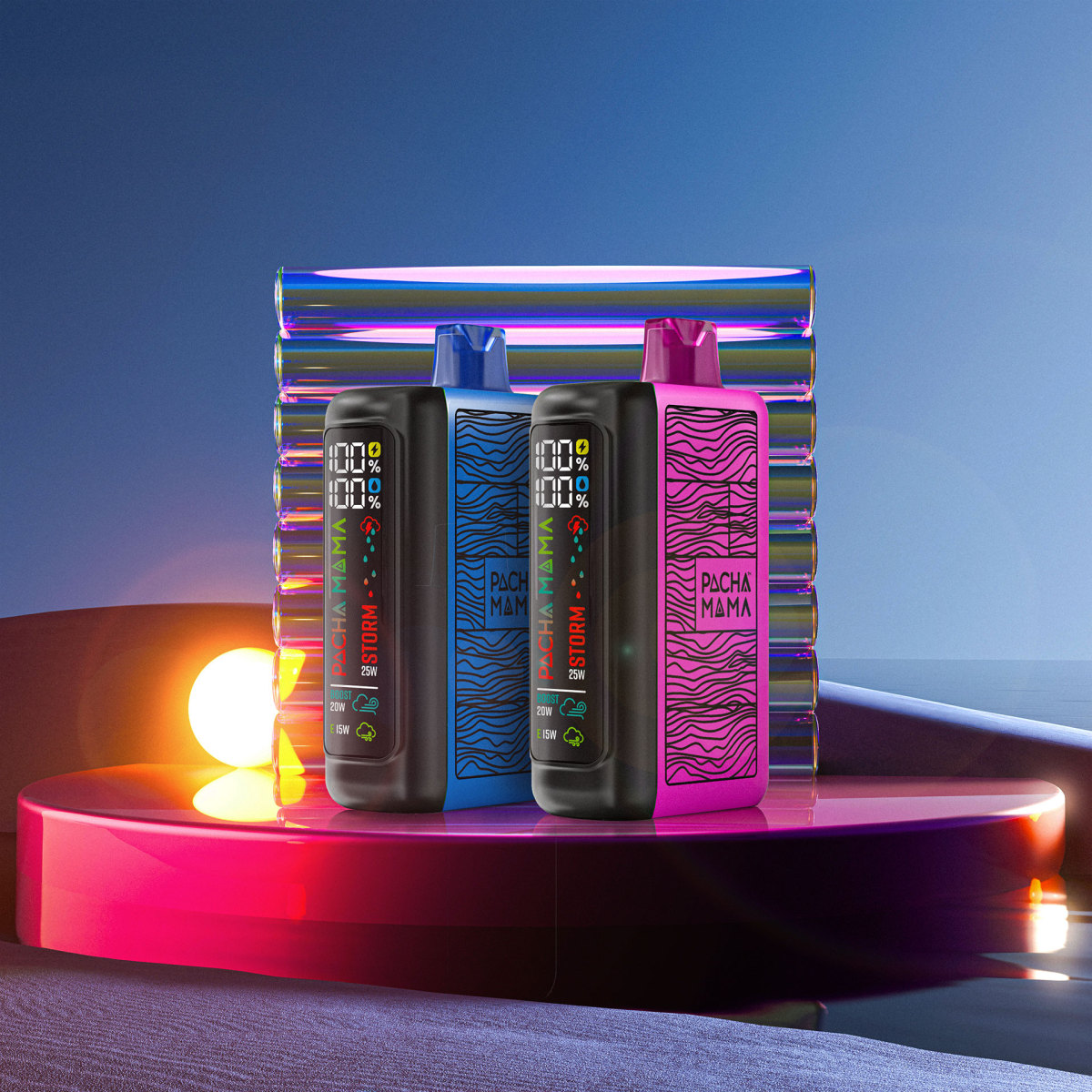
- Charlie’s has activated its first US-based manufacturing and filling line, enabling Pachamama 25K to qualify as a US-filledvape product.
- Pachamama 25K now meets Texas’ domestic manufacturing requirements and has begun distribution to ~300 Texas retail stores.
- Texas SB 2024 restricts prefilled disposables whose consumables originate from China or other “foreign adversary” countries, making US filling a new market-entry requirement.
- State-level rules are accelerating a shift from China-made prefilled products to hybrid supply chains (Chinese hardware + US-based filling).
- The “US-filled” trend is reshaping global production, reducing Shenzhen’s dominance in full-stack disposable manufacturing.
2Firsts, December 2, 2025, according to an ACCESS Newswire report, Charlie’s Holdings, Inc. (OTCQB: CHUC) announced that its first US-based manufacturing and filling facility had officially commenced operations and begun shipments to retail customers in Texas.
Charlie’s Holdings, Inc. (OTCQB: CHUC) announced that its first US-based manufacturing and filling facility is now operational and has begun shipping vapor products to retailers in Texas.
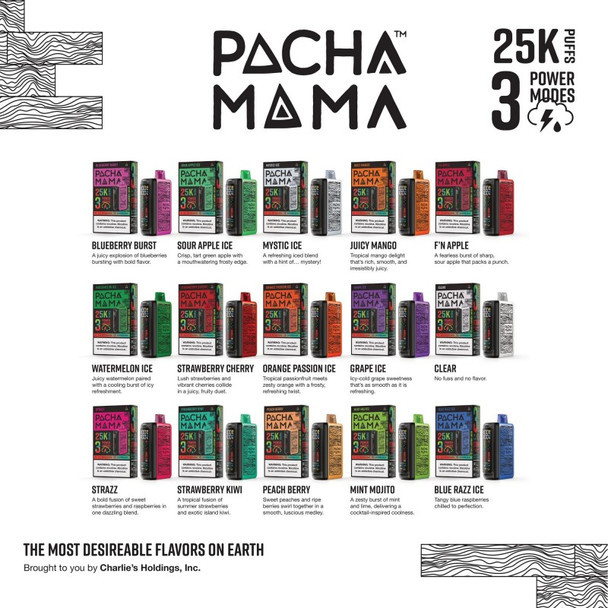
According to the company, the new facility handles US filling and final production for select product lines. The release confirms that Charlie’s has rolled out a US-filled vapor line, specifically highlighting the Pachamama 25K series.
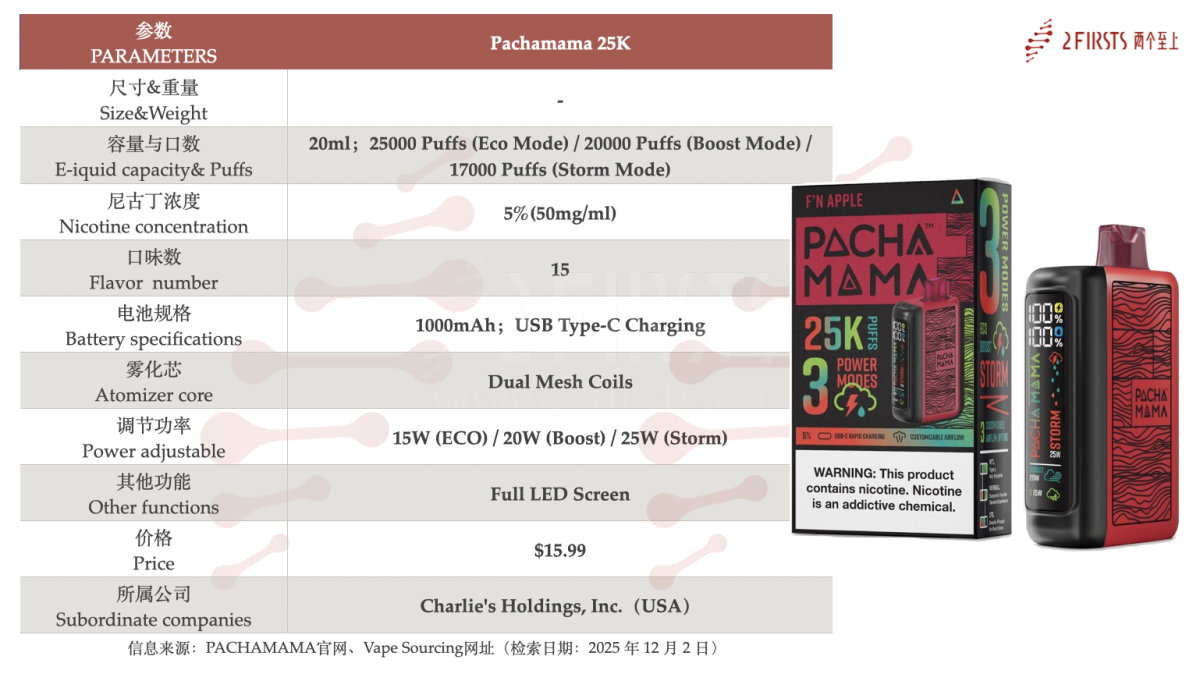
▲Read more:Product | 2Firsts Exclusive: Breaking Down Pachamama 25K, CHUC’s First U.S.-Made Factory Product
The announcement states:“The Company’s popular Pachamama 25K line now meets the domestic manufacturing requirements of the state of Texas.”
With the new capacity online, Charlie’s has initiated shipments to approximately 300 retail stores in Texas. While the announcement does not specify channel types, the company’s historical distribution patterns indicate convenience stores, vape shops, and other brick-and-mortar retail outlets.
In the release, Charlie’s President Henry Sicignano III emphasized the strategic significance of the new US facility:
“We originally expected our US-filling facility to mitigate Far East shipping delays and to lessen tariff costs, but Texas’ new domestic manufacturing requirements have also created a massive sales opportunity for Charlie’s.”
He added:
“Demand is so great, we now plan to devote 100% of our current US manufacturing capacity to the state of Texas; if all goes well, and if we expand our US manufacturing initiative in the coming months, we believe Texas could double Charlie’s sales forecasts for 2026.”
This development aligns with Charlie’s previously disclosed timeline:
- Q2 2025 earnings: the company first outlined plans to build a US manufacturing and filling facility.
- Q3 2025 earnings: management confirmed the facility would launch in Q4 to support US filling for select product lines.
- December 2025 announcement: the facility is operational, and Pachamama 25K is now produced through the US-based filling line and distributed across Texas retail channels.
Texas SB 2024: The Policy Trigger Behind the “Built in USA” Manufacturing Model
In June 2025, the Texas Legislature passed SB 2024, signed shortly after by the Governor, with the law scheduled to take effect on September 1, 2025. The statute expands the definition of an “e-cigarette product” to include not only traditional devices but also any consumable liquid or substance intended for vaporization, regardless of nicotine content.
The core regulatory shift targets prefilled disposable vapes. Under SB 2024, any such product whose e-liquid or consumable originates from China or any jurisdiction designated by the United States as a “foreign adversary” is prohibited from being sold or distributed in Texas.
This establishes a new compliance threshold: products built on the traditional model of China manufacturing + prefilled exportcan no longer access the Texas market—nor any state that may adopt similar rules. To remain eligible, brands must shift to US-filled products and ensure that consumable sourcing and end-to-end supply compliance meet state requirements.
In effect, SB 2024 formally moves production origin, filling location, and consumable sourcing into the center of regulatory scrutiny—placing significant pressure on prefilled, export-dependent supply chains and accelerating a broader industry shift toward US filling, compliant supply chains, traceable origin, and state-aligned product design and distribution.
From JUUL’s Outlier Model to Charlie’s Strategic Shift: The Rise of US-Based Filling
Charlie’s current US-filling strategy can be traced back to the industry’s earliest outlier: JUUL. Unlike most vapor products built on the conventional “Shenzhen full-stack manufacturing” model, JUUL has long relied on a distinct structure identified through customs data and supply chain research: its devices and empty cartridges/pods were produced in Suzhou, not by traditional e-cigarette OEMs, but by manufacturers rooted in the IT hardware supply chain.
This cross-industry sourcing model remained unique for years—no major vapor brand attempted to replicate it.
That changed in March 2025, when Fifty Bar publicly announced its “Built in USA / US-made disposable vape” positioning. Its model involved importing disposable devices or hardware components (cartridges/pods/components) from China, then performing fill + package + ship operations in California—creating its own “US-filled” narrative.
By September 2025, after Texas passed SB 2024, “origin compliance” quickly became a market prerequisite. Multiple disposable vape brands began publicly emphasizing “Built in USA” credentials, using US-based filling as a key selling point. Examples include FASTA, SKE, and NEXA.
Across these cases, a pattern emerges:
As the long-dominant “China full manufacturing + prefilled export” model faces mounting regulatory and channel constraints, a hybrid supply chain—China-made empty hardware + US-based filling + state-level compliance—is becoming the industry’s de facto risk-mitigation and market-entry strategy.
“Built in USA” for Charlie’s: Risk Management or Long-Term Strategy?
Strengthening Supply Chain Resilience
By establishing US-based filling and production capacity, Charlie’s reduces exposure to cross-Pacific logistics delays, customs bottlenecks, tariff volatility, and geopolitical risk. A “US-filled + local distribution” model gives the company greater control over final-mile production, lowering operational uncertainty.
Regulatory Compliance and Market Access
Texas SB 2024 and similar state-level policies elevate origin and filling requirements into gatekeeping conditions. The traditional “overseas prefilled import” model faces rising prohibition risk. US-filled product lines provide Charlie’s a structural advantage in securing continued access to Texas and other states that may adopt comparable rules.
Business Model Expansion and Path to Long-Term Operations
Charlie’s already holds a large PMTA asset base and has strengthened its financial structure through prior asset sales (such as divesting its PACHA synthetic nicotine disposable assets to R.J. Reynolds). With US-based filling now in place, the company is positioned to shift from an “export + asset monetization” profile toward a “domestic production + compliant distribution + long-term operating model.”
This combination enhances the company’s resilience to regulatory shifts and supply chain shocks while increasing its attractiveness to investors, distributors, and retail partners. In a tightening regulatory environment, “compliant, stable, US-filled” becomes a commercial advantage in itself.
A New Supply Chain Order: The Ripple Effects of the “Built in USA” Trend
With Texas SB 2024 elevating origin and filling location into enforceable regulatory criteria, “Built in USA / US-filled” is no longer merely a marketing narrative—it is becoming a structural requirement for state-level market access. From Fifty Bar to Charlie’s, this model is moving from isolated cases toward a scalable, industry-wide pattern.
As state-level restrictions intensify, US demand for domestic filling + local supply chain capability continues to grow. More brands are likely to adopt the “import empty hardware, fill in the US” structure, shifting portions of downstream manufacturing from China to the US.
This trend is already reshaping China’s export-dependent supply chain. The legacy “fully made and prefilled in China” model faces structural limitations in states adopting origin-compliance rules. Shenzhen—long the global center of NGP manufacturing—now sees its advantage in fully integrated disposable production compressed upstream into device hardware and modular components, with global production influence beginning to diffuse.
For OEMs and brands, building or partnering with US-based filling facilities, or securing state-aligned compliance capabilities, will become essential for long-term market access. This emerging supply chain order is redefining the production boundary between China and the US—and will likely serve as a key competitive variable across the global vapor industry over the next two years.
Disclaimer
This article is provided solely for professional research, industry discussion, and informational purposes. Any references to brands, companies, products, technologies, or policies are made for factual reporting and analytical purposes only, and do not constitute endorsement, recommendation, promotion, or advertising by 2Firsts.
Nicotine-containing products, including but not limited to cigarettes, e-cigarettes, heated tobacco products, and nicotine pouches, carry significant health risks. Readers are responsible for complying with all applicable laws and regulations in their respective jurisdictions, including age restrictions and access limitations.
The information contained in this article should not be regarded as investment, legal, medical, regulatory, or commercial advice. While 2Firsts strives to ensure the accuracy and reliability of its content, it does not assume liability for any direct or indirect loss arising from errors, omissions, inaccuracies, or reliance on the information contained herein.
This article is not intended for individuals below the legal age for accessing tobacco or nicotine-related information in their jurisdiction.
Copyright Notice
This article is either original content produced by 2Firsts or content reproduced, translated, summarized, or adapted from third-party sources with attribution where applicable. The intellectual property rights of the original content remain with 2Firsts or the respective original rights holders.
No individual or organization may copy, reproduce, distribute, republish, modify, translate, or otherwise use this content without prior authorization. Any unauthorized use may result in legal action.
For copyright-related inquiries, corrections, or removal requests, please contact: info@2firsts.com.
AI-Assisted Translation and Editing Notice
Portions of this article may have been translated, edited, or reviewed with the assistance of artificial intelligence tools to improve efficiency and readability. Due to the limitations of AI-assisted translation and editing, discrepancies, omissions, or inaccuracies may exist when compared with the original source.
Where applicable, readers are advised to refer to the original source for the most complete and accurate information. If you identify any errors or believe that any content infringes upon your rights, please contact us at info@2firsts.com, and we will review and address the matter promptly.