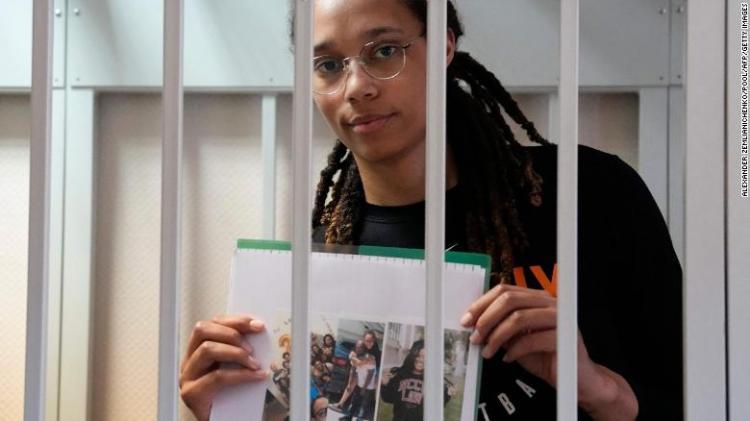
A Russian defense expert testified on Tuesday in her high-risk drug smuggling trial that the inspection of the e-cigarette carried by WNBA star Brittney Griner at Moscow airport in February did not comply with Russian law.
According to Griner's lawyer, Maria Blagovolina, one of the violations was that the test results did not show the amount of THC in the substance.
Forensic chemist Dmitry Gladyshev testified for the defense during a roughly two-hour meeting, stating that the examination did not comply with legal requirements and standards set forth in the Criminal Procedure Law with regards to research integrity.
The defense lawyers also questioned the prosecution's expert, Alexander Korablyov, who examined the pods Griner removed from her luggage.
Griner's appearance in court in Khimki City marks her seventh hearing, as she faces accusations from Russian prosecutors of attempting to smuggle less than one gram of cannabis oil in her luggage. She has pleaded guilty to drug charges - a decision her lawyer hopes will result in a lighter sentence - and faces up to 10 years in prison.
Despite pleading guilty, the US State Department remains steadfast in its assertion that she was wrongfully detained. During the WNBA off-season, supporters of two-time Olympic gold medalist Griner are calling for her release, fearing that she is being used as a political pawn in the war between Russia and Ukraine.
US officials are facing immense pressure from Griner's family, lawmakers, and the professional basketball community to bring her back to the US, which could potentially be part of a prisoner exchange. Griner wrote a letter to President Joe Biden pleading for his help in securing her release.
Elizabeth Rood, who is acting as the United States embassy in Moscow, attended a hearing on Tuesday and subsequently stated that the United States will "continue to support her in every step of the process" as long as Griner is safely returned to the US.
Griner's next hearing is scheduled for Thursday.
On Tuesday, one of her lawyers told CNN outside the courthouse that Griner is concerned yet nervous about the impending verdict.
She still knows that the end is near, of course. She heard the news, so she hopes that one day she can go home, and we hope so too," said Blagovolina.
When asked about their team's strategy of challenging the evidence presented by Russian prosecutors, Blagovolina stated, "Well, the court should consider many factors. She admits that she did bring something, but we need to know what it was. What substance?
Blagovolina also informed CNN that her team's experts discovered "some defects" in the machines used to measure the substance.
During the trial, Griner testified that she had a prescription for medical marijuana from a doctor and had no intention of bringing the drug into Russia. Her lawyer had previously stated that she underwent drug testing after being detained in February and tested negative.
The lawyer cites grounds of "improper" detention.
Griner's lawyer has presented arguments claiming that the basketball player was not handled properly after being intercepted by personnel at Sheremetyevo International Airport on February 17th.
Last week, one of her lawyers, Alexander Boykov, stated that her detention, search, and arrest were "inappropriate" and pointed out that more details will be revealed during the closing arguments.
She testified that after being intercepted at the airport, Griner was forced to sign documents that she did not fully understand. She stated that initially, she used Google Translate on her phone, but was later transferred to another room where her phone was taken away, and she was forced to sign more documents.
She testified that no lawyer was present and she was not informed of her rights. These rights would include the right to access a lawyer after being detained and the right to know what she is being accused of. According to Russian law, she should have been informed of her rights within three hours of being arrested.
Blagovolina, a partner at Rybalkin, Gortsunyan, Dyakin & Partners, stated after last week's hearing that during her testimony, Griner explained to the court that she is aware of and respects Russian laws and never intended to violate them.
The detained player testified that she was aware of Russian law and had no intention of bringing cannabis oil into the country. She also noted that she was in a hurry.
Blagovolina said that Griner confirmed she has a doctor's prescription for medical marijuana, which she uses to treat knee pain and arthritis inflammation.
Boykov, from the Moscow Legal Center, stated that they continue to maintain that she hastily packed her suitcase without realizing that substances allowed in the United States ended up in the suitcase and arrived in the Russian Federation.
Less than a week before these comments were made, CNN reported that the Biden administration proposed a prisoner exchange with Russia, suggesting the release of a convicted Russian arms smuggler, Viktor Bout, in exchange for Trevor Reed and another detained American, Paul Whelan.
Several sources familiar with the matter have reported that Russian officials have rejected a proposal from the United States to release a convicted murderer who was previously a colonel in Russia's intelligence agency, Vadim Krasikov.
Sources have informed CNN that US officials did not accept the proposal as a legitimate bargaining chip, partly because the proposal was transmitted through an informal backchannel. The release of Krasikov is also complicated as he is currently being held in Germany.
John Kirby, spokesperson for the Department of Defense, told CNN that attempting to avoid the United States' very serious proposal was malicious. He urged Russia to take the proposal seriously and later added, "We very much hope to see Brittney and Paul reunited with their families.
Griner's family, supporters, and WNBA teammates continue to express messages of solidarity and hope while awaiting the end of the trial.
Statement:
This article is compiled from third-party information and is intended solely for industry exchange and learning.
This article does not represent the views of 2FIRSTS, and 2FIRSTS cannot confirm the truthfulness and accuracy of its content. The translation of this article is intended solely for communication within the industry and for research purposes.
Due to limitations in the level of translation, the translated article may not perfectly match the original text. Please refer to the original version for accuracy.
2FIRSTS maintains full alignment with the Chinese government's positions and statements on any domestic, Hong Kong, Macau, Taiwan, or foreign-related issues.
All information compiled here belongs to the original media and author. If there is any infringement, please contact us to request deletion.
Disclaimer
This article is provided solely for professional research, industry discussion, and informational purposes. Any references to brands, companies, products, technologies, or policies are made for factual reporting and analytical purposes only, and do not constitute endorsement, recommendation, promotion, or advertising by 2Firsts.
Nicotine-containing products, including but not limited to cigarettes, e-cigarettes, heated tobacco products, and nicotine pouches, carry significant health risks. Readers are responsible for complying with all applicable laws and regulations in their respective jurisdictions, including age restrictions and access limitations.
The information contained in this article should not be regarded as investment, legal, medical, regulatory, or commercial advice. While 2Firsts strives to ensure the accuracy and reliability of its content, it does not assume liability for any direct or indirect loss arising from errors, omissions, inaccuracies, or reliance on the information contained herein.
This article is not intended for individuals below the legal age for accessing tobacco or nicotine-related information in their jurisdiction.
Copyright Notice
This article is either original content produced by 2Firsts or content reproduced, translated, summarized, or adapted from third-party sources with attribution where applicable. The intellectual property rights of the original content remain with 2Firsts or the respective original rights holders.
No individual or organization may copy, reproduce, distribute, republish, modify, translate, or otherwise use this content without prior authorization. Any unauthorized use may result in legal action.
For copyright-related inquiries, corrections, or removal requests, please contact: info@2firsts.com.
AI-Assisted Translation and Editing Notice
Portions of this article may have been translated, edited, or reviewed with the assistance of artificial intelligence tools to improve efficiency and readability. Due to the limitations of AI-assisted translation and editing, discrepancies, omissions, or inaccuracies may exist when compared with the original source.
Where applicable, readers are advised to refer to the original source for the most complete and accurate information. If you identify any errors or believe that any content infringes upon your rights, please contact us at info@2firsts.com, and we will review and address the matter promptly.