2Firsts Compliance Brief|Issue #1 Thresholds & Shakeups: Inside the New Wave of U.S. Compliance Consolidation

Jul.17.2025
2Firsts Compliance Brief|Issue #1 Thresholds & Shakeups: Inside the New Wave of U.S. Compliance Consolidation

Top News Analysis


BAT Acquires Three Pacha Brands from Charlie’s Holdings

2FIRSTS | BAT Subsidiary Acquires Three More CHUC E-Cigarette Products in $1.5 Million Deal


British American Tobacco (BAT), through its U.S. subsidiary R.J. Reynolds, has acquired three e-cigarette brands — PachaSyn, PachaMama, and Pacha Disposable — from Charlie’s Holdings. This move not only expands BAT’s presence in the U.S. but also reflects increased investor confidence in the PMTA pathway.


2Firsts observes that these acquired products are already progressing through different stages of the PMTA process. As enforcement tightens and unapproved products exit the market, regulatory certainty is beginning to encourage bold investment. Major tobacco firms appear to be entering a new confidence cycle — one where acquiring approved or PMTA-pending assets is seen as a viable growth strategy amid increasing barriers to market access.


North Carolina Enforces New Directory Rule for ENDS Sales

2FIRSTS | North Carolina Enforces Comprehensive E-Cigarette Regulations: Unlisted Products Banned Starting July


Starting July 1, North Carolina officially implemented HB900, requiring all vapor and consumable nicotine products to be listed in the state’s public directory to remain on sale. Manufacturers of non-listed products face fines of $10,000 per SKU, while retailers face escalating penalties for noncompliance.


According to 2Firsts analysis of the June 30 directory update:


● Total products listed: 876

● Brands: 28 manufacturers, mostly U.S.-based

● Product types: Disposables, cartridges, e-liquids, and refillables

● Flavor profile:

·Tobacco & menthol variants: 495 products

·Other flavors: 381 products (~43.5%), across 104 unique flavor descriptions

·Examples: Raspberry & Dragon Fruit, Orange Fantasie, Pineapple Ice


Most flavored entries are from U.S. brands like Vapetasia, Twist, and Cold Fusion — suggesting that flavor itself is not banned, but requires formal PMTA compliance to remain viable. Notably, there are no Chinese brands listed in the current North Carolina directory.


PMI Ties Compliance to Local Manufacturing with $600M U.S. Investment

2FIRSTS | PMI Launches "Invest in America" Campaign as ZYN Factory Set for Full Operation in 2026


Philip Morris International’s U.S. affiliate announced a $600 million investment into a nicotine pouch facility in Arizona, alongside a national campaign titled “Invested in America.” This move responds directly to Trump-era policies and Republican narratives pushing for U.S.-based manufacturing and tougher import enforcement.


2Firsts views this as a powerful signal of how political alignment, regulatory pressure, and trade protectionism are reshaping industry strategy. For PMI, aligning manufacturing location with regulatory credibility has become part of the playbook.


2Firsts View


China’s Manufacturers Diverge: Compliance vs. Illicit Strategy


As U.S. enforcement intensifies — particularly at customs and state-level — many Chinese manufacturers are adopting starkly different paths. Some, including companies with prior success in Europe or other regulated markets, see this as a historic opportunity to enter the U.S. via compliance. Others, especially those that previously relied on “gray clearance” methods, are pivoting toward more aggressive black-market strategies as traditional loopholes close.


This divide reflects a growing consensus: compliance is no longer optional. The FDA’s actions are forcing strategic repositioning, separating long-term players from short-term opportunists.


Acceptance Letters: The New Minimum Threshold for U.S. Market Entry


With illegal products being cleared from shelves and state directories tightening PMTA-based eligibility, one baseline standard is emerging — the FDA Acceptance Letter.


While the letter itself does not guarantee final approval, it proves a product’s PMTA is officially filed and under review. Increasingly, this is becoming the minimum regulatory threshold to access the U.S. market. Customs enforcement and state-level compliance systems — including directory rules like North Carolina’s — all acknowledge the Acceptance Letter as valid interim proof of compliance.


For brands planning serious entry into the U.S., having at least an accepted PMTA on file is no longer a nice-to-have — it’s essential.


2Firsts Compliance Solutions


Accelerating Access with 2Firsts Compliance Platform


To help manufacturers and brands respond to this changing landscape, 2Firsts has launched the Compliance Solutions platform — connecting Chinese and global manufacturers with scientists, labs, and regulatory experts.


This initiative lowers the cost and complexity of compliance while offering customized strategies for navigating PMTA and state regulations.


Acceptance Pro Solution

Your First Step Toward U.S. Market Access


2Firsts offers the Acceptance Pro Solution — a rapid, science-based service designed to help you secure the FDA’s Acceptance Letter.


What’s Included:

● Submission-ready PMTA documents tailored to your ENDS or Nicotine Pouch product

● Expert support for FDA eSubmitter and correspondence

● Scientifically optimized documents for acceptance-stage review

● Reference price: $20,000 USD (covers up to 10 SKUs)


Whether you’re entering the U.S. for the first time or relaunching through compliance, this is your regulatory starting point.


Stay Ahead — Subscribe Now


Want to receive weekly insights on compliance trends, enforcement updates, and market strategy?

Subscribe to our compliance newsletter here
 

South Korea Vape Strategies Diverge as BAT Reconsiders Exit and PMI Takes VEEV to About 14,000 Stores
BAT Rothmans says it previously considered exiting South Korea's vaping market because of competitive pressure from unregulated products, but is now reassessing conditions following changes to the country's nicotine regulatory framework. Vuse and other BAT vaping products remain available through existing distribution channels. The statement followed a South Korean media report that interpreted BAT's broader withdrawal from selected Vapour markets as a full exit from South Korea. Meanwhile, Philip Morris International launched VEEV inPRIME in the country in June and began expanding distribution to around 14,000 convenience stores and other retail channels in July. The contrasting moves highlight differing investment strategies as South Korea's regulated vaping market evolves.
Aug.14
Scottish Vape Display Rules Could Cost Businesses £61 Million, Affecting More Than 11,000 Retail Outlets
A Scottish government impact assessment estimates that proposed vape display and packaging rules could create up to £61 million ($82 million) in compliance costs for businesses, affecting more than 11,000 retail outlets. The estimated costs are mainly linked to inventory adjustments, retail storage changes and the resources required for businesses to understand and implement the new requirements. The measures form part of the UK’s broader efforts to tighten vape regulation, particularly around product displays, packaging and sales practices.
Aug.10
Snowplus Enters Japan’s FamilyMart Network With Zero-Nicotine NEO Line and Kishidan Campaign
Snowplus distributor H&S said the zero-nicotine, zero-tar NEO vaping line will begin rolling out across FamilyMart stores in Japan from September 14, 2026, excluding some locations. The DASH line will also be sold at selected FamilyMart stores in southern Kyushu and Okinawa. Snowplus simultaneously named Japanese rock band Kishidan as a brand ambassador, combining convenience-store distribution with a broader consumer marketing push in Japan.
Sep.15
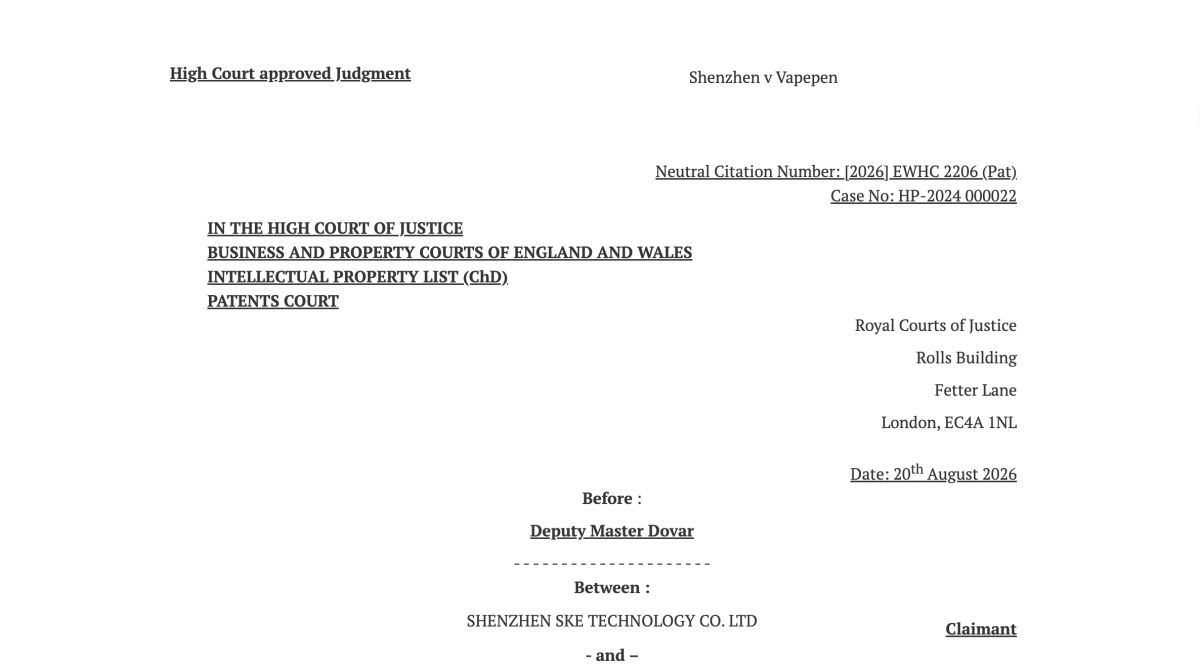
Yinghe-Controlled Vape Maker SKE Ordered to Post £569,039 Security as It Pursues Crystal Bar Design Infringement Case in UK
The UK High Court has ordered Chinese vape manufacturer Shenzhen SKE Technology to provide £569,039 ($776,000) in security for costs in its design infringement proceedings against Vapepen London and other defendants over its Crystal Bar vape product. The court did not accept the defendants’ main argument that recovering costs from a China-based company would face significant enforcement obstacles, but found that SKE had not sufficiently disclosed its own financial position. The order is procedural and does not determine the underlying infringement claims.
News
Aug.21
Ispire Q4 Revenue Rebounds 33% but Full-Year Sales Still Fall 25% as FY2027 Focus Shifts to Malaysia Manufacturing, ODM, Nicotine Pouches and Age Verification
Ispire Technology reported FY2026 revenue of about $96 million, down 24.7% year over year, as U.S. cannabis-vapor hardware and European e-cigarette sales declined by $17.4 million and $12.7 million, respectively. Fourth-quarter revenue rose 32.5% to $26.7 million, while quarterly gross margin fell to 6.3%. For FY2027, the company is prioritizing Malaysia manufacturing and vapor ODM while continuing to develop nicotine pouches, IKE Tech age-verification technology and G-Mesh licensing. Ispire has not separately disclosed the revenue or profit contribution of those newer businesses.
Regulations
Sep.17 by 2Firsts Perspectives
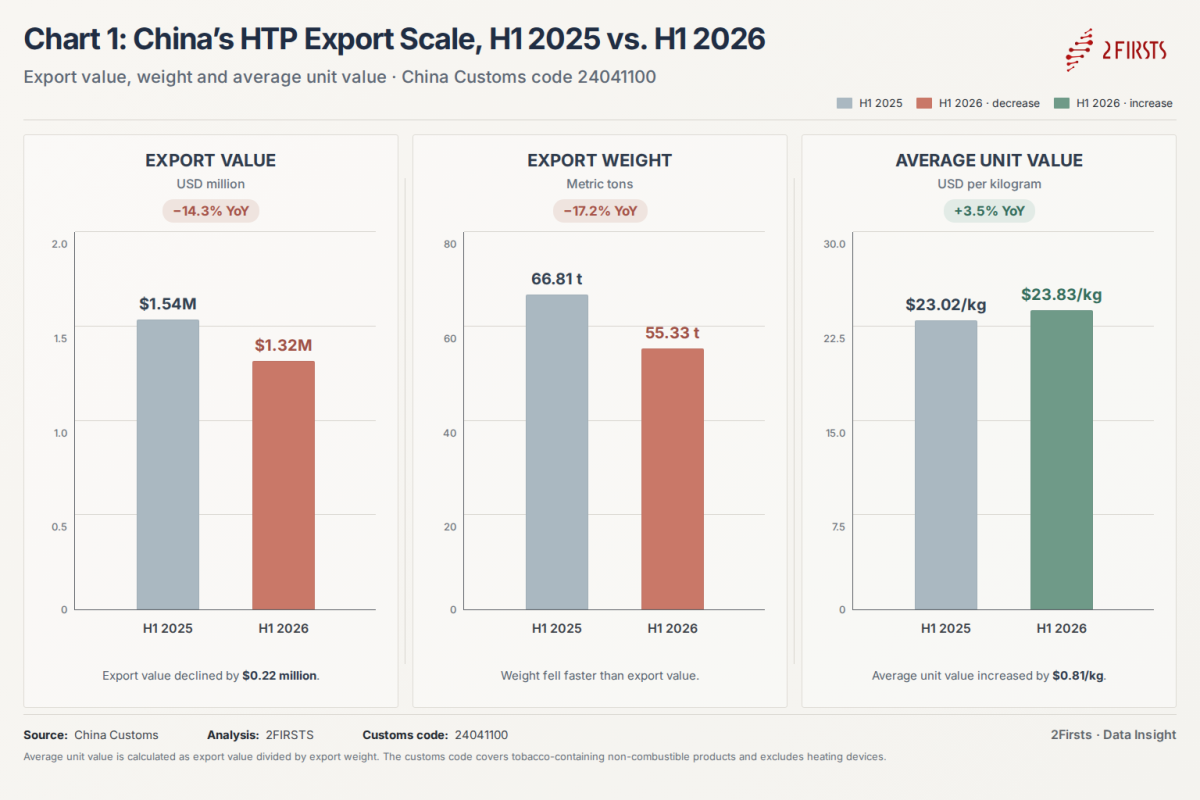
China’s HTP Exports Fell 14.3% in H1 2026 as Russia and Belarus Accounted for 76% Lead
In H1 2026, China’s HS 24041100 exports stood at $1.32 million, down 14.3% YoY, with volume falling 17.2% to 55.33 tons. Market distribution shifted drastically amid overall export drops. Exports to Russia and Belarus totaled $1 million, taking 76.0% of all shipments versus 29.5% in H1 2025. Belarus became the top destination with export value jumping 177.5%, while the Philippines, Singapore and Indonesia’s combined share slumped from 49.3% to 11.2%.Domestically, Yunnan led exporter registrations; Jiangsu and Shanghai were key suppliers, yet Anhui and Sichuan had no exports. Heavy concentration means order or declaration changes for Russia/Belarus greatly affect national aggregate data. The data shows customs entry points (not end markets), covering tobacco consumables only, excluding heating equipment and the complete HTP supply chain.
Aug.11