Key Points
● China’s core vape exports reached about $4.88 billion in 2026H1, up 3.1% year over year.
● April marked a temporary low point following China’s export rebate adjustment, but shipments recovered in May and June.
● Vaping devices and atomization hardware exports increased 8.9% YoY, becoming the main growth contributor.
● Nicotine-containing vaping products remained nearly flat, rising 0.5% YoY.
● Nicotine substitute-related products represented by 6-methyl nicotine rose 65.2% YoY, emerging as a new growth and regulatory signal.
2Firsts | Shenzhen
July 20, 2026
China’s vape exports did not experience the sharp contraction many industry observers expected after the country’s export rebate adjustment.
According to China Customs data analyzed by 2Firsts, China’s core vape exports reached approximately $4.88 billion in the first half of 2026, up 3.1% year over year. Including nicotine substitute-related products represented by 6-methyl nicotine, China’s broader vaping and nicotine-related exports totaled about $4.96 billion, up 3.8%.
But behind the stable headline number lies a deeper shift.
The growth engine behind China’s vape exports is changing. Hardware has become more resilient, traditional nicotine-containing vaping products are entering a period of adjustment, and emerging nicotine substitute-related categories are gaining momentum.
The key story of 2026H1 is not whether China’s vape exports recovered.
It is what is driving the recovery.
A U.S. Supply Shock Set the Stage for China’s 2026 Export Reset
The biggest source of volatility for China’s vape exports over the past year has been the U.S. market.
In 2025, intensified U.S. enforcement against unauthorized vape products disrupted cross-border supply channels. Shortages emerged across parts of the market, followed by a rapid replenishment cycle once logistics pathways partially reopened.
China’s exports to the U.S. reached a record monthly high of about $590 million in October 2025.
But the surge did not represent a fundamental improvement in consumer demand.
2Firsts’ analysis found that the October peak was driven largely by enforcement cycles, logistics recovery and inventory replenishment rather than organic market expansion.
The episode changed how suppliers viewed the U.S. market.
Instead of reflecting a stable demand environment, export flows increasingly became influenced by:
● enforcement intensity;
● logistics availability;
● distributor inventory levels;
● replenishment timing.
For Chinese manufacturers, the challenge shifted from simply producing more products to managing a more volatile global supply chain.

April’s Export Drop Reflected Policy Repricing, Not Demand Collapse
China’s vape exports fell sharply in April 2026.
According to China Customs data analyzed by 2Firsts, April exports declined to $694 million, down 20.9% year over year and 23.2% month over month, marking the lowest April level in three years. April was also the first full month after China removed export rebates for certain vape-related products.
The decline reflected more than market demand.
Industry analysis by 2Firsts showed that the policy shift was pushing manufacturers to reconsider cost structures, cash flow management and production strategies.
The downturn proved temporary.
Nicotine-containing vaping product exports recovered after April:
● March: about $624 million;
● April: about $438 million;
● May: about $487 million;
● June: about $613 million.
The rebound suggests April represented a policy transition shock rather than a sustained collapse in underlying demand.
Hardware Takes the Lead as China’s Vape Growth Engine Shifts
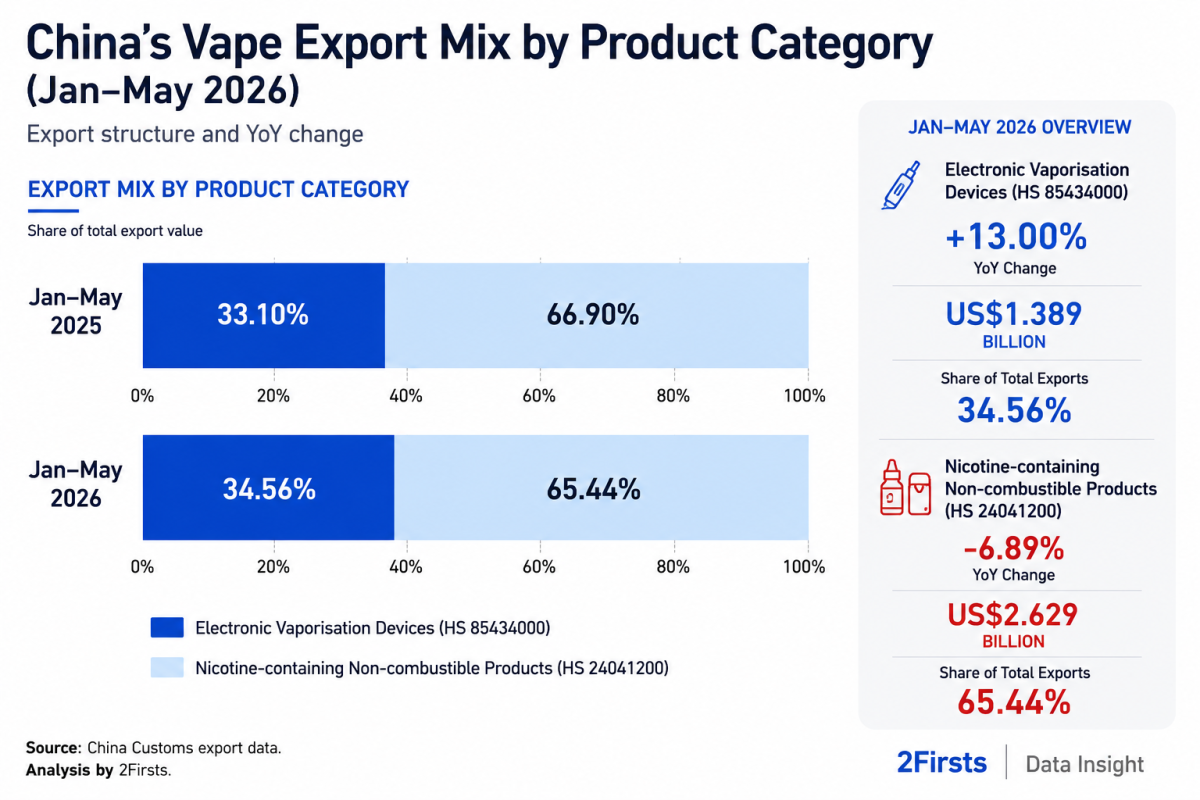
China’s first-half export growth was uneven across product categories.
Vaping devices and atomization hardware (HS85434000) increased 8.9% year over year, becoming the strongest contributor to export growth.
By contrast, nicotine-containing vaping products (HS24041200) increased only 0.5%, remaining largely unchanged from the previous year.
The divergence suggests that China’s vape export model is becoming less dependent on one dominant product category.
Hardware resilience reflects continued manufacturing strength and supply chain competitiveness, while slower nicotine-product growth points to increasing pressure from regulation, pricing changes and market maturity.
6-Methyl Nicotine-Linked Products Emerge as a New Export Signal
A different trend is emerging outside traditional vape categories.
Nicotine substitute-related products represented by 6-methyl nicotine (HS24041990) reached approximately $87.5 million in exports during 2026H1, up 65.2% year over year.
Although still smaller than hardware and nicotine-containing vaping products, the category is expanding much faster.
Historical data shows the category has already moved beyond an early-stage market:
Year | Export Value |
2023 | $5.5 million |
2024 | $147.4 million |
2025 | $135.6 million |
2026H1 | $87.5 million |
The recent U.S. debate around 6-methyl nicotine represents growing regulatory attention toward a category that has already developed export scale.
Because customs codes cannot identify specific chemical compounds, HS24041990 should not be interpreted as a direct measurement of 6-methyl nicotine exports. However, it provides an important proxy for tracking the expansion of nicotine substitute-related products.
U.S. Imports Stabilize, but Product Mix Is Changing
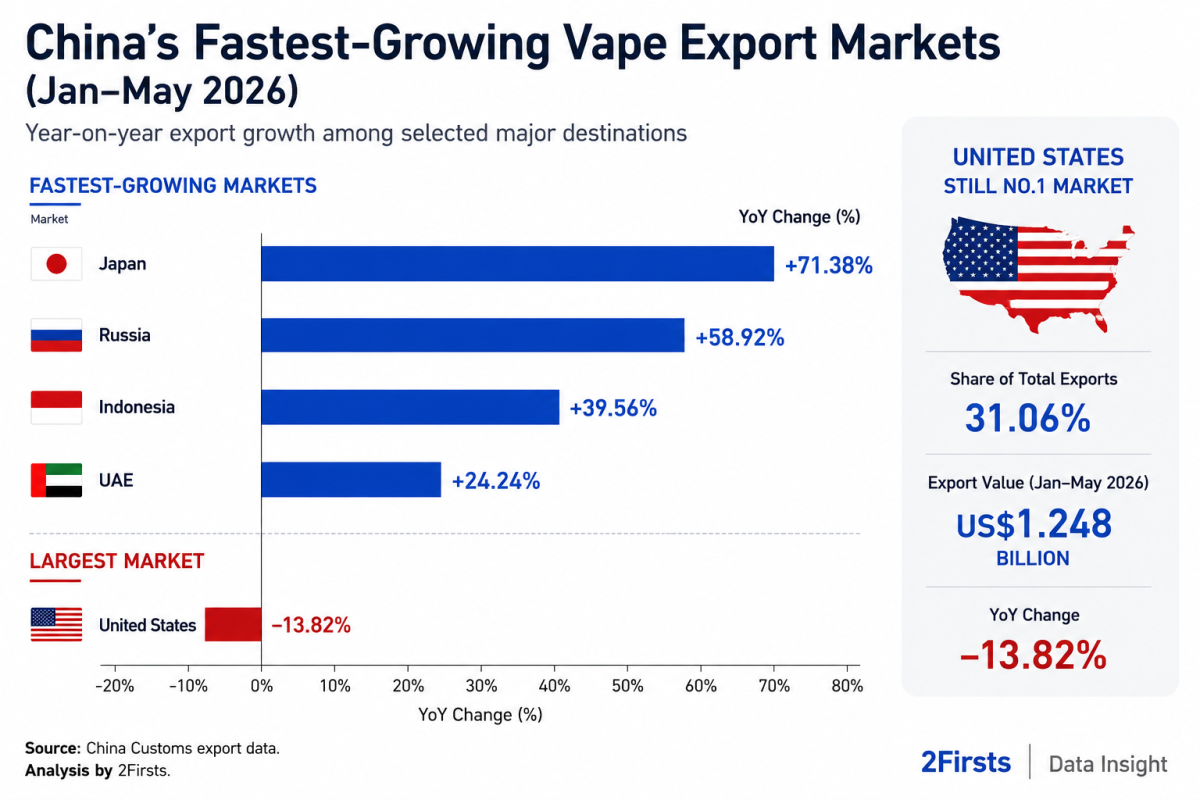
The U.S. remains China’s largest vape export market.
However, 2026H1 data shows that stability in total exports masks significant changes in product composition.
China’s exports to the U.S.:
Category | YoY Change |
Vaping devices and atomization hardware | +15.2% |
Nicotine-containing vaping products | -5.5% |
Nicotine substitute-related products | +234.7% |
The U.S. market is not simply returning to its previous state.
The shortage and replenishment cycle of 2025 reshaped distribution dynamics, while 2026 data shows suppliers are adapting through different product pathways.
China’s Vape Supply Chain Moves From Scale Competition to Structural Competition
The first half of 2026 does not show a loss of momentum for China’s vape exports.
Instead, it shows a change in what drives that momentum.
Hardware growth highlights the continued strength of China’s manufacturing ecosystem. The stabilization of nicotine-containing product exports reflects a more mature and regulated market environment. The rapid expansion of nicotine substitute-related products signals the emergence of new product pathways.
For Chinese suppliers, future competitiveness will depend less on manufacturing scale alone and more on their ability to adapt to:
● regulatory changes;
● product evolution;
● shifting market structures.
China’s vape exports remain resilient.
But the engine of growth is changing.
Data does not explain the market by itself — but it reveals where the market is moving. 2Firsts Data will continue tracking China’s vape exports, global market flows and product mix shifts, providing data-driven insights into the structural changes shaping the global nicotine industry.
Data Scope
This analysis defines:
Core vape exports:
● Vaping devices and atomization hardware (HS85434000)
● Nicotine-containing vaping products (HS24041200)
Expanded nicotine-related exports:
● Core vape exports above
● Nicotine substitute-related products represented by 6-methyl nicotine (HS24041990)
HS24041990 cannot be directly equated with 6-methyl nicotine exports, but serves as an important indicator for tracking related nicotine substitute product trends.
Cover Image generated by AI

Disclaimer
This article is provided solely for professional research, industry discussion, and informational purposes. Any references to brands, companies, products, technologies, or policies are made for factual reporting and analytical purposes only, and do not constitute endorsement, recommendation, promotion, or advertising by 2Firsts.
Nicotine-containing products, including but not limited to cigarettes, e-cigarettes, heated tobacco products, and nicotine pouches, carry significant health risks. Readers are responsible for complying with all applicable laws and regulations in their respective jurisdictions, including age restrictions and access limitations.
The information contained in this article should not be regarded as investment, legal, medical, regulatory, or commercial advice. While 2Firsts strives to ensure the accuracy and reliability of its content, it does not assume liability for any direct or indirect loss arising from errors, omissions, inaccuracies, or reliance on the information contained herein.
This article is not intended for individuals below the legal age for accessing tobacco or nicotine-related information in their jurisdiction.
Copyright Notice
This article is either original content produced by 2Firsts or content reproduced, translated, summarized, or adapted from third-party sources with attribution where applicable. The intellectual property rights of the original content remain with 2Firsts or the respective original rights holders.
No individual or organization may copy, reproduce, distribute, republish, modify, translate, or otherwise use this content without prior authorization. Any unauthorized use may result in legal action.
For copyright-related inquiries, corrections, or removal requests, please contact: info@2firsts.com.
AI-Assisted Translation and Editing Notice
Portions of this article may have been translated, edited, or reviewed with the assistance of artificial intelligence tools to improve efficiency and readability. Due to the limitations of AI-assisted translation and editing, discrepancies, omissions, or inaccuracies may exist when compared with the original source.
Where applicable, readers are advised to refer to the original source for the most complete and accurate information. If you identify any errors or believe that any content infringes upon your rights, please contact us at info@2firsts.com, and we will review and address the matter promptly.