
- Key Points
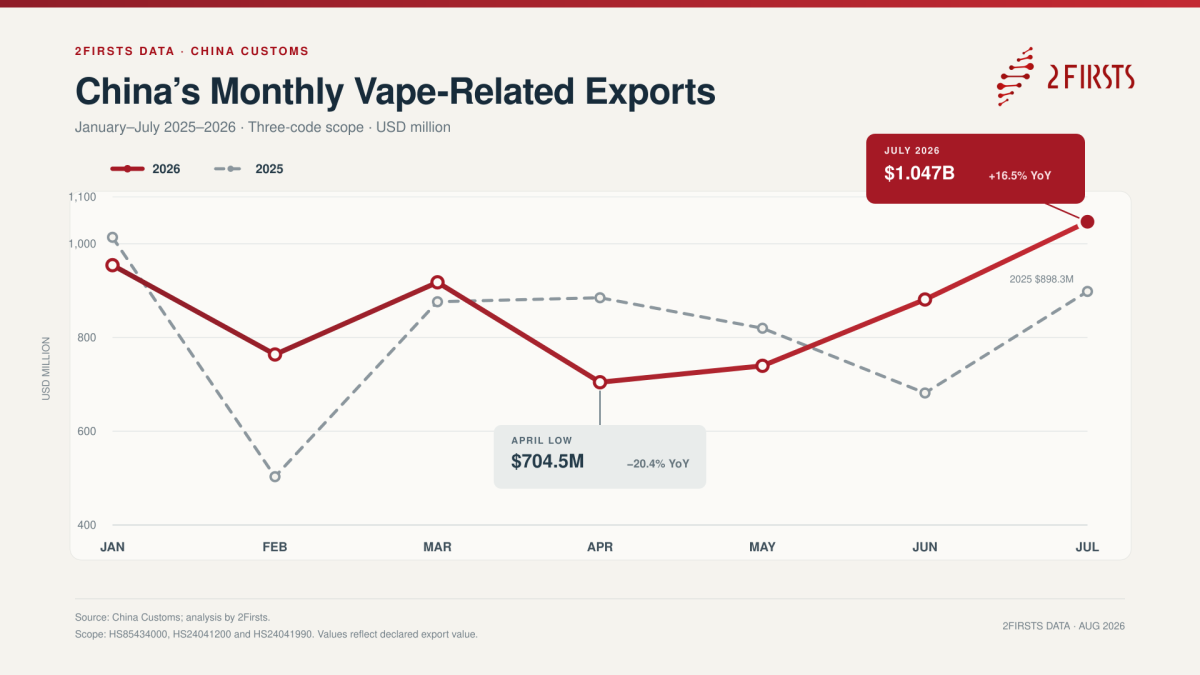
- China’s exports across three vape- and nicotine-related customs codes reached $1.047 billion in July 2026, up 16.5% YoY and 18.8% MoM.
- U.S.-bound exports rose 53.5% to $404.2 million, accounting for approximately 94.9% of the total YoY increase.
- Exports under HS24041200 increased 24.7%, while electronic vaporisation device exports declined 0.4%.
- January–July exports reached $6.008 billion, an increase of 5.8% from the same period in 2025.
- July marked a sharp acceleration in U.S.-bound shipments, but one month of data is not sufficient to establish a sustained recovery in export momentum.
2Firsts | Shenzhen
August 24, 2026
China’s vape- and nicotine-related exports reached approximately $1.047 billion in July 2026, according to China Customs data analysed by 2Firsts.
The total was 16.5% higher than the $898.3 million recorded in July 2025 and 18.8% above the June 2026 level. It was the first month in 2026 in which exports across the three customs codes exceeded $1 billion, and the highest monthly total of the year.
For January through July, exports reached approximately $6.008 billion, up 5.8% from $5.677 billion in the same period of 2025. The cumulative growth rate accelerated from 3.8% in the first half of the year.
But July’s growth was not broadly distributed across export markets. The U.S. generated nearly 95% of the year-over-year increase, while nicotine-containing non-combustible products under HS24041200 accounted for most of the product-level expansion. Device exports, by comparison, remained broadly level with July 2025.
July Exports Reach $1.047 Billion, the Highest Monthly Level of 2026
China’s exports across the three customs codes fell to $704.5 million in April, down 20.4% year over year. Shipments subsequently recovered month by month.
Month | Export Value | YoY | MoM |
April 2026 | $704.5M | −20.4% | −23.2% |
May 2026 | $739.6M | −9.8% | +5.0% |
June 2026 | $881.0M | +29.3% | +19.1% |
July 2026 | $1.047B | +16.5% | +18.8% |
June and July both recorded year-over-year and month-over-month growth, offsetting most of the declines recorded in April and May.
Over the longer post-April period, however, the increase remained more modest. Exports totalled $3.372 billion from April through July 2026, only 2.7% higher than in the corresponding period of 2025.
The data therefore show that exports have recovered from the short-term low following China’s April export rebate adjustment, but cumulative growth during the period remains limited.
U.S.-Bound Shipments Account for Nearly 95% of July’s Growth
The U.S. was the decisive source of July’s export increase.
China exported approximately $404.2 million of products under the three customs codes to the U.S. in July, up 53.5% from $263.3 million a year earlier. The increase amounted to approximately $141.0 million.
Exports to all markets outside the U.S., by comparison, increased just 1.2%, from $635.1 million to $642.6 million.
Market Scope | July 2025 | July 2026 | YoY |
United States | $263.3M | $404.2M | +53.5% |
Markets outside the U.S. | $635.1M | $642.6M | +1.2% |
Global total | $898.3M | $1.047B | +16.5% |
The three codes generated a combined year-over-year increase of approximately $148.5 million in July. The U.S. accounted for $141.0 million of that increase, equivalent to 94.9%.
The U.S. share of China’s exports across the three codes rose from 29.3% in July 2025 to 38.6% in July 2026.

The figures indicate that the 16.5% headline increase was not the result of simultaneous expansion across major global markets. It was highly concentrated in the U.S.
July Reverses the Direction of 2026 U.S.-Bound Exports
The July surge also changed the cumulative direction of China’s U.S.-bound exports in 2026.
On a comparable three-code basis:
Period | 2026 U.S.-Bound Exports | YoY |
January–May | $1.267B | −13.0% |
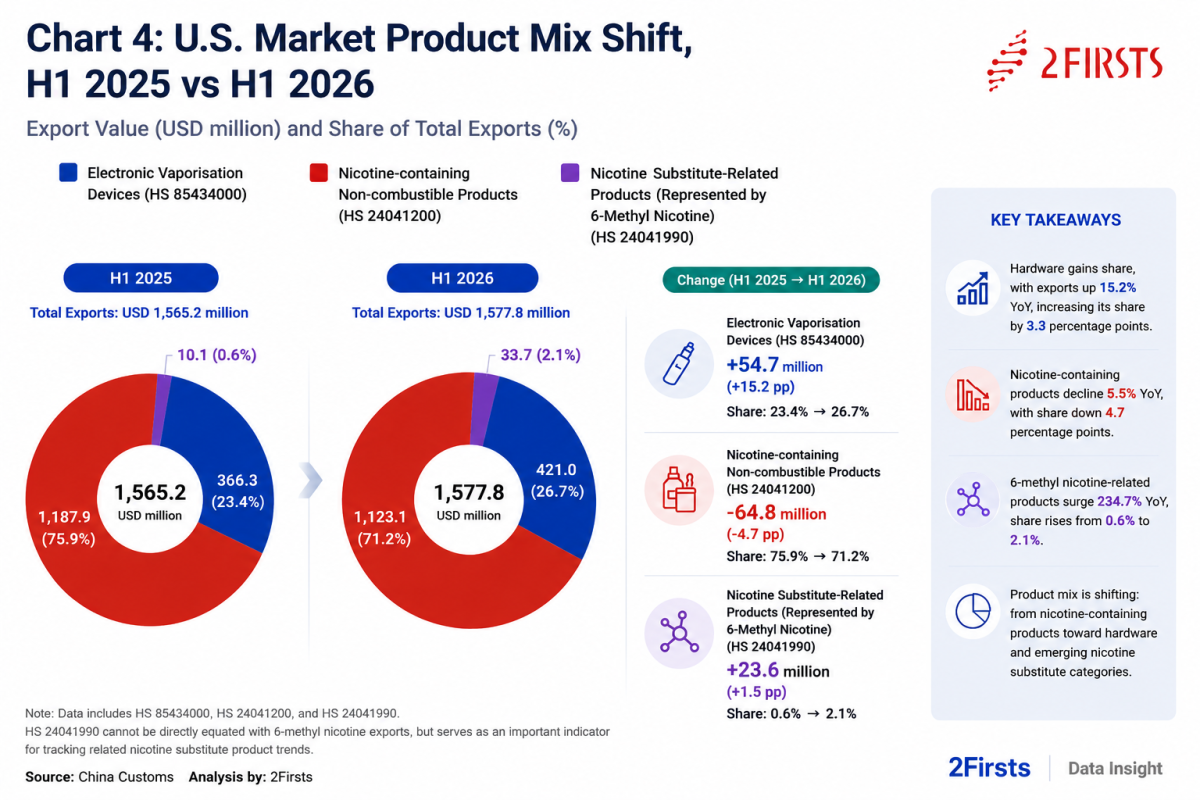
First half | $1.577B | +0.8% |
July only | $404.2M | +53.5% |
January–July | $1.981B | +8.4% |
U.S.-bound exports were still down 13.0% in the first five months of the year. By the end of the first half, cumulative shipments had returned to broadly the same level as in 2025. July’s sharp increase then pushed January–July exports 8.4% above the previous year.
Previous 2Firsts analysis showed that the U.S. market experienced a period of volatility in 2025 shaped by intensified enforcement, supply shortages, logistics normalisation and inventory rebuilding. China’s U.S.-bound exports reached a monthly peak of approximately $591 million in October 2025, but that high did not necessarily represent a corresponding increase in underlying consumer demand.
July 2026 therefore marks a clear acceleration in U.S.-bound shipments, but one month of data is not sufficient to establish that earlier export momentum has fully returned. Future shipments could still be affected by enforcement, logistics, distributor inventories and the timing of import orders.
Nicotine-Containing Vape Products (HS24041200) Account for 85% of the July Increase in U.S.-Bound Exports
The July increase in U.S.-bound exports was driven primarily by nicotine-containing non-combustible products under HS24041200.
HS Code | July 2025 | July 2026 | YoY | YoY Increase |
HS24041200 | $195.7M | $315.5M | +61.2% | +$119.8M |
HS85434000 | $65.8M | $81.3M | +23.4% | +$15.4M |
HS24041990 | $1.8M | $7.5M | +324.0% | +$5.7M |
Total | $263.3M | $404.2M | +53.5% | +$141.0M |
HS24041200 accounted for approximately 85.0% of the U.S. year-over-year increase. Electronic vaporisation devices contributed around 10.9%, while nicotine-substitute-related products under HS24041990 contributed about 4.0%.
HS24041990 recorded the fastest percentage growth, but its absolute value remained much smaller than the other two categories. The main change in U.S.-bound exports was therefore not the replacement of conventional nicotine products by emerging substitutes. It was a sharp increase in HS24041200 shipments, accompanied by growth in both devices and nicotine-substitute-related products.
Modular Product Designs May Be Reshaping the Export Classification Mix
An industry source familiar with the U.S. vape market and China’s supply chain told 2Firsts that the changing performance of HS85434000 and HS24041200 may be linked to the growing presence of modular vape products in the U.S.
The source cited Foger Switch Pro as an example. The product uses a two-part design connected magnetically: one component contains the e-liquid and a small internal battery, while the other is a reusable main battery base that contains no e-liquid and can be recharged.
Consumers can initially purchase the complete kit and continue using the main battery base while buying only replacement e-liquid components. The model can reduce the cost of repeat purchases and separates the e-liquid component from the primary battery hardware that would previously have been integrated into a single disposable device.
Public retail monitoring data indicate that Foger has become one of the leading product lines in the U.S. market. In the eight weeks ending March 22, 2026, Foger Switch Pro ranked fifth by dollar sales among the e-cigarette brands and product lines tracked by the CDC Foundation using Circana data. The dataset covers multi-outlet retailers and convenience stores, but excludes vape shops, online retailers, and devices or accessories sold without e-liquid. It therefore does not represent the entire U.S. market.
Retail listings broadly reflect the structure described by the source. Foger Switch Pro is offered as a system consisting of a reusable charging base and a replaceable e-liquid component, with the complete kit, replacement component, and charging device also listed separately.
The source said the growth in U.S.-bound exports under HS85434000 during the first half of 2026 may partly have reflected initial sales of such modular kits. Where the main battery device and the nicotine-containing e-liquid component are declared separately, the two parts may be reported under HS85434000 and HS24041200, respectively. Earlier one-piece disposable vapes, by contrast, integrated the battery and e-liquid into a single product and were typically declared as a complete e-liquid-containing product.
The source added that the acceleration in HS24041200 exports in July may indicate an expanding replacement-component market around modular systems. Some follower brands may be introducing e-liquid components designed to work with battery bases that have already established a user base, allowing them to enter the market without building and promoting an entirely new hardware ecosystem.
This interpretation remains an industry assessment based on market and supply-chain observations. Customs data do not identify brands, models, product bundles or compatibility arrangements, nor do they show whether different components of the same retail system were declared separately. Compatibility may also vary across product versions and production batches. The role of Foger and related follower products in the increase under HS24041200 therefore cannot be independently established from customs data.
Still, the July figures indicate a clear change in the composition of U.S.-bound growth. Device exports continued to rise, but nicotine-containing vape products accounted for most of the additional export value. The expansion of modular systems and their replacement-component markets may provide an important commercial clue to understanding that shift.
July Shifts the Growth Engine From Hardware to Nicotine-Containing Products
The three product categories also diverged at the global level.
HS Code | July 2026 | July YoY | January–July 2026 | Cumulative YoY |
HS24041200 | $716.7M | +24.7% | $3.957B | +4.1% |
HS85434000 | $313.3M | −0.4% | $1.946B | +7.3% |
HS24041990 | $16.9M | +88.9% | $104.4M | +68.6% |
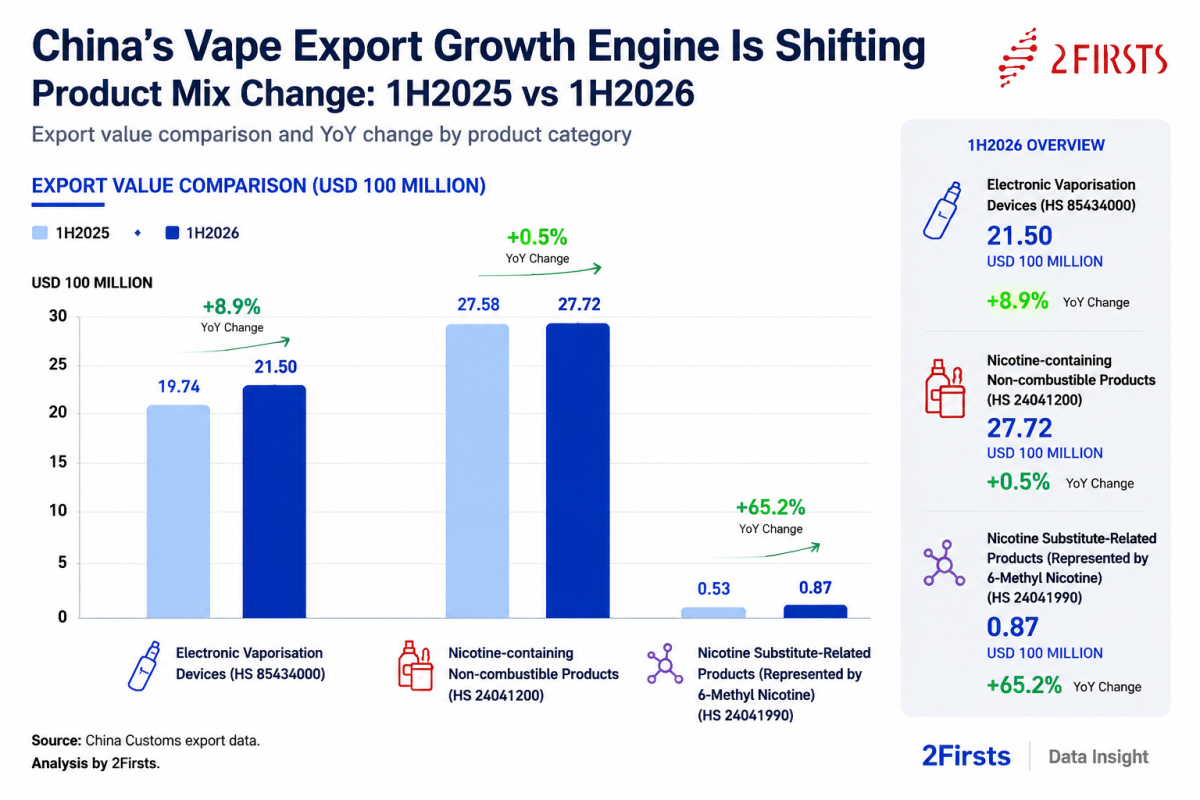
During January–May, device exports rose 13.0%, while exports under HS24041200 declined 6.9%. In the first half, devices were still the leading source of growth, increasing 8.9%, while HS24041200 was broadly stable with a 0.5% increase.
July changed that pattern.
Exports under HS24041200 rose 24.7%, adding approximately $141.8 million from a year earlier and accounting for around 95.5% of the overall increase across the three codes.
Device exports increased 28.2% from June but declined 0.4% from July 2025. The sequential rebound therefore returned device shipments to approximately the previous year’s level rather than establishing new year-over-year growth.
By the end of July, the cumulative year-over-year increase under HS24041200 had reached approximately $156.4 million, exceeding the $131.7 million increase in device exports. HS24041200 had therefore become the largest source of absolute export growth during January–July.
HS24041990 continued to expand rapidly, with July exports up 88.9% and January–July exports up 68.6%. However, the category represented only around 1.7% of combined exports during the first seven months. It remains more significant as an emerging product and regulatory signal than as a leading contributor to total export value.
Performance Outside the U.S. Remains Uneven
Although the U.S. dominated July’s increase, several Asian, Middle Eastern and other markets also recorded growth.
Exports to South Korea rose 62.9% to $51.1 million, while shipments to Indonesia increased 46.6% to $24.0 million. Japan rose 28.6% to $37.8 million, and Saudi Arabia increased 114.4% to $12.4 million.
Several established markets moved in the opposite direction:
- Germany declined 31.7% to $36.2 million;
- Malaysia fell 34.3% to $25.2 million;
- the United Kingdom declined 6.9% to $160.8 million;
- the Netherlands fell 34.5% to $10.3 million;
- Spain declined 45.8% to $5.1 million.
Growth and contraction across non-U.S. destinations largely offset each other, leaving total exports to markets outside the U.S. only 1.2% higher than a year earlier.
The pattern differs from the first five months of 2026, when U.S.-bound exports declined and growth in Japan, Russia, Indonesia and the UAE provided support. In July, the export mix became more concentrated in the U.S. again.
July Signals Acceleration, but Not Yet a Sustained Trend
China’s exports across the three vape- and nicotine-related customs codes reached $1.047 billion in July, rising 16.5% and moving decisively above the April low.
But the structure behind the headline is more important than the headline alone.
The U.S. accounted for nearly 95% of the year-over-year increase. HS24041200 was the largest source of product growth. Device exports remained broadly flat from a year earlier, and total shipments to markets outside the U.S. increased only 1.2%.
July should therefore be viewed as an important change in export momentum, rather than confirmation of a broad-based recovery.
Three questions will be important in the coming months:
- whether U.S.-bound exports can maintain growth in August and September;
- whether the increase under HS24041200 reflects sustained orders or inventory and shipment timing;
- whether device exports can return to year-over-year growth rather than relying on sequential recovery.
- One month of data can change the direction of cumulative growth. Establishing a new trend will require a longer time series.
Data does not explain the market by itself, but it can reveal where change is occurring. 2Firsts Data will continue tracking China’s vape- and nicotine-related exports, global market flows and changes in product structure.
Cover Image generated by AI
Data Scope
This analysis covers three China Customs commodity codes:
- HS85434000: electronic cigarettes and similar personal electronic vaporisation devices;
- HS24041200: other nicotine-containing products intended for non-combustible use;
- HS24041990: other nicotine-substitute products intended for non-combustible use.
HS24041990 may include products related to 6-methyl nicotine and other nicotine substitutes. However, customs classifications do not identify specific chemical ingredients, and the code should not be interpreted as a direct measurement of 6-methyl nicotine exports.
Customs data reflect declared cross-border shipments rather than overseas retail sales or end-market consumption. Monthly figures may also be affected by logistics, inventory movements, order batches and declaration timing.
Source: China Customs; analysis by 2Firsts.
Disclaimer
This article is provided solely for professional research, industry discussion, and informational purposes. Any references to brands, companies, products, technologies, or policies are made for factual reporting and analytical purposes only, and do not constitute endorsement, recommendation, promotion, or advertising by 2Firsts.
Nicotine-containing products, including but not limited to cigarettes, e-cigarettes, heated tobacco products, and nicotine pouches, carry significant health risks. Readers are responsible for complying with all applicable laws and regulations in their respective jurisdictions, including age restrictions and access limitations.
The information contained in this article should not be regarded as investment, legal, medical, regulatory, or commercial advice. While 2Firsts strives to ensure the accuracy and reliability of its content, it does not assume liability for any direct or indirect loss arising from errors, omissions, inaccuracies, or reliance on the information contained herein.
This article is not intended for individuals below the legal age for accessing tobacco or nicotine-related information in their jurisdiction.
Copyright Notice
This article is either original content produced by 2Firsts or content reproduced, translated, summarized, or adapted from third-party sources with attribution where applicable. The intellectual property rights of the original content remain with 2Firsts or the respective original rights holders.
No individual or organization may copy, reproduce, distribute, republish, modify, translate, or otherwise use this content without prior authorization. Any unauthorized use may result in legal action.
For copyright-related inquiries, corrections, or removal requests, please contact: info@2firsts.com.
AI-Assisted Translation and Editing Notice
Portions of this article may have been translated, edited, or reviewed with the assistance of artificial intelligence tools to improve efficiency and readability. Due to the limitations of AI-assisted translation and editing, discrepancies, omissions, or inaccuracies may exist when compared with the original source.
Where applicable, readers are advised to refer to the original source for the most complete and accurate information. If you identify any errors or believe that any content infringes upon your rights, please contact us at info@2firsts.com, and we will review and address the matter promptly.



