California Federal Judge Approves Juul's Multi-Million Dollar Settlement

Jan.31.2023
California Federal Judge Approves Juul's Multi-Million Dollar Settlement
A US federal judge approves a multimillion-dollar settlement between Juul and plaintiffs in a class-action lawsuit.

A federal judge in California has tentatively approved a multimillion-dollar settlement for e-cigarette manufacturer Juul, which could pay out millions to plaintiffs in a class action lawsuit.


On January 20th, U.S. District Judge William Orrick approved a settlement agreement for a class action lawsuit against Juul in the federal court of San Francisco. The agreement provides a payment of $255 million (approximately RMB 1.72 billion) to class members in exchange for releasing economic loss claims. According to court documents, the settlement covers between 200,000 and 2 million class members, approximately 15% of the claimants.


This announcement was made ahead of the scheduled trial in April 2023 with its largest investors Juul and Altria. The settlement was reached after years of negotiations and will dismiss Juul from the trial, allowing Altria to proceed under the terms of the settlement alone. Class members who reject the settlement will continue to participate in the trial.


The settlement and litigation notices regarding Altria will be provided directly to known purchasers and disseminated through widespread distribution," according to court documents. All notices will be linked to or directed towards the settlement website.


A group lawsuit against Juul alleges that the e-cigarette giant used deceptive marketing to fuel the youth vaping epidemic and falsely claimed that its e-cigarette pods contained 5% nicotine, which is approximately equivalent to a pack of cigarettes. The pods actually contained significantly higher levels of nicotine than advertised.


The plaintiff also claims that Juul incorrectly marketed its product as safer than traditional cigarettes. At present, there is no evidence to support this claim.


Disclaimer

This article is provided solely for professional research, industry discussion, and informational purposes. Any references to brands, companies, products, technologies, or policies are made for factual reporting and analytical purposes only, and do not constitute endorsement, recommendation, promotion, or advertising by 2Firsts.

Nicotine-containing products, including but not limited to cigarettes, e-cigarettes, heated tobacco products, and nicotine pouches, carry significant health risks. Readers are responsible for complying with all applicable laws and regulations in their respective jurisdictions, including age restrictions and access limitations.

The information contained in this article should not be regarded as investment, legal, medical, regulatory, or commercial advice. While 2Firsts strives to ensure the accuracy and reliability of its content, it does not assume liability for any direct or indirect loss arising from errors, omissions, inaccuracies, or reliance on the information contained herein.

This article is not intended for individuals below the legal age for accessing tobacco or nicotine-related information in their jurisdiction.


Copyright Notice

This article is either original content produced by 2Firsts or content reproduced, translated, summarized, or adapted from third-party sources with attribution where applicable. The intellectual property rights of the original content remain with 2Firsts or the respective original rights holders.

No individual or organization may copy, reproduce, distribute, republish, modify, translate, or otherwise use this content without prior authorization. Any unauthorized use may result in legal action.

For copyright-related inquiries, corrections, or removal requests, please contact: info@2firsts.com.


AI-Assisted Translation and Editing Notice

Portions of this article may have been translated, edited, or reviewed with the assistance of artificial intelligence tools to improve efficiency and readability. Due to the limitations of AI-assisted translation and editing, discrepancies, omissions, or inaccuracies may exist when compared with the original source.

Where applicable, readers are advised to refer to the original source for the most complete and accurate information. If you identify any errors or believe that any content infringes upon your rights, please contact us at info@2firsts.com, and we will review and address the matter promptly.


JUUL2 Sued Within a Week of FDA Authorization as AJ Marketing Alleges Infringement of Programmable Vape Patent
Less than a week after JUUL2 received U.S. FDA marketing authorization on August 28, 2026, JUUL Labs was sued for patent infringement in federal court in Delaware. AJ Marketing LLC filed the complaint on September 3, alleging that both JUUL 1 and JUUL2 infringe U.S. Patent No. 8,851,068 B2. The patent covers aspects of programmable electronic vaporization devices, including controls over dose delivery, usage frequency and operating parameters. The plaintiff is seeking reasonable royalties and ongoing royalties tied to the remaining life of the patent. JUUL has not yet publicly responded to the case.
Sep.10
FDA Revises Import Alert 98-07 Rules, Bringing May Enforcement Priorities Into Unauthorized ENDS Detentions
The U.S. Food and Drug Administration has revised the rules under Import Alert 98-07 to incorporate its May 2026 enforcement-priority policy for certain electronic nicotine delivery systems marketed without premarket authorization. The alert continues to allow detention without physical examination, or DWPE, for ENDS lacking required marketing authorization, while directing field divisions to apply the May risk-based framework. When necessary, detention or refusal decisions must also undergo review by the FDA's Center for Tobacco Products. Products including PACHA and Vuse Pro have already emerged as industry examples of the May policy, although enforcement discretion does not constitute FDA marketing authorization.
News
Sep.28 by 2Firsts Perspectives
Gallup Tracks Nicotine Pouch Use for the First Time: 11% of U.S. Adults Smoke, 9% Vape and 4% Use Nicotine Pouches
Gallup’s 2026 Consumption Habits survey tracked nicotine pouch use for the first time. The survey found that 11% of U.S. adults reported smoking cigarettes in the past week, 9% reported vaping, and 4% reported using nicotine pouches. Cigarette smoking remained near Gallup’s long-term low, while adult vaping rates stayed relatively stable in recent years.
Market
Aug.25 by 2Firsts Perspectives
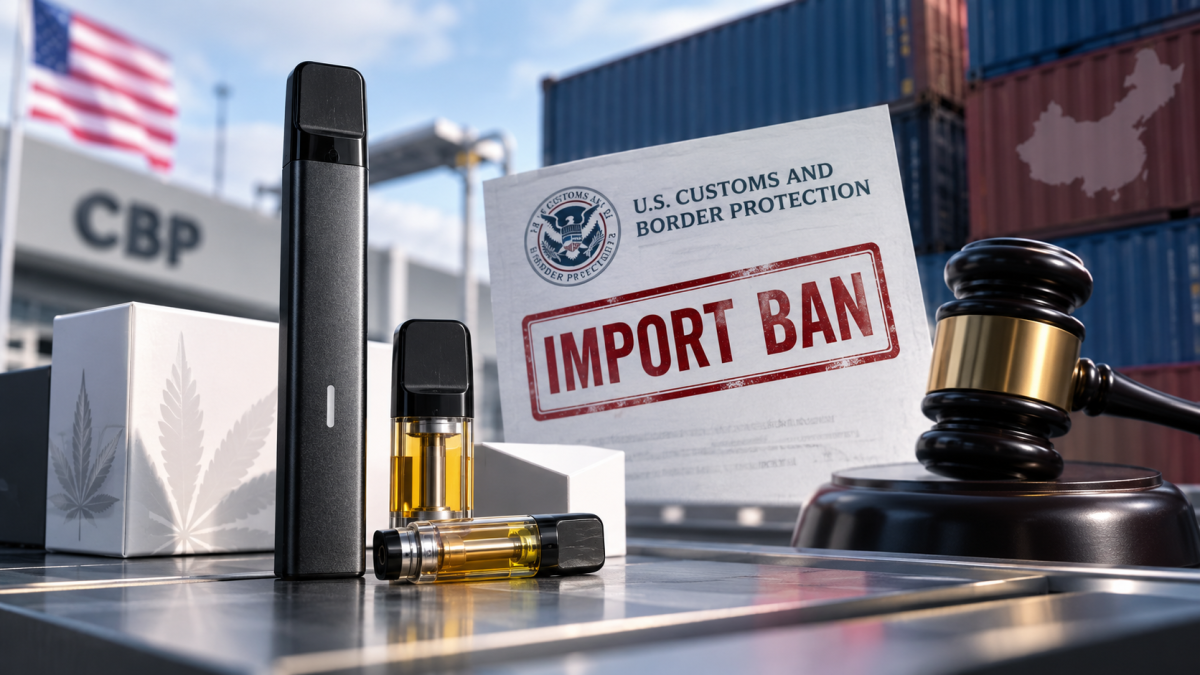
STIIIZY Redesign Fails to Escape PAX Labs Patent Import Ban as Section 337 Case Also Involves China ALD
U.S. Customs and Border Protection ruled that STIIIZY had not shown that the redesigned cannabis-vape products covered by its latest request fall outside an ITC limited exclusion order tied to PAX Labs patents. CBP accepted some of STIIIZY’s claim-construction and non-infringement arguments, but the company did not address two additional claims in the same patent. Earlier STIIIZY redesigned cartridges and certain associated components imported with them had received separate CBP clearance.
Sep.16
FDA Unifies Tobacco Registration and Product Listing Form Across Product Categories
The U.S. FDA has consolidated two tobacco establishment registration and product listing forms into a redesigned Form FDA 3741 covering all regulated product categories, including e-cigarettes, heated tobacco products and nicotine pouches. The current requirements remain limited to domestic establishments. Separately, the FDA has proposed extending registration and product listing requirements to foreign manufacturers, signaling greater regulatory attention to manufacturing entities and product-level information across the tobacco and nicotine supply chain.
FDA
Sep.30
Scottish Vape Display Rules Could Cost Businesses £61 Million, Affecting More Than 11,000 Retail Outlets
A Scottish government impact assessment estimates that proposed vape display and packaging rules could create up to £61 million ($82 million) in compliance costs for businesses, affecting more than 11,000 retail outlets. The estimated costs are mainly linked to inventory adjustments, retail storage changes and the resources required for businesses to understand and implement the new requirements. The measures form part of the UK’s broader efforts to tighten vape regulation, particularly around product displays, packaging and sales practices.
Aug.10