Key Points
- Charlie’s says 30 PACHA products were tentatively identified for a proposed FDA public webpage covering products generally not prioritized for enforcement; the status is not marketing authorization.
- The company says it has tens of thousands of completed age-gated PACHA disposable vapes and a test-market purchase commitment from a major U.S. vape retailer.
- Charlie’s currently reports 678 PMTA-related product assets and plans to pursue regulatory development, partnerships and transactions around the portfolio.
- Reynolds’ rollout of unauthorized Vuse Pro products provides another corporate response to the new enforcement framework, while the FDA is also incorporating those priorities into import enforcement.
2Firsts
September 11, 2026
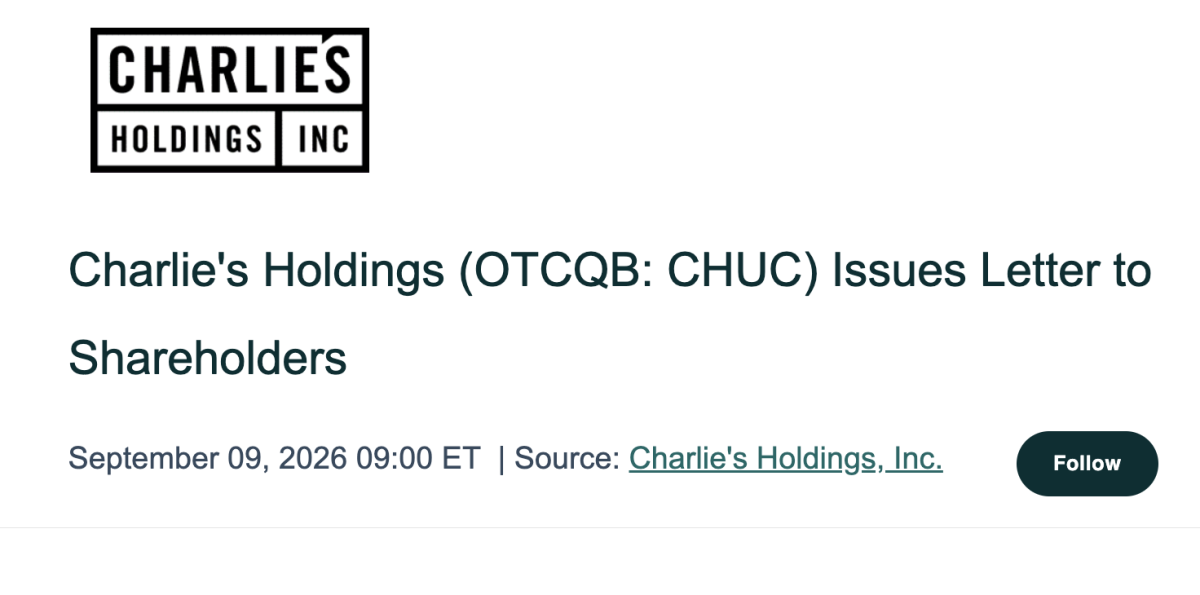
According to a shareholder letter issued by Charlie’s Holdings on September 9, 2026, the company is moving to commercialize PACHA vaping products and develop its remaining PMTA assets, with age-verification technology, test-market sales and partnerships with major tobacco companies forming part of its strategy.
The moves come after the U.S. Food and Drug Administration reset enforcement priorities for certain unauthorized vaping products earlier this year. For Charlie’s, those regulatory changes are beginning to translate into decisions on products, regulatory assets and strategic transactions.
30 PACHA Products Tentatively Identified for Proposed Non-Priority Webpage
Charlie’s said the FDA previously notified the company that 30 PACHA products had been tentatively identified for inclusion on a proposed public webpage.
The webpage would identify certain products for which the FDA generally does not intend to prioritize enforcement of premarket authorization requirements.
Charlie’s has also stated in regulatory filings that such status does not constitute FDA marketing authorization, does not prevent case-by-case enforcement and does not indicate that the underlying PMTAs will ultimately be granted.
The FDA’s May 2026 enforcement guidance established more detailed priorities for certain ENDS and nicotine pouch products marketed without premarket authorization.
Certain products with pending PMTAs that have reached specified stages of review may generally face lower enforcement priority.
For non-tobacco-flavored ENDS, applications must also contain sufficient information for the FDA to assess whether the product meets the applicable public-health standard.
Age-Gated PACHA Products Prepared for Test-Market Sales
Charlie’s is also incorporating age-verification technology into its PACHA commercialization strategy.
The company said it has received tens of thousands of completed age-gated PACHA disposable vaping products and secured a test-market purchase commitment from a major U.S. vape retailer.
Shipments are expected to begin after final testing of the related consumer application is completed.
Charlie’s has previously said it intends to use IKE-related age-gating technology to collect real-world compliance data and supplement certain PACHA PMTAs with age-verification information.
The strategy extends age verification beyond point-of-sale checks into product design, market testing and regulatory submissions.
When the FDA authorized the first non-tobacco, non-menthol flavored Glas ENDS products earlier this year, the devices also incorporated app-based age and identity verification.
Charlie’s has pointed to that development as relevant to its own regulatory and commercialization strategy for flavored ENDS.
678 PMTA Assets Become a Strategic Focus
Charlie’s currently reports 678 PMTA-related product assets.
The company says at least 200 remain in Filing Review without having received marketing denial orders.
The portfolio covers multiple disposable vape formats and e-liquid products across different capacities and configurations.
Charlie’s said in the shareholder letter that it will continue seeking partnerships with large global tobacco companies as it looks to develop and monetize those regulatory assets.
The company has already completed one such transaction.
In 2025, Charlie’s sold 16 PACHA synthetic-nicotine products and related PMTA assets to R.J. Reynolds Vapor Company for $7.5 million in cash, with up to an additional $4.2 million in contingent payments.
The transaction shows that, for a smaller vaping company such as Charlie’s, PMTA assets can serve not only as a route to self-commercialization but also as assets for sale, licensing or strategic partnerships.
FDA Guidance Is Beginning to Shape Corporate Decisions
Charlie’s latest moves provide a corporate example of how the FDA’s enforcement reset is affecting commercial strategy.
For years, the U.S. vaping market was often discussed in binary terms: products with FDA marketing authorization and products without it.
The new guidance does not change the legal status of unauthorized products, but it further distinguishes how the FDA intends to prioritize limited enforcement resources.
That creates a more differentiated operating environment. Certain products with pending PMTAs may face lower enforcement priority, while products without PMTA submissions, counterfeit products, products involving false declarations or those presenting significant youth-appeal concerns remain higher enforcement priorities.
For companies, pending PMTA status, stage of review, age-verification measures and youth-risk controls are increasingly affecting commercial decisions alongside final marketing authorization.
Reynolds Pursues Another Route With Vuse Pro
Large tobacco companies are also taking steps under the changing enforcement environment.
R.J. Reynolds Vapor Company has begun selling Vuse Pro devices and Peach, Berry, Watermelon and Fresh Mint pods in selected U.S. markets.
Those products have not received FDA marketing authorization.
Vuse Pro incorporates age-verification technology, while Reynolds has paired the rollout with ID scanning, purchase limits and retailer compliance measures.
Reynolds submitted a PMTA for the age-gated Vuse Pro platform in 2024.
BAT has also cited U.S. regulatory and enforcement actions in investor materials as a factor supporting growth in its U.S. New Categories business.
Charlie’s and Reynolds differ substantially in scale and resources, but both are advancing commercial strategies involving products without final FDA marketing authorization under the new enforcement-priority framework.
Lower-Priority Treatment Also Means Enforcement Resources Are Being Reordered
When the FDA issued its May guidance, it also said it would continue focusing on products and operators presenting the greatest enforcement concerns, including products without PMTA submissions, counterfeits, false declarations, serious violations and products with substantial youth appeal.
That framework is now entering operational enforcement.
The FDA updated Import Alert 98-07 in September to require field personnel to consider the May 2026 enforcement priorities when deciding whether unauthorized ENDS products should be detained without physical examination.
Where a product may fall within the lower-priority framework, the matter can be referred to the Center for Tobacco Products for further review.
The update shows that the new priorities are moving beyond policy statements and into import enforcement procedures.
For the U.S. vaping market, that creates two simultaneous effects: certain pending products may receive limited enforcement discretion, while the FDA can focus more resources on products outside that framework.
Charlie’s Offers a Corporate Signal of a Changing Regulatory Environment
Charlie’s remains a relatively small vaping company.
It reported second-quarter 2026 revenue of about $3.8 million, up 116% from a year earlier. First-half revenue was about $8.6 million, although the company continued to report operating and continuing-operation losses.
That financial position makes commercialization and monetization of its PMTA portfolio particularly important.
The latest shareholder letter therefore represents more than an optimistic assessment of the regulatory environment.
From reactivating PACHA-related PMTA assets and preparing age-gated test sales to seeking partnerships with large tobacco companies, Charlie’s is converting the FDA’s enforcement changes into specific business actions.
Reynolds’ Vuse Pro rollout provides another corporate example.
U.S. vaping companies are beginning to respond in different ways to the FDA’s new enforcement-priority framework, with regulatory changes now feeding into product launches, compliance technology, PMTA asset strategies and corporate partnerships. The next issue to watch is not only which products receive lower-priority treatment, but whether the FDA increasingly concentrates enforcement on unauthorized products outside that framework.
Follow 2Firsts for timely updates on global tobacco and nicotine industry developments, corporate strategy and market trends.
Cover Image: Charlie’s Holdings
Disclaimer
This article is provided solely for professional research, industry discussion, and informational purposes. Any references to brands, companies, products, technologies, or policies are made for factual reporting and analytical purposes only, and do not constitute endorsement, recommendation, promotion, or advertising by 2Firsts.
Nicotine-containing products, including but not limited to cigarettes, e-cigarettes, heated tobacco products, and nicotine pouches, carry significant health risks. Readers are responsible for complying with all applicable laws and regulations in their respective jurisdictions, including age restrictions and access limitations.
The information contained in this article should not be regarded as investment, legal, medical, regulatory, or commercial advice. While 2Firsts strives to ensure the accuracy and reliability of its content, it does not assume liability for any direct or indirect loss arising from errors, omissions, inaccuracies, or reliance on the information contained herein.
This article is not intended for individuals below the legal age for accessing tobacco or nicotine-related information in their jurisdiction.
Copyright Notice
This article is either original content produced by 2Firsts or content reproduced, translated, summarized, or adapted from third-party sources with attribution where applicable. The intellectual property rights of the original content remain with 2Firsts or the respective original rights holders.
No individual or organization may copy, reproduce, distribute, republish, modify, translate, or otherwise use this content without prior authorization. Any unauthorized use may result in legal action.
For copyright-related inquiries, corrections, or removal requests, please contact: info@2firsts.com.
AI-Assisted Translation and Editing Notice
Portions of this article may have been translated, edited, or reviewed with the assistance of artificial intelligence tools to improve efficiency and readability. Due to the limitations of AI-assisted translation and editing, discrepancies, omissions, or inaccuracies may exist when compared with the original source.
Where applicable, readers are advised to refer to the original source for the most complete and accurate information. If you identify any errors or believe that any content infringes upon your rights, please contact us at info@2firsts.com, and we will review and address the matter promptly.