China's E-Cigarette Exports Decline in Early 2025, U.S. Remains Top Market

Mar.20.2025
China's E-Cigarette Exports Decline in Early 2025, U.S. Remains Top Market
China's e-cigarette exports in January and February 2025 totaled $1.5 billion, down 9.4% from the same period in 2024.

Key points:


1. In January and February 2025, China's e-cigarette exports totaled approximately $1.5 billion, a decrease of 9.4% compared to the same period in 2024. In January, exports were $1.002 billion, a year-on-year decrease of 1.47%; in February, exports were $0.498 billion, a year-on-year decrease of 22.07%.


2. The United States leads with an export value of $5.95 billion, accounting for 39.64% of the total, followed by the United Kingdom at $1.45 billion in second place, and Germany at $1.15 billion in the third place.


2Firsts, reporting from Shenzhen - On March 20th, the General Administration of Customs of the People's Republic of China released the e-cigarette export data for January and February 2025.


It suggested that China's e-cigarette exports totaled approximately $1.5 billion in January and February this year, a 9.4% decrease compared to $1.656 billion during the same period in 2024. 


In January 2025, e-cigarette exports were $1.02 billion, a 1.47% decrease from the previous year, while in February, e-cigarette exports were $498 million, a 22.07% decrease year-on-year.


In January and February 2025, the top ten destination countries for e-cigarette exports from China were the United States, the United Kingdom, Germany, South Korea, Malaysia, the United Arab Emirates, the Netherlands, Canada, Russia, and Japan. 


Among them, the United States ranked first with an export value of approximately $595 million, accounting for 39.64% of the total export value in January and February and holding the top spot in terms of export value. The United Kingdom followed with an export value of $145 million, and Germany came in third with an export value of $115 million.


We welcome news tips, article submissions, interview requests, or comments on this piece.

Please contact us at info@2firsts.com, or reach out to Alan Zhao, CEO of 2Firsts, on LinkedIn


Notice

1.  This article is intended solely for professional research purposes related to industry, technology, and policy. Any references to brands or products are made purely for objective description and do not constitute any form of endorsement, recommendation, or promotion by 2Firsts.

2.  The use of nicotine-containing products — including, but not limited to, cigarettes, e-cigarettes, nicotine pouchand heated tobacco products — carries significant health risks. Users are responsible for complying with all applicable laws and regulations in their respective jurisdictions.

3.  This article is not intended to serve as the basis for any investment decisions or financial advice. 2Firsts assumes no direct or indirect liability for any inaccuracies or errors in the content.

4.  Access to this article is strictly prohibited for individuals below the legal age in their jurisdiction.


Copyright


This article is either an original work created by 2Firsts or a reproduction from third-party sources with proper attribution. All copyrights and usage rights belong to 2Firsts or the original content provider. Unauthorized reproduction, distribution, or any other form of unauthorized use by any individual or organization is strictly prohibited. Violators will be held legally accountable.

For copyright-related inquiries, please contact: info@2firsts.com


AI Assistance Disclaimer


This article may have been enhanced using AI tools to improve translation and editorial efficiency. However, due to technical limitations, inaccuracies may occur. Readers are encouraged to refer to the cited sources for the most accurate information.

We welcome any corrections or feedback. Please contact us at: info@2firsts.com

Australia Adds 6-Methylnicotine to Schedule 9 Prohibited Substances, Effective October 1
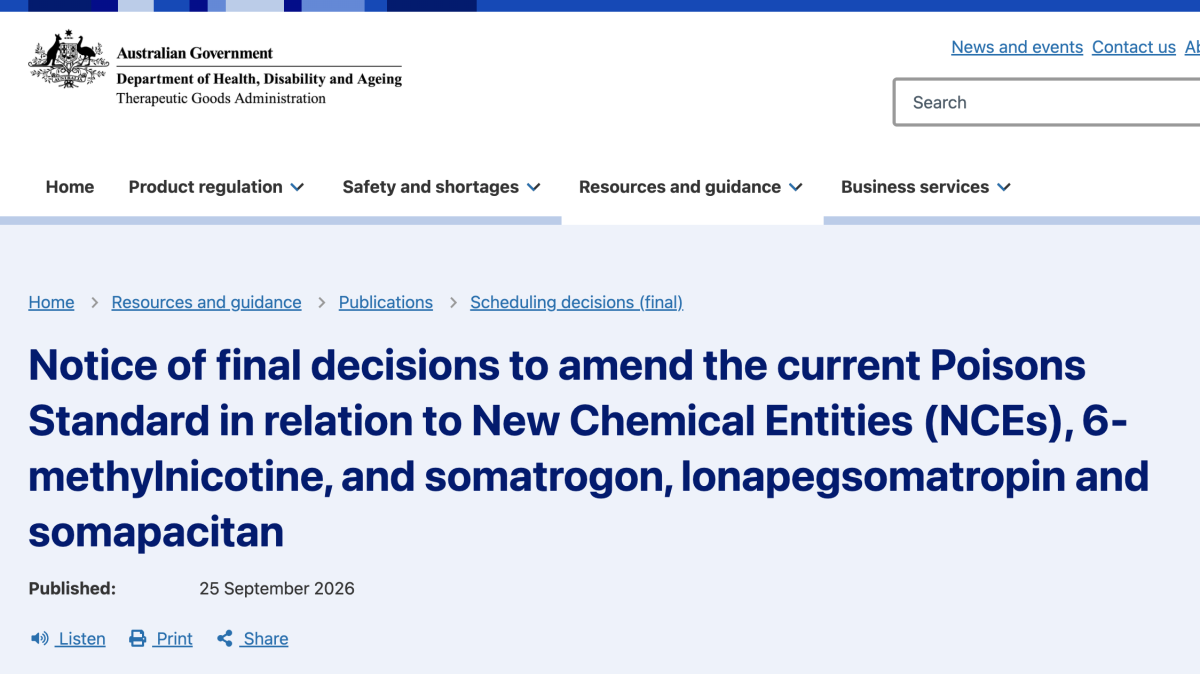
Australia's Therapeutic Goods Administration published a final decision on September 25 to classify 6-methylnicotine as a Schedule 9 prohibited substance under the Poisons Standard, effective October 1, 2026. TGA said the chemical has been reported in e-cigarette liquids sold in Australia and marketed as nicotine-free or nicotine alternatives, while evidence also indicates its use in preparations such as oral pouches. The government originally proposed a Schedule 7 classification but ultimately adopted the stricter Schedule 9 designation, citing acute toxicity, dependence risk, use in unapproved consumer products and misleading marketing.
News
Sep.29 by 2Firsts Perspectives
India Duty-Free Nicotine Pouch Sales Face Regulatory Test as ZYN, FOX Classification Remains Open
The Bombay High Court has ruled that airport duty-free shops are not exempt from India's domestic regulatory laws merely because they operate beyond the customs barrier, leaving in place a sales halt covering ZYN and FOX nicotine pouches at Mumbai's international airport. The court, however, did not determine that the products necessarily qualify as "drugs" under India's Drugs and Cosmetics Act. The retailers have four weeks to submit product information to the appropriate authorities, including CDSCO, which must complete its review within 30 days of receiving the submissions.
Sep.24
South Korea Extends Vape Rules to Unmanned Stores After Bringing Synthetic Nicotine Under Tobacco Law
South Korea's Ministry of Gender Equality and Family said on September 14 that it plans to designate unmanned e-cigarette stores as businesses where minors are prohibited from entering or working. Operators would be required to verify customers' ages and display notices restricting access by minors. The proposal is open for public comment through October 6. The move follows an April expansion of South Korea's statutory tobacco definition that brought products made with natural or synthetic nicotine under the Tobacco Business Act. Nicotine-free liquids and products using nicotine analogues such as 6-methylnicotine, however, remain an emerging regulatory issue.
Sep.21
Ireland Raises Nicotine Product Taxes Again as Cigarettes Gain €1 and Vape Duty Is Set to Jump 40%
Ireland has increased tobacco excise under Budget 2027 and announced a further rise in its E-liquid Products Tax. From Oct. 7, the tax burden on a pack of 20 cigarettes in the most popular price category increased by €1, with pro-rata increases on other tobacco products. The government plans to raise EPT from €0.50 to €0.70 per millilitre from Jan. 1, 2027, a 40% increase applying to both nicotine-containing and nicotine-free e-liquids. The tobacco duty increase is expected to raise about €63.1 million in a full year.
Regulations
Oct.09
Wisconsin Vape Directory One Year On: Retailer Reports Four Store Closures and 70% Staff Cuts
Wisconsin's electronic vaping device directory has been fully enforced for more than a year, and local vape retailers say the reduced range of eligible products has contributed to declining sales, store closures and layoffs. Johnny Vapes owner Ben Hall said he has closed four of seven locations and cut about 70% of his staff. State law bars the sale of vaping devices not listed on the Wisconsin Department of Revenue directory and allows penalties of $1,000 per day for each unlisted device sold or offered for sale. In April 2026, the U.S. Court of Appeals for the Seventh Circuit allowed enforcement of the law to continue.
Regulations
Oct.10
Latest UK ONS Data: Vaping Rate Edges Down to 9.9% in 2025, a Year After Overtaking Cigarette Smoking
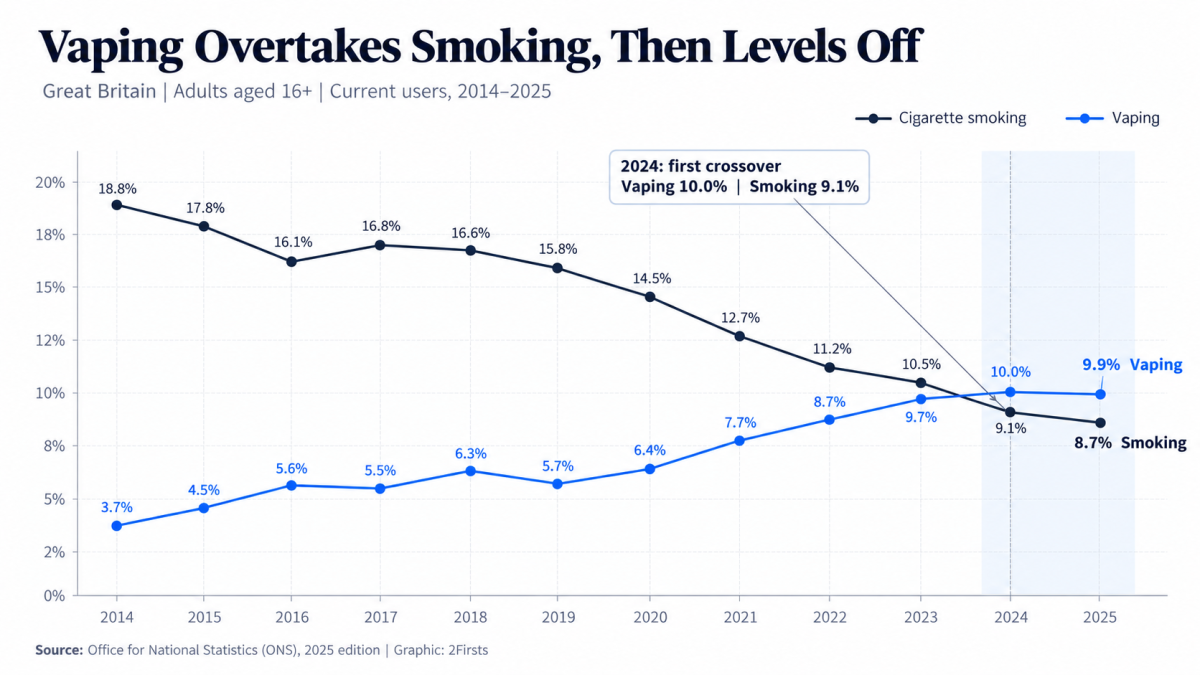
Vaping prevalence in Great Britain edged down to 9.9% in 2025 from 10.0% in 2024, with the number of adult users holding at approximately 5.4 million for a second consecutive year, according to the Office for National Statistics (ONS). E-cigarette use had risen from 6.4% in 2020 to 10.0% in 2024, when it exceeded cigarette smoking prevalence for the first time. Cigarette smoking continued to decline to 8.7% in 2025, widening the gap to 1.2 percentage points. Daily vaping declined slightly, while usage among adults aged 25–34 increased despite falling rates in other age groups.
DATA
Oct.14