Key Points:
Largest Seizure in History
·The U.S. Department of Justice, along with the FDA, the U.S. Marshals Service, and other agencies.
·One of the distributors raided was the Midwest Goods warehouse in Bensenville, Illinois, where more than 600,000 products worth over $14 million were seized.
·The seizure of millions of dollars worth of illegal e-cigarette products is the largest federal law enforcement operation to date.
Targeting the Youth Market
·Attorney General Bondi criticized the products for using flavored packaging to specifically attract teenagers.
·The FDA Commissioner emphasized the need to mobilize schools, families, and communities to combat the youth e-cigarette epidemic.
Industry Shock
·Industry representatives warned that the move could "uproot" a large number of small and medium-sized retailers and mom-and-pop shops.
·The Vapor Technology Association stated that cracking down on distributors would impact the entire supply chain.
Midwest Goods' Response
·The company stated that most of its products are American-made e-liquids that have been submitted for PMTAs (pre-market approval applications), but the FDA has long awaited their review.
·Midwest Goods accused the FDA of being more lenient with "Big Tobacco" and unfair to small and medium-sized businesses.
·Midwest Goods stated that it will continue to cooperate with the investigation and reserves the right to pursue legal action.
Policy Background
·This operation is related to the Trump administration's recent focus on regulating Chicago.
·It reflects the United States' tougher regulation of e-cigarettes amidst the issue of youth tobacco control.
2Firsts, September 11th - On September 10th local time, the U.S. Food and Drug Administration (FDA) and Customs and Border Protection (CBP) jointly announced that during a week-long enforcement operation in Chicago, over 4 million unauthorized e-cigarette products were seized, with an estimated retail value of over $86 million (approximately RMB 627 million). Officials stated that this was the largest e-cigarette seizure in the United States to date. (Related: Largest E-cigarette Seizure in U.S. History: 4.7 Million Illegal E-Cigarettes Seized, Retail Value Approximately RMB 627 Million)
According to Chicago media reports, some of the products were seized at the warehouse of e-cigarette distributor Midwest Goods in Bensenville, Illinois.In response, Midwest Goods issued a statement stating that its products, mostly bottled e-liquids made in the United States, had submitted a PMTA (Premarket Application) for their products, but the FDA had long pending review. The company accused the FDA of being lenient toward "Big Tobacco" and unfair to small and medium-sized businesses, and stated that it would continue to cooperate with the investigation and reserve the right to pursue legal action.
The following is the original report:
The U.S. Department of Justice (DOJ) raided an e-cigarette distribution warehouse on Wednesday, seizing thousands of items the DOJ deemed illegal. This was part of a multistate raid.
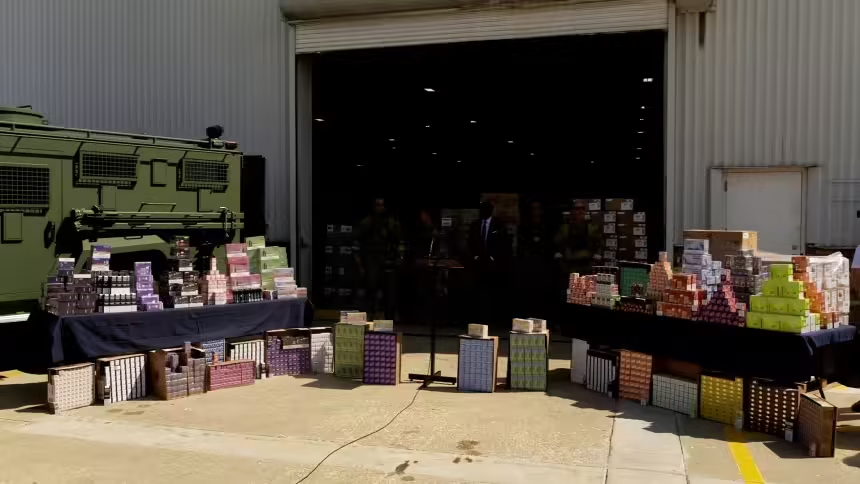
The investigation began months ago, and on Wednesday morning, a multi-agency raid on a Midwest Goods warehouse in Bensenville resulted in the seizure of millions of dollars worth of illegal e-cigarettes and related products(According to other media reports, more than 600,000 e-cigarette products valued at over $14 million were seized at the warehouse).
U.S. Attorney General Pam Bondi and Health and Human Services Secretary Robert F. Kennedy Jr. visited the Chicago area and spoke at a press conference about the raid. This was an early morning raid unrelated to ICE and Operation Midway Blitz.
Federal agents on the scene were dressed in U.S. Marshals uniforms and even deployed an armored vehicle.
The Justice Department displayed what it called "dangerous" e-cigarette products, many of which were flavored. Bondi said the products were illegal and marketed to young people.
The five-state operation was the largest seizure in the agency's history.
"We can't let this youth vaping epidemic continue and do nothing. We must educate houses of worship, school districts, parents, and teachers—we need everyone's help," said FDA Commissioner Marty Makary.
The raid took place as Chicago became a focus of the Trump administration's crackdown for three consecutive weeks, prompting many community members to gather and observe.
Heavily armed U.S. Marshals were seen entering and exiting the warehouse.
The companies involved later issued a statement saying, "While these premarket applications were under review, the FDA has allowed most, if not all, of these products to enter the market... Midwest will continue to cooperate with federal authorities and, if necessary, pursue legal action to defend our rights."
Bondy emphasized, "This is a clear message to retailers and distributors who are peddling illegal e-cigarette products to children and families: Today is the end. This is your final warning."
Industry representatives said Wednesday's incident could severely damage the entire e-cigarette industry. Tony Abboud of the Vapor Technology Association said, "When you target distributors, it means all the small mom-and-pop stores that rely on them will be forced to close."
This is a civil seizure, but Bondy noted that criminal charges could be filed as the investigation progresses.
Kennedy Jr. said, "They are making products that are too dangerous to sell to their own citizens, yet they are dumping them into our country."
Midwest Distribution (also known as Midwest Goods) describes itself as a wholesale distributor of e-cigarettes and vaping products to herb shops and retail stores. Its website lists 24 brands. The company is registered with the Illinois Secretary of State's office.
Midwest Goods' full statement:
"This morning, the U.S. Food and Drug Administration (FDA) and the U.S. Marshals Service executed a civil seizure order at our facility. Midwest is fully cooperating with the authorities in this court-authorized action."
The majority of the products affected by the seizure order are bottled e-liquids from over 75 brands for use in refillable, open-top vaping devices. These e-liquids are manufactured by American companies employing hundreds, if not thousands, of American workers. We understand that many of these products have already submitted Premarket Tobacco Product Applications (PMTAs), but the FDA has been waiting for years to review them. The law requires the FDA to make a decision within 180 days, but these applications have been pending for more than five years since the original deadline of September 9, 2020. Until then, the FDA has allowed these products to continue to be sold. These less harmful products have contributed to the historic lows in smoking rates in the United States. Furthermore, according to the CDC's 2023 National Youth Tobacco Survey, less than 6% of youth e-cigarette users use devices that work with bottled e-liquids."
Midwest We have been diligently cooperating with the FDA. Following a routine FDA inspection in August of this year, we removed some of the products of concern from our catalog and inventory, and have proactively offered to remove other products if the FDA has concerns. However, the FDA has not required us to stop selling any other products.
We find the FDA's action particularly puzzling given reports earlier this week that the FDA plans to expedite its review of some major tobacco company products within a few months, even after the products seized from our warehouses. Furthermore, there are reports that major tobacco companies are actively promoting disposable e-cigarettes without premarket authorization. Despite this, Midwest will continue to cooperate with federal authorities and, if necessary, pursue legal action to defend our rights.
We welcome news tips, article submissions, interview requests, or comments on this piece.
Please contact us at info@2firsts.com, or reach out to Alan Zhao, CEO of 2Firsts, on LinkedIn
Notice
1. This article is intended solely for professional research purposes related to industry, technology, and policy. Any references to brands or products are made purely for objective description and do not constitute any form of endorsement, recommendation, or promotion by 2Firsts.
2. The use of nicotine-containing products — including, but not limited to, cigarettes, e-cigarettes, nicotine pouchand heated tobacco products — carries significant health risks. Users are responsible for complying with all applicable laws and regulations in their respective jurisdictions.
3. This article is not intended to serve as the basis for any investment decisions or financial advice. 2Firsts assumes no direct or indirect liability for any inaccuracies or errors in the content.
4. Access to this article is strictly prohibited for individuals below the legal age in their jurisdiction.
Copyright
This article is either an original work created by 2Firsts or a reproduction from third-party sources with proper attribution. All copyrights and usage rights belong to 2Firsts or the original content provider. Unauthorized reproduction, distribution, or any other form of unauthorized use by any individual or organization is strictly prohibited. Violators will be held legally accountable.
For copyright-related inquiries, please contact: info@2firsts.com
AI Assistance Disclaimer
This article may have been enhanced using AI tools to improve translation and editorial efficiency. However, due to technical limitations, inaccuracies may occur. Readers are encouraged to refer to the cited sources for the most accurate information.
We welcome any corrections or feedback. Please contact us at: info@2firsts.com