Columbus City Council votes on flavored tobacco ban

Dec.12.2022
Columbus City Council votes on flavored tobacco ban
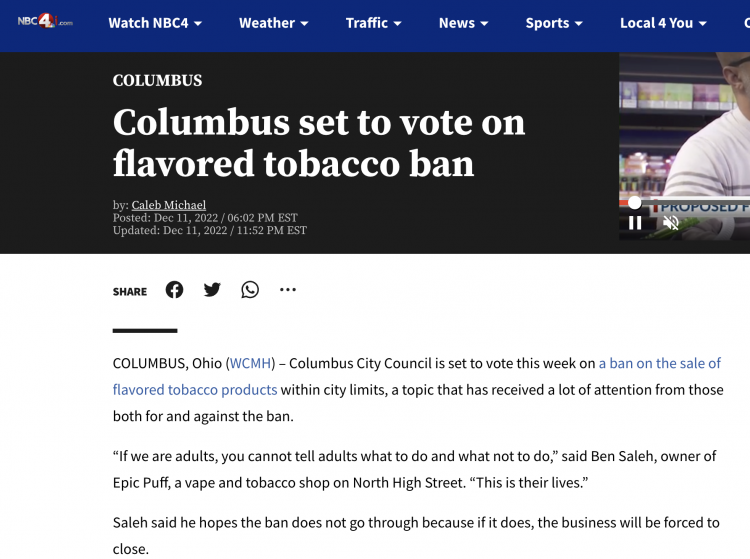
Columbus Council to vote on ban of flavored tobacco sales; supporters and opponents weigh in on the issue.

The Columbus City Council will vote this week on a ban of flavored tobacco products within city limits, a topic of significant interest for both proponents and opponents of the ban.


If we are adults, you cannot tell adults what to do or not to do," said Ben Saleh, owner of Epic Puff, a tobacco and e-cigarette shop on North Street. "This is their life.


Salih expressed his hope that the ban would not be approved, as it would lead to the forced closure of businesses.


Epic Puff opened in October. Shortly thereafter, Saleh stated that he became aware of the proposed ban.


Columbus restricted firearms and items to the liquor license.


According to Saleh, if flavored tobacco products are taken off the shelves, 80% of the store's sales will disappear. If this happens, he and other small business owners will continue to protest.


We will gather together and may consider a class-action lawsuit," he said. "Consider that if I lost $200,000 in just my investment, not to mention the landlord fees of around $200,000 for the remaining lease, imagine everyone else. We're talking about millions of people here.


2FIRSTS will continue to provide updates on this issue, which will be available on the '2FIRSTSAPP'. Scan the QR code below to download the app.


Disclaimer

This article is provided solely for professional research, industry discussion, and informational purposes. Any references to brands, companies, products, technologies, or policies are made for factual reporting and analytical purposes only, and do not constitute endorsement, recommendation, promotion, or advertising by 2Firsts.

Nicotine-containing products, including but not limited to cigarettes, e-cigarettes, heated tobacco products, and nicotine pouches, carry significant health risks. Readers are responsible for complying with all applicable laws and regulations in their respective jurisdictions, including age restrictions and access limitations.

The information contained in this article should not be regarded as investment, legal, medical, regulatory, or commercial advice. While 2Firsts strives to ensure the accuracy and reliability of its content, it does not assume liability for any direct or indirect loss arising from errors, omissions, inaccuracies, or reliance on the information contained herein.

This article is not intended for individuals below the legal age for accessing tobacco or nicotine-related information in their jurisdiction.


Copyright Notice

This article is either original content produced by 2Firsts or content reproduced, translated, summarized, or adapted from third-party sources with attribution where applicable. The intellectual property rights of the original content remain with 2Firsts or the respective original rights holders.

No individual or organization may copy, reproduce, distribute, republish, modify, translate, or otherwise use this content without prior authorization. Any unauthorized use may result in legal action.

For copyright-related inquiries, corrections, or removal requests, please contact: info@2firsts.com.


AI-Assisted Translation and Editing Notice

Portions of this article may have been translated, edited, or reviewed with the assistance of artificial intelligence tools to improve efficiency and readability. Due to the limitations of AI-assisted translation and editing, discrepancies, omissions, or inaccuracies may exist when compared with the original source.

Where applicable, readers are advised to refer to the original source for the most complete and accurate information. If you identify any errors or believe that any content infringes upon your rights, please contact us at info@2firsts.com, and we will review and address the matter promptly.

FDA Grants PMTA Authorization to 11 ZYN ULTRA Nicotine Pouches, Bringing Total Authorized Pouches to 43
The U.S. Food and Drug Administration authorized 11 ZYN ULTRA nicotine pouch products made by Swedish Match USA through the premarket tobacco product application pathway on August 21, 2026. Ten of the authorized products have a labeled nicotine content of 9 mg, while ZYN ULTRA Smooth was authorized at 11 mg. The reviews were conducted through FDA’s nicotine pouch PMTA pilot program. FDA has now authorized 43 nicotine pouch products, including 23 through the pilot.
Aug.24
Charlie’s Says 30 PACHA Vape SKUs Tentatively Identified for FDA’s Non-Priority Enforcement Public List
Charlie’s Holdings said the U.S. Food and Drug Administration notified the company on June 23, 2026, that 30 PACHA vape SKUs with submitted PMTAs had been tentatively identified for inclusion on a planned public-facing FDA webpage. Under enforcement guidance issued by FDA in May, the webpage is intended to identify certain unauthorized products for which the agency generally does not intend to prioritize enforcement of premarket authorization requirements. Charlie’s disclosed the development alongside second-quarter revenue of $3.8 million, up 116% year over year.
Aug.25
Malaysia’s Vape Rules Face Review as Health Minister Dzulkefly Ahmad Addresses Dropped Nicotine Appeal
According to Free Malaysia Today on August 26, 2026, Malaysia’s Health Minister Dzulkefly Ahmad said the Health Ministry would explain the government’s decision to withdraw its appeal against a High Court ruling involving the exemption of liquid nicotine used in vape products from the Poisons List. The High Court previously ruled that the exemption decision was irrational. Dzulkefly said withdrawing the appeal did not mean the government would stop regulating vaping, and that future regulatory approaches would continue under existing legal frameworks.
Aug.28
JUUL2 Sued Within a Week of FDA Authorization as AJ Marketing Alleges Infringement of Programmable Vape Patent
Less than a week after JUUL2 received U.S. FDA marketing authorization on August 28, 2026, JUUL Labs was sued for patent infringement in federal court in Delaware. AJ Marketing LLC filed the complaint on September 3, alleging that both JUUL 1 and JUUL2 infringe U.S. Patent No. 8,851,068 B2. The patent covers aspects of programmable electronic vaporization devices, including controls over dose delivery, usage frequency and operating parameters. The plaintiff is seeking reasonable royalties and ongoing royalties tied to the remaining life of the patent. JUUL has not yet publicly responded to the case.
Sep.10
Juul Sublicense Reshapes Vuse Alto Patent Bill as Court Ends R.J. Reynolds’ 5.25% Royalty Obligation to Altria
According to Law360 on August 31, 2026, a federal judge in North Carolina ruled that a patent sublicense between R.J. Reynolds Vapor Co. and Juul Labs Inc. relieves Reynolds of its obligation to continue paying royalties to Altria Client Services LLC over Vuse Alto. A jury had previously found that Vuse Alto infringed three Altria patents and awarded approximately $95.2 million in past damages, after which Reynolds was ordered to pay an ongoing royalty equal to 5.25% of positive net sales. The new ruling finds that a valid sublicense can eliminate future infringement, potentially ending what Altria described as hundreds of millions of dollars in future royalties.
Sep.01
Australia’s One Nation Proposes 75% Tobacco Tax Cut, Says Lower Prices Could Hit Illicit Market
Australia’s One Nation party has proposed cutting tobacco excise by 75%, arguing that lower legal cigarette prices could narrow the gap with illicit tobacco and reduce demand for black-market products. The proposal comes as Australia continues expanding enforcement against illicit tobacco supply chains through border controls, retail inspections and organised-crime investigations. Supporters argue high taxes have contributed to illicit-market growth, while opponents warn that lower tobacco prices could undermine public-health goals. The proposal is a party policy position and has not been adopted by the Australian government.
Aug.18