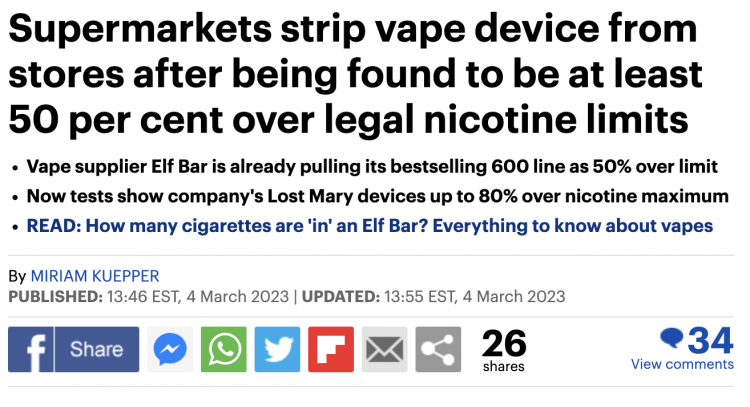
According to reports from the Daily Mail and Mirror, on the evening of March 4th, ELFBAR's product LOSTMARY was found to contain over 50% more nicotine than the legal limit in the UK. This marks the second time this year that ELFBAR has exceeded the allowable nicotine levels in the UK.
According to a report, further testing on five BM600 dual apple-flavoured electronic cigarettes purchased from Sainsbury's supermarket revealed that they contain an average of 3.6ml of e-liquid. Meanwhile, five identical watermelon ice-flavoured e-cigarettes purchased from Asda were found to contain an average of 3.2ml of e-liquid.
According to a test conducted by the Daily Mail, some BM600 products contain nicotine levels exceeding the maximum permissible limit of 80%. The Daily Mail further explains that the reason for the exceeding nicotine levels is due to the e-cigarette liquid containing 3.6ml (the legal limit being 2ml). However, the Daily Mail did not indicate whether the nicotine concentration exceeded the legal standard of 2%.
UK supermarket chains Sainsbury's and Asda have announced that they will be removing the LOST MARY BM600 product from their shelves after receiving test results.
According to reports, electronic cigarette manufacturers are required to register detailed information about their products (such as nicotine content) with the Medicines and Healthcare products Regulatory Agency (MHRA) before they can be sold in the UK. However, the MHRA does not conduct any testing on electronic cigarettes during the product registration process.
The MHRA will only take action upon receiving a product violation alert, such as exceeding regulatory limits on nicotine content.
Professor Andrew Bush, a pediatric specialist from Imperial College London, expressed shock and concern over the findings, stating, "This is absolutely shocking. If the media is needed to expose such significant misconduct, then what is the role of our regulatory systems?" in an interview with The Daily Mail.
Andrew Bush stated, "There is an urgent need for compliance checks to be conducted when manufacturers register e-cigarettes, with further spot checks conducted after e-cigarettes are released to ensure companies are following the law.
Chris Allen, CEO of the Brouton Laboratory conducting the tests, has called for regulatory authorities to swiftly address the issue. He has urged them to take strong actions such as removing the products that exceed the limits, conducting product testing, and disposing of non-compliant products.
The Daily Mail reported that they reached out to ELFBAR for comments on LOST MARY product testing but did not receive a response.
2FIRSTS will continue to monitor the situation and conduct interviews with ELFBAR, MHRA, and other related organizations. Stay tuned for updates.
Related Reading: "ELFBAR 600 Product Removal" Special Topic Summary
Reference:
Supermarkets have removed a specific type of vape device from their stores following discovery that it contained at least 50% more nicotine than is legal.
Two major supermarkets have removed another vaping product from their shelves due to concerns about its safety.
Disclaimer
This article is provided solely for professional research, industry discussion, and informational purposes. Any references to brands, companies, products, technologies, or policies are made for factual reporting and analytical purposes only, and do not constitute endorsement, recommendation, promotion, or advertising by 2Firsts.
Nicotine-containing products, including but not limited to cigarettes, e-cigarettes, heated tobacco products, and nicotine pouches, carry significant health risks. Readers are responsible for complying with all applicable laws and regulations in their respective jurisdictions, including age restrictions and access limitations.
The information contained in this article should not be regarded as investment, legal, medical, regulatory, or commercial advice. While 2Firsts strives to ensure the accuracy and reliability of its content, it does not assume liability for any direct or indirect loss arising from errors, omissions, inaccuracies, or reliance on the information contained herein.
This article is not intended for individuals below the legal age for accessing tobacco or nicotine-related information in their jurisdiction.
Copyright Notice
This article is either original content produced by 2Firsts or content reproduced, translated, summarized, or adapted from third-party sources with attribution where applicable. The intellectual property rights of the original content remain with 2Firsts or the respective original rights holders.
No individual or organization may copy, reproduce, distribute, republish, modify, translate, or otherwise use this content without prior authorization. Any unauthorized use may result in legal action.
For copyright-related inquiries, corrections, or removal requests, please contact: info@2firsts.com.
AI-Assisted Translation and Editing Notice
Portions of this article may have been translated, edited, or reviewed with the assistance of artificial intelligence tools to improve efficiency and readability. Due to the limitations of AI-assisted translation and editing, discrepancies, omissions, or inaccuracies may exist when compared with the original source.
Where applicable, readers are advised to refer to the original source for the most complete and accurate information. If you identify any errors or believe that any content infringes upon your rights, please contact us at info@2firsts.com, and we will review and address the matter promptly.