
Key Points
● Revision launched: The European Commission has opened an online call for evidence, marking a new phase in the review of EU tobacco products and tobacco advertising rules, including the TPD and TAD.
● Policy scope: The Commission’s options include expanding rules to novel products, possible flavour rules, stronger labelling and packaging requirements, and tighter digital marketing and advertising rules.
● Rapid feedback: A 2Firsts review of 855 early entries found 434 submissions were logged between 09:00 and 12:06 Brussels time on May 21, showing rapid early engagement.
● Key disputes: Recurring themes include differentiated regulation, adult smoker choice, tobacco harm reduction, illicit trade, youth protection and economic impact.
● Next steps: The current call for evidence runs until June 15, 2026, followed by a planned 12-week public consultation and Commission adoption expected in the fourth quarter of 2026.
2Firsts
May 21 2026
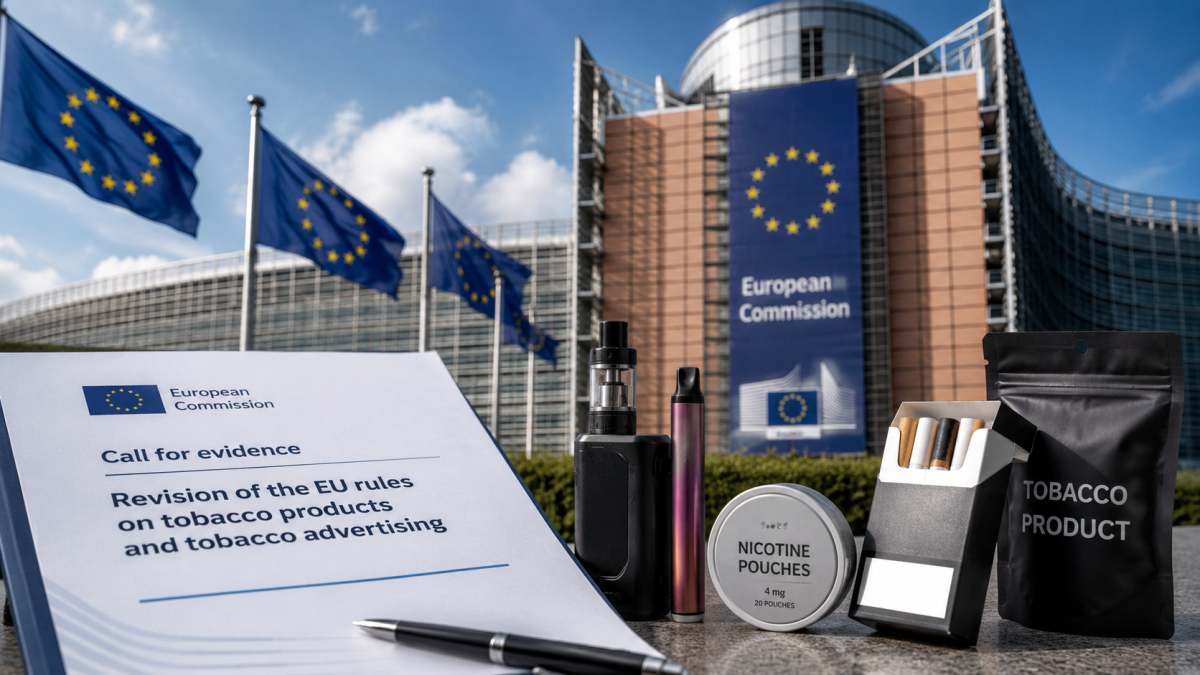
The European Commission has opened an online call for evidence on the revision of EU tobacco products and tobacco advertising rules, moving the review of the Tobacco Products Directive and the Tobacco Advertising Directive into a new phase that could shape future rules on flavours, disposable e-cigarettes, nicotine pouches, packaging and digital marketing.
The call for evidence document outlines options that could expand the scope of EU rules to novel products and tighten requirements on flavours, labelling, packaging, digital marketing and advertising, while stressing that the options remain part of an impact assessment rather than a final proposal.
The feedback period runs from May 18 to June 15, 2026. A public consultation is planned for the second quarter of 2026, while Commission adoption is planned for the fourth quarter of the year, according to the Commission’s initiative page. The initiative is listed as a proposal for a directive under the public health policy area.

Feedback Data Shows Rapid Early Engagement
A 2Firsts review of 855 feedback entries downloaded from the Commission’s “Have Your Say” portal shows rapid early engagement with the consultation. The entries were recorded between May 18 and May 21, with a sharp increase on May 21, when 434 submissions were logged between 09:00 and 12:06 Brussels time. Responses were concentrated in several member states: Spain accounted for 222 entries, followed by Poland with 159 and the Netherlands with 88. Most submissions were filed by EU citizens.
A keyword-based review and manual reading of selected entries suggest several recurring lines of argument:
● Differentiated regulation: Some submitters argued that combustible tobacco and non-combustible nicotine products should not be treated alike, citing differences between cigarettes, e-cigarettes, heated tobacco products and nicotine pouches.
● Adult smoker access and harm reduction: Several comments framed newer nicotine products as alternatives for adult smokers and warned that broad restrictions could reduce the attractiveness or availability of those alternatives.
● Flavours and product appeal: Flavour restrictions were a recurring concern, with some submitters arguing that flavours play a role in switching away from cigarettes, while regulators may view them through the lens of youth appeal.
● Illicit trade and enforcement: Some comments warned that stricter limits on flavours or product categories could shift demand toward unregulated channels, raising concerns over age checks, product standards and enforcement.
● Youth protection: A number of comments accepted the need to prevent youth access, but argued that enforcement, age verification and controls on illegal sales should be prioritised over broad product bans.
● Economic and regional impact: Some entries raised concerns about specialist vape shops, tobacconists, small businesses and tobacco-growing regions that may be affected by future EU rules.
As the feedback deadline is still some weeks away, the figures and views above should be read as an early snapshot of participation rather than as a measure of overall public opinion.
Commission Seeks Evidence Before Legislative Proposal
The call for evidence is part of the Commission’s impact assessment process. The Commission said the exercise is intended to gather views from the public and stakeholders on its understanding of the problems, possible solutions and potential impacts of different options.
The initiative is led by the Commission’s Directorate-General for Health and Food Safety, DG SANTE, and is described as a likely legislative initiative, with an indicative timetable of December 2026. The document says it does not prejudge whether the initiative will be pursued or what its final content may be, and that all elements, including timing, remain subject to change.
The document cites Article 114 of the Treaty on the Functioning of the European Union as the legal basis. Article 114 is commonly used to harmonise national rules and ensure the functioning of the EU internal market. The Commission said divergent national rules on tobacco and related products may affect product circulation and competition, making EU-level coordination necessary.
Spain’s 2025 draft rules on vape flavours and nicotine pouches had already raised concerns over the EU single market. 2Firsts previously reported that Spain planned to ban all non-tobacco vape flavours, cap nicotine pouches at 0.99 mg per pouch and introduce stricter plain packaging requirements. After Spain notified the draft through the Commission’s TRIS system in January 2025, the Commission and several member states, including Italy, Sweden, Greece, Romania, Hungary, Czechia and Croatia, raised objections, arguing that the measures could affect the free movement of goods and test the integrity of the EU single market.
New Products, Flavours and Digital Marketing Drive the Review
The Commission said the initiative aims to update EU tobacco control rules in response to recent market developments, consumption trends and digital marketing practices. Its stated goals are to improve the functioning of the internal market, strengthen public health protection and ensure continued implementation of the World Health Organization Framework Convention on Tobacco Control, in line with Europe’s Beating Cancer Plan.
The call for evidence document also links the review to Europe’s Beating Cancer Plan and the Safe Hearts Plan, saying both emphasise tobacco control as part of disease prevention. It says the revision would support the EU objective of a tobacco-free generation by 2040.
The Commission identified market fragmentation as one of the problems the initiative aims to address. It cited divergent national rules on flavours in e-cigarettes, plain packaging, disposable e-cigarettes, tobacco heating devices, nicotine products other than e-cigarettes and refill containers, including nicotine pouches, and electronic non-nicotine delivery systems. Such divergence, it said, creates barriers to the internal market and distorts competition.
The document also points to public health risks linked to novel products. It says several such products, including nicotine pouches and heated herbal products, are currently not covered by the existing directives, while the directives lack the flexibility to address rapid product developments. It also says products that attract young people through flavours and colourful packaging may pose risks of initiation into nicotine addiction and tobacco use.
Digital marketing is another focus of the review. The Commission said novel products are increasingly promoted through digital channels, especially social media, often by influencers. It said targeted online promotion has been shown to increase uptake, particularly among young people, and that the existing directives were not designed to address the scale and nature of today’s digital marketing practices.
Options Remain Subject to Impact Assessment
The Commission said it will develop policy options around further requirements for products already covered by the directives, an expanded scope for novel products, and more flexibility to respond to rapid product developments.
The options include:
● possible rules on flavours across the product categories identified in the document;
● stronger labelling and packaging requirements, including plain packaging;
● tighter digital marketing and advertising rules; and
● simplification of certain provisions to reduce complexity and resource intensity.
The Commission said the impact assessment will examine economic effects on operators, as well as social and health impacts, including the cost of inaction for national budgets and public health systems. It also said the revision is expected to affect consumption, consumer choice and public health positively, particularly for young people.
Revision Process Follows 2026 Evaluation Report
The call for evidence follows the Commission’s 2026 evaluation of the EU tobacco control framework. 2Firsts previously reportedthat the evaluation found EU smoking rates had fallen from 28% to 24% since 2012, while tobacco-related deaths had also declined significantly.
The same evaluation identified e-cigarettes, heated tobacco products and nicotine pouches as emerging public health concerns, particularly in relation to younger users, product attractiveness and online promotion. The call for evidence document says the evaluation also found that smoking prevalence in the EU remains high, particularly among young people, and that recent market developments, consumption trends and digital marketing practices need to be addressed.
In addition to the current four-week call for evidence, the Commission plans to launch a 12-week public consultation. The former is intended to gather early input on the problem definition, possible policy directions and potential impacts as part of the impact assessment process, while the latter will be a broader and more structured consultation targeting citizens, businesses, representative organisations, EU countries’ public authorities, academics, researchers and non-governmental organisations.
2Firsts will continue to monitor the feedback process, the planned public consultation and further developments in the EU’s review of tobacco products and tobacco advertising rules.
(Cover image generated by AI.)

Disclaimer
This article is provided solely for professional research, industry discussion, and informational purposes. Any references to brands, companies, products, technologies, or policies are made for factual reporting and analytical purposes only, and do not constitute endorsement, recommendation, promotion, or advertising by 2Firsts.
Nicotine-containing products, including but not limited to cigarettes, e-cigarettes, heated tobacco products, and nicotine pouches, carry significant health risks. Readers are responsible for complying with all applicable laws and regulations in their respective jurisdictions, including age restrictions and access limitations.
The information contained in this article should not be regarded as investment, legal, medical, regulatory, or commercial advice. While 2Firsts strives to ensure the accuracy and reliability of its content, it does not assume liability for any direct or indirect loss arising from errors, omissions, inaccuracies, or reliance on the information contained herein.
This article is not intended for individuals below the legal age for accessing tobacco or nicotine-related information in their jurisdiction.
Copyright Notice
This article is either original content produced by 2Firsts or content reproduced, translated, summarized, or adapted from third-party sources with attribution where applicable. The intellectual property rights of the original content remain with 2Firsts or the respective original rights holders.
No individual or organization may copy, reproduce, distribute, republish, modify, translate, or otherwise use this content without prior authorization. Any unauthorized use may result in legal action.
For copyright-related inquiries, corrections, or removal requests, please contact: info@2firsts.com.
AI-Assisted Translation and Editing Notice
Portions of this article may have been translated, edited, or reviewed with the assistance of artificial intelligence tools to improve efficiency and readability. Due to the limitations of AI-assisted translation and editing, discrepancies, omissions, or inaccuracies may exist when compared with the original source.
Where applicable, readers are advised to refer to the original source for the most complete and accurate information. If you identify any errors or believe that any content infringes upon your rights, please contact us at info@2firsts.com, and we will review and address the matter promptly.



