Key Points
- FDA granted MRTP orders for 20 ZYN nicotine pouch products.
- The products were previously authorized through PMTA in January 2025.
- The orders allow one specific lower-risk marketing claim.
- The authorization lasts five years and requires postmarket surveillance.
2Firsts
July 1, 2026
The U.S. Food and Drug Administration (FDA) announced that it has issued modified risk granted orders to Swedish Match USA for 20 ZYN nicotine pouch products, allowing the products to be marketed in the United States with a specific modified risk claim.
20 ZYN Products Receive MRTP Orders
FDA said the authorization covers 20 ZYN nicotine pouch products. The products were previously authorized for sale in the United States through the premarket tobacco product application, or PMTA, pathway in January 2025.
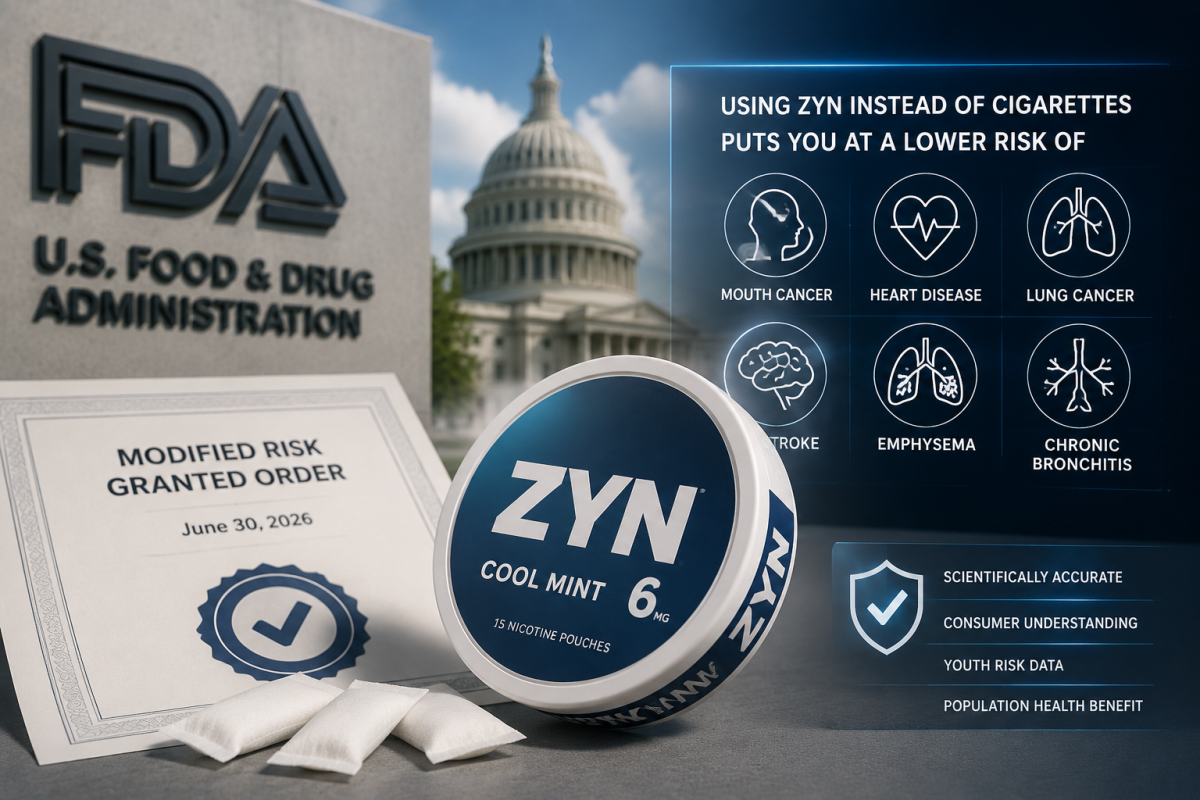
The MRTP orders allow the products to use the following claim: “Using ZYN instead of cigarettes puts you at a lower risk of mouth cancer, heart disease, lung cancer, stroke, emphysema, and chronic bronchitis.”
The authorized products cover 10 flavors, each in two nicotine strengths, 3 mg and 6 mg, for a total of 20 products. The flavors are ZYN Chill, ZYN Cinnamon, ZYN Citrus, ZYN Coffee, ZYN Cool Mint, ZYN Menthol, ZYN Peppermint, ZYN Smooth, ZYN Spearmint and ZYN Wintergreen.
FDA said a modified risk tobacco product order applies to specific products, not an entire tobacco product class or nicotine pouch category.
FDA Review Covered Consumer Understanding and Youth Risk
FDA said its scientific review considered several factors: the products’ relative health risks to individuals who use tobacco, consumer understanding and perception of the products marketed with the modified risk claim, youth-risk data and the potential impact on the population as a whole.
The agency concluded that Swedish Match had demonstrated that the specific modified risk claim is scientifically accurate for these ZYN products, that consumers understand the claim and that marketing the products with the claim would benefit the population as a whole.
Bret Koplow, acting director of FDA’s Center for Tobacco Products, said FDA’s review of modified risk products is intended to ensure that adult users have clear, science-based information about the relative harms of tobacco products so they can make informed choices.
FDA also said it considered recommendations from the January 22, 2026, Tobacco Products Scientific Advisory Committee meeting, public comments, data and information submitted to the agency, and other scientific information identified by FDA.
PMTA and MRTP Are Different Pathways
FDA stressed that PMTA authorization and MRTP authorization are separate regulatory pathways.
Authorization through the PMTA pathway allows a new tobacco product to be legally sold in the United States. The MRTP pathway is optional and allows a company, if it meets a higher scientific standard, to communicate FDA-authorized relative-risk information about specific products.
The ZYN products had already received PMTA authorization and therefore could be sold in the U.S. market. The new MRTP orders further allow these specific products to use a specific modified risk claim reviewed by FDA.
This distinction is important for the industry. Under the U.S. regulatory system, “authorized for sale” and “authorized to communicate lower-risk information” are not the same. Companies seeking to make relative-risk communications must go through the MRTP pathway and obtain separate authorization.
Five-Year Orders With Postmarket Requirements
FDA said the authorization requires Swedish Match USA to conduct postmarket surveillance and studies, including assessments of MRTP users’ behaviours and their understanding of risk-related information.
The orders will expire in five years. Before expiration, the company may request and receive FDA authorization to continue marketing the products as modified risk tobacco products.
FDA also said it may withdraw the orders if it determines at any point that continued MRTP marketing no longer benefits the health of the population as a whole, including if there is a significant increase in youth uptake.
FDA emphasised that there is no safe tobacco product and that people who do not use tobacco products should not start. For adults who currently smoke cigarettes, fully quitting all tobacco products would most benefit their health. However, switching completely from cigarettes to FDA-authorized nicotine pouches may reduce exposure to many harmful chemicals found in cigarettes.
To date, FDA has authorized 26 nicotine pouch products. These products have undergone scientific review and were found by FDA to meet the applicable public health standard.
Industry Impact and Next Steps
From an industry perspective, FDA’s decision sends three signals.
First, the regulatory position of nicotine pouches in the U.S. market is becoming clearer. ZYN had already received PMTA authorization, and the new MRTP orders show that some nicotine pouch products may obtain limited modified-risk communication rights if they meet the evidentiary standard.
Second, MRTP authorization may become an important regulatory asset for nicotine pouch brand differentiation. For companies, marketing authorization is the entry point; the ability to lawfully use relative-risk claims may affect brand communication, consumer education and channel strategy.
Third, youth risk remains a central FDA constraint. The authorization does not mean regulatory relaxation. Companies must continue to demonstrate that the products and related marketing do not significantly increase youth use or undermine population health.
For the nicotine pouch industry, ZYN’s MRTP authorization may encourage other brands to consider modified-risk applications. However, FDA made clear that MRTP orders apply only to specific products and specific claims, not to the entire category. Other companies would still need to submit their own data and undergo case-by-case review.
Key issues to watch include how Swedish Match uses the authorized modified risk claim in the U.S. market, how the claim appears on packaging, websites, retail materials and consumer communications, and how FDA evaluates postmarket surveillance data.
Overall, FDA’s decision is not a broad endorsement of the nicotine pouch category. It is an authorization for 20 specific ZYN products, one specific claim and a specific body of evidence. It moves U.S. nicotine pouch regulation from the question of market entry toward the question of reviewed and authorized relative-risk communication.
Follow 2Firsts for the latest updates on global tobacco harm reduction, nicotine products and regulatory developments.
Cover image:generated by AI
Disclaimer
This article is provided solely for professional research, industry discussion, and informational purposes. Any references to brands, companies, products, technologies, or policies are made for factual reporting and analytical purposes only, and do not constitute endorsement, recommendation, promotion, or advertising by 2Firsts.
Nicotine-containing products, including but not limited to cigarettes, e-cigarettes, heated tobacco products, and nicotine pouches, carry significant health risks. Readers are responsible for complying with all applicable laws and regulations in their respective jurisdictions, including age restrictions and access limitations.
The information contained in this article should not be regarded as investment, legal, medical, regulatory, or commercial advice. While 2Firsts strives to ensure the accuracy and reliability of its content, it does not assume liability for any direct or indirect loss arising from errors, omissions, inaccuracies, or reliance on the information contained herein.
This article is not intended for individuals below the legal age for accessing tobacco or nicotine-related information in their jurisdiction.
Copyright Notice
This article is either original content produced by 2Firsts or content reproduced, translated, summarized, or adapted from third-party sources with attribution where applicable. The intellectual property rights of the original content remain with 2Firsts or the respective original rights holders.
No individual or organization may copy, reproduce, distribute, republish, modify, translate, or otherwise use this content without prior authorization. Any unauthorized use may result in legal action.
For copyright-related inquiries, corrections, or removal requests, please contact: info@2firsts.com.
AI-Assisted Translation and Editing Notice
Portions of this article may have been translated, edited, or reviewed with the assistance of artificial intelligence tools to improve efficiency and readability. Due to the limitations of AI-assisted translation and editing, discrepancies, omissions, or inaccuracies may exist when compared with the original source.
Where applicable, readers are advised to refer to the original source for the most complete and accurate information. If you identify any errors or believe that any content infringes upon your rights, please contact us at info@2firsts.com, and we will review and address the matter promptly.