Key Points:
- FDA launches a web-based PMTA system, replacing the old PDF + eSubmitter model with guided, structured online submissions.
- Real-time validation and AI-ready data fields are expected to shorten RTA screening and accelerate Acceptance Letter timelines.
- Multi-user collaboration and auto-save streamline internal workflows for applicants and reduce formatting errors.
- Starting January 2, 2026, FDA will require applicants to use the web-based system or the latest PMTA forms, with outdated formats likely triggering immediate RTA.
- The shift is seen as a potential turning point for grey-market products seeking a clearer path toward full regulatory compliance.
2Firsts, December 04, 2025 — According to FDA Newsroom,FDA Launches Web-Based PMTA Forms to Streamline Tobacco Product Submission.On December 03, 2025, the U.S. Food and Drug Administration (FDA) announced the launch of new web-based application forms for tobacco premarket submissions, including the Premarket Tobacco Product Application (PMTA) and Substantial Equivalence (SE) pathways. The new online forms are now accessible through the CTP Portal NextGen platform.

The update covers the primary submission and amendment forms as well as new unique-identifying (grouping) forms. The full set of updated documents includes:
- FDA Form 4057 (PMTA submission)
- FDA Form 4057a (PMTA amendment)
- FDA Form 4057b (PMTA unique-ID / grouping)
- FDA Form 3965 (SE submission)
- FDA Form 3965a (SE amendment)
- FDA Form 3965b (SE unique-ID / grouping)
The web-based system introduces step-by-step guidance, draft-saving functionality, multi-user collaboration, and an integrated validation tool to help applicants ensure completeness and accuracy prior to submission.
FDA emphasized that the web-based forms currently apply to PMTA and SE submissions only. Other tobacco product submissions, such as ingredient listings, harmful constituent reports, or existing-product listings, will continue to follow the legacy process using eSubmitter or PDF uploads.
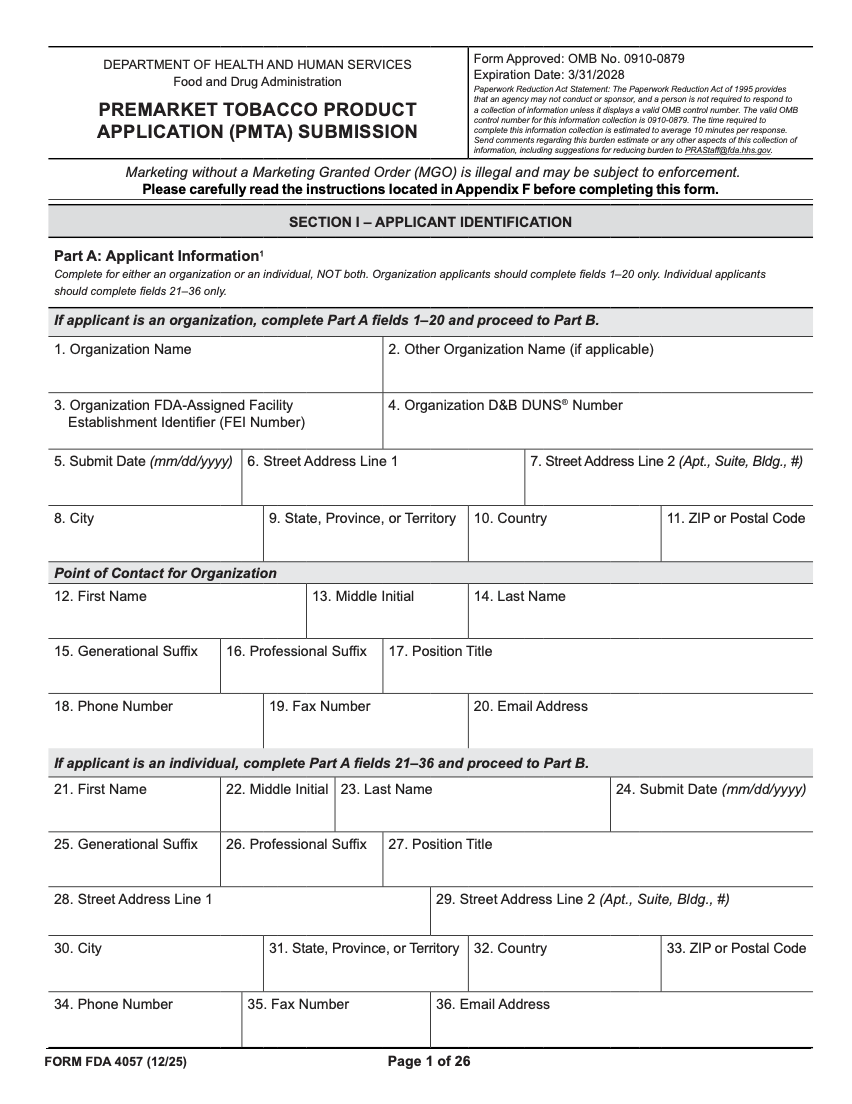
According to the agency, the overhaul aims to improve the efficiency, effectiveness, and transparency of tobacco-product application reviews. The updated forms incorporate revisions developed through public comments collected during the Office of Management and Budget (OMB) review process.
The CTP Portal NextGen platform remains the centralized access point for all tobacco-product regulatory submissions.
Contextual Background & Broader FDA Modernization Efforts
According to FDA, these changes aim to enhance efficiency, consistency, and transparency of regulatory submissions — reducing administrative burdens and lowering the risk of technical rejection due to format or completeness issues.
In a broader context, the FDA’s roll-out of web-based submission forms for tobacco products is part of a larger institutional push toward modernization, accelerated reviews, and AI-enabled regulatory operations under current leadership.
In June 2025, the FDA introduced a generative AI tool named Elsa, designed to assist scientific reviewers, investigators and staff across all centers with tasks such as clinical-protocol review, adverse-event summary, label comparison and database coding — tasks that previously consumed substantial time and resources.
According to the agency, Elsa has already begun expediting scientific evaluations and review processes, helping shorten timelines for internally reviewed submissions.

Under the leadership of Marty Makary, FDA has signaled an ambitious agenda to modernize and accelerate its entire regulatory apparatus — not only for tobacco products but also for drugs and therapeutic approvals.
As part of this broader push, the FDA recently launched a pilot program to speed up review of certain oral nicotine-pouch applications under the PMTA pathway, a move that underscores the agency’s intent to reduce traditional delays in tobacco-product authorization.
Taken together, these efforts suggest that the launch of web-based PMTA / SE forms — and the adoption of a unified submission portal — should be seen not as an isolated initiative, but as part of a comprehensive shift: toward a regulatory regime that favors efficiency, data-driven review, and AI-aided processes across product categories.
Expert Insight: What the Web PMTA Shift Really Means
What This Change Brings — and What It Could Trigger
According to a 2Firsts expert with long-standing PMTA experience, that the new web-based system fundamentally changes how applicants assemble and deliver their submissions. Instead of bundling PDF versions of FDA Forms 4057 and 4057A into an eSubmitter package, applicants can now choose between four streamlined paths: web-based PMTA submission, PMTA amendment, SE submission, and SE amendment.
The expert emphasized that the redesigned interface breaks the traditional Form 4057/4057B structure into seven guided modules, providing step-by-step instructions to ensure applicants align each section with FDA’s scientific and administrative expectations. Compared with the older PDF-plus-eSubmitter model, the system offers a more intuitive workflow and reduces errors tied to formatting and packaging.
The upgrade also introduces real-time collaboration. Multiple users can now work on the same submission simultaneously, with instantaneous draft saving and revision, eliminating the previous requirement to complete the entire 4057 package in one sequence before compression.
Critically, the expert highlighted that the new system enables automatic, real-time validation of required fields, giving FDA’s AI-assisted internal review tools a cleaner data structure. This could significantly shorten RTA screening and Acceptance Letter issuance. Historically, many PMTA delays stemmed not from scientific gaps but from formatting deficiencies; the web-based structure directly addresses that.
After January 2, 2026, FDA will require applicants either to use the web-based system or, if they continue using eSubmitter, to submit only the latest versions of Forms 4057 and 4057A. Failure to use updated forms is likely to trigger an immediate RTA.
What It Means in Practice
According to the expert, the new system offers more than convenience: it aligns with FDA’s broader ambition to incorporate AI into early-stage review and accelerate decision timelines. By forcing structured data entry and eliminating inconsistent PDF formats, FDA is preparing the PMTA workflow for greater automation.
The expert expects a substantial reduction in early-stage delays. “Lower-quality PMTA submissions will be identified faster, and higher-quality submissions could move through screening far more quickly,” the expert noted. The web-based structure could also pave the way for predictive review tools — allowing FDA to triage submissions more effectively and allocate staff attention to scientifically complex products.
More broadly, the expert said this reform could encourage more grey-market or semi-compliant products to begin the pathway toward formal regulation. With clearer instructions, fewer administrative traps, and faster feedback loops, the incentive for manufacturers to seek full compliance may increase.
CTP Portal NextGen: Brief System Update Timeline
- 2023 — FDA begins internal development of a modernized submission portal to replace the legacy eSubmitter tool and original CTP Portal environment.
- Early 2024 — Pilot testing launched with selected companies, focusing on document-upload workflows and security / authentication.
- Late 2024 — The platform starts integrating eSubmitter-like functions, with structural design to support future PMTA/SE migration.
- June 2025 — FDA completes OMB-reviewed updates to PMTA/SE forms (4057/4057a/4057b and 3965/3965a/3965b) and announces mandatory use from July 6, 2025.
- December 2025 — Web-based PMTA/SE forms formally launched via CTP Portal NextGen — marking the first full transition of tobacco premarket submissions to browser-based format.
Disclaimer
This article is provided solely for professional research, industry discussion, and informational purposes. Any references to brands, companies, products, technologies, or policies are made for factual reporting and analytical purposes only, and do not constitute endorsement, recommendation, promotion, or advertising by 2Firsts.
Nicotine-containing products, including but not limited to cigarettes, e-cigarettes, heated tobacco products, and nicotine pouches, carry significant health risks. Readers are responsible for complying with all applicable laws and regulations in their respective jurisdictions, including age restrictions and access limitations.
The information contained in this article should not be regarded as investment, legal, medical, regulatory, or commercial advice. While 2Firsts strives to ensure the accuracy and reliability of its content, it does not assume liability for any direct or indirect loss arising from errors, omissions, inaccuracies, or reliance on the information contained herein.
This article is not intended for individuals below the legal age for accessing tobacco or nicotine-related information in their jurisdiction.
Copyright Notice
This article is either original content produced by 2Firsts or content reproduced, translated, summarized, or adapted from third-party sources with attribution where applicable. The intellectual property rights of the original content remain with 2Firsts or the respective original rights holders.
No individual or organization may copy, reproduce, distribute, republish, modify, translate, or otherwise use this content without prior authorization. Any unauthorized use may result in legal action.
For copyright-related inquiries, corrections, or removal requests, please contact: info@2firsts.com.
AI-Assisted Translation and Editing Notice
Portions of this article may have been translated, edited, or reviewed with the assistance of artificial intelligence tools to improve efficiency and readability. Due to the limitations of AI-assisted translation and editing, discrepancies, omissions, or inaccuracies may exist when compared with the original source.
Where applicable, readers are advised to refer to the original source for the most complete and accurate information. If you identify any errors or believe that any content infringes upon your rights, please contact us at info@2firsts.com, and we will review and address the matter promptly.