Key Points
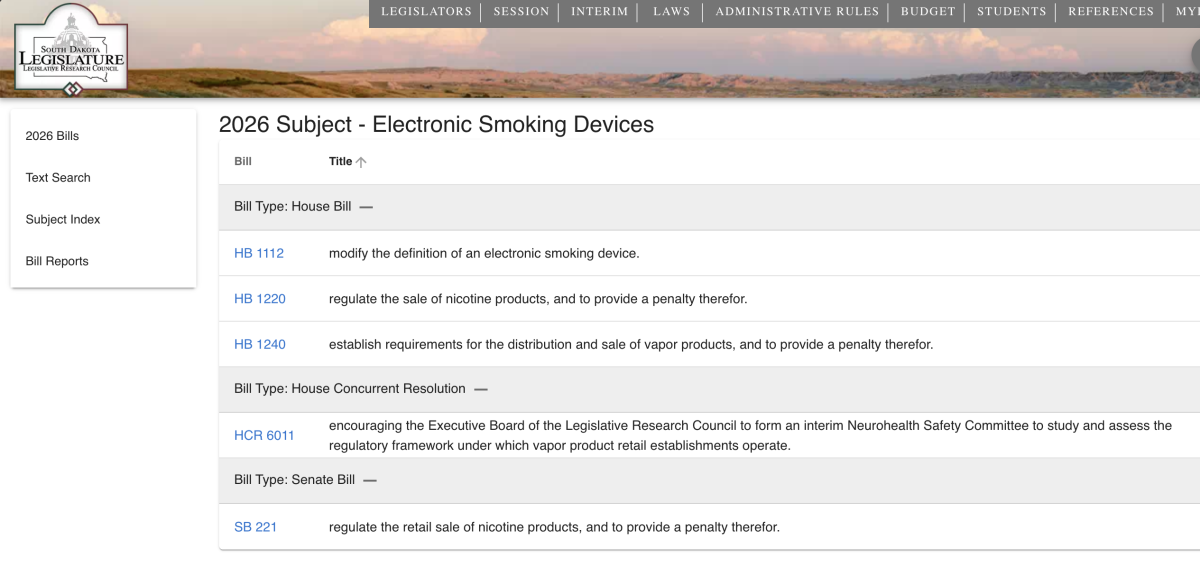
- Senate Bill 221 would require retailers to obtain a state license to sell nicotine products in South Dakota.
- The amended bill expands its scope from vapor products to all nicotine products.
- Licensed retailers would be restricted from vending machine sales, direct shipping, phone sales and free samples.
- The measure establishes a 500-foot distance requirement from schools for new nicotine retail locations.
- The Senate committee advanced the bill on a 7–0 vote.
2Firsts, February 22, 2026
According to KELO, A South Dakota Senate committee has advanced Senate Bill 221 (SB 221), legislation aimed at tightening regulations on nicotine product sales in the state.
The Senate Health and Human Services Committee recommended passage of the amended bill on a 7–0 vote. Originally introduced as a three-page measure focused on vapor products, the bill was revised into a nine-page proposal covering all nicotine products.
Under the amended legislation, retailers would be required to secure a state license to sell nicotine products. The bill specifies that license holders would be prohibited from selling nicotine products through vending machines, shipping products directly to individuals, conducting sales by phone, or providing free samples. Sales to individuals under 21 would remain illegal under existing South Dakota law.
The proposal also establishes a location restriction, preventing licensed nicotine retailers from operating within 500 feet of an elementary or secondary school. An exception would apply to businesses that sold nicotine products at the same location prior to July 1, 2026.
Republican Sen. Chris Kar, the bill’s prime sponsor, said the measure addresses what he described as an evolving nicotine delivery market, particularly disposable vapes, which he said has developed faster than state statutes.
Supporters, including representatives from the American Heart Association and the South Dakota Nurses Association, cited youth usage rates. Opponents, including representatives of South Dakota Retailers for Better Alternatives and the South Dakota Retailers Association, argued that the bill could impose additional regulatory burdens on law-abiding businesses.
Lawmakers in favor of the bill said it introduces “guardrails” while not preventing adults aged 21 and over from legally purchasing nicotine products.
(Cover Image Source: sdlegislature.gov)
Disclaimer
This article is provided solely for professional research, industry discussion, and informational purposes. Any references to brands, companies, products, technologies, or policies are made for factual reporting and analytical purposes only, and do not constitute endorsement, recommendation, promotion, or advertising by 2Firsts.
Nicotine-containing products, including but not limited to cigarettes, e-cigarettes, heated tobacco products, and nicotine pouches, carry significant health risks. Readers are responsible for complying with all applicable laws and regulations in their respective jurisdictions, including age restrictions and access limitations.
The information contained in this article should not be regarded as investment, legal, medical, regulatory, or commercial advice. While 2Firsts strives to ensure the accuracy and reliability of its content, it does not assume liability for any direct or indirect loss arising from errors, omissions, inaccuracies, or reliance on the information contained herein.
This article is not intended for individuals below the legal age for accessing tobacco or nicotine-related information in their jurisdiction.
Copyright Notice
This article is either original content produced by 2Firsts or content reproduced, translated, summarized, or adapted from third-party sources with attribution where applicable. The intellectual property rights of the original content remain with 2Firsts or the respective original rights holders.
No individual or organization may copy, reproduce, distribute, republish, modify, translate, or otherwise use this content without prior authorization. Any unauthorized use may result in legal action.
For copyright-related inquiries, corrections, or removal requests, please contact: info@2firsts.com.
AI-Assisted Translation and Editing Notice
Portions of this article may have been translated, edited, or reviewed with the assistance of artificial intelligence tools to improve efficiency and readability. Due to the limitations of AI-assisted translation and editing, discrepancies, omissions, or inaccuracies may exist when compared with the original source.
Where applicable, readers are advised to refer to the original source for the most complete and accurate information. If you identify any errors or believe that any content infringes upon your rights, please contact us at info@2firsts.com, and we will review and address the matter promptly.