French Nicotine Pouch Ban Delayed Again Amid Pressure from EU Member States

Jun.23.2025
French Nicotine Pouch Ban Delayed Again Amid Pressure from EU Member States
The French nicotine pouch ban has been postponed again to August 25 due to pressure from EU member states, with the business community watching anxiously.

Key Points:


·France delays implementation of ban on nicotine pouches, originally scheduled for May 26th, due to objections submitted by seven EU countries. 


·The ban will now take effect on August 25th, classifying nicotine pouches as dangerous chemicals and violators may face imprisonment or hefty fines. 


·The delay in implementation is in response to the concerns raised by the seven EU countries.


According to recent reports from European media, France's comprehensive ban on nicotine pouches will be extended until August 25th to allow lawmakers more time to address opposition from seven EU member states. The ban was originally set to take effect on May 26th and includes prohibiting the production, sale, import, export, possession, and use of nicotine pouches.


According to the drafted legislation, nicotine pouches are considered "toxic substances" and treated similar to hazardous chemicals. If the ban is implemented as planned, those caught carrying nicotine pouches could face up to one year in prison or a fine of 15,000 euros (17,369 US dollars), while manufacturers or retailers could be sentenced to five years in prison and fined up to 375,000 euros (434,145 US dollars).


However, the strict sanctions have been temporarily suspended as seven EU member states, including Romania, Greece, Hungary, Slovakia, Czech Republic, Italy, and Sweden, have submitted "detailed opinions" according to EU technical regulations information system. This delay provides France with time to respond to the concerns raised by the aforementioned EU countries and has also sparked widespread attention from the business community.


We welcome news tips, article submissions, interview requests, or comments on this piece.

Please contact us at info@2firsts.com, or reach out to Alan Zhao, CEO of 2Firsts, on LinkedIn


Notice

1.  This article is intended solely for professional research purposes related to industry, technology, and policy. Any references to brands or products are made purely for objective description and do not constitute any form of endorsement, recommendation, or promotion by 2Firsts.

2.  The use of nicotine-containing products — including, but not limited to, cigarettes, e-cigarettes, nicotine pouchand heated tobacco products — carries significant health risks. Users are responsible for complying with all applicable laws and regulations in their respective jurisdictions.

3.  This article is not intended to serve as the basis for any investment decisions or financial advice. 2Firsts assumes no direct or indirect liability for any inaccuracies or errors in the content.

4.  Access to this article is strictly prohibited for individuals below the legal age in their jurisdiction.


Copyright


This article is either an original work created by 2Firsts or a reproduction from third-party sources with proper attribution. All copyrights and usage rights belong to 2Firsts or the original content provider. Unauthorized reproduction, distribution, or any other form of unauthorized use by any individual or organization is strictly prohibited. Violators will be held legally accountable.

For copyright-related inquiries, please contact: info@2firsts.com


AI Assistance Disclaimer


This article may have been enhanced using AI tools to improve translation and editorial efficiency. However, due to technical limitations, inaccuracies may occur. Readers are encouraged to refer to the cited sources for the most accurate information.

We welcome any corrections or feedback. Please contact us at: info@2firsts.com

South Korea Imports 12,126 Kg of Nicotine Analogues From April to August After Bringing Synthetic Nicotine Under Tobacco Law
South Korea's liquid-vape market is showing changes across raw-material imports, product types and sales channels after synthetic nicotine came under the Tobacco Business Act on April 24. Customs data show nicotine-analogue imports totaled 12,126 kilograms from April through August, while synthetic-nicotine imports over the same five months totaled 231,663 kilograms, just 39.3% of the amount imported in March alone. Physical liquid-vape stores tracked in Seoul and Gyeonggi Province fell 9.9%, unmanned outlets edged higher and online sales listings increased from 27,774 to 42,437. Government testing of 105 liquid inhalation products promoted as nicotine-free separately found nicotine in 13 and 6-methylnicotine in 12.
Sep.22
Imperial Brands Acquires Helwit Owner Yoik Group for SEK 515 Million, More Than Doubling Swedish Nicotine Pouch Share
Imperial Brands has agreed to acquire 100% of Swedish modern oral nicotine company Yoik Group AB for an initial SEK515 million, equivalent to about US$53.9 million, plus a deferred payment linked to performance over the next two years. Yoik owns nicotine pouch brand Helwit, which held about 3.4% of Sweden’s modern oral nicotine market over the past 12 months. Imperial says the acquisition will more than double its existing share of the Swedish market. Helwit is also sold elsewhere in the Nordics, through European online channels and in selected UK retail outlets.
Sep.08
South Korea Constitutional Court Upholds Volume-Based E-Liquid Tax, With Challenged Rates at KRW 370 and KRW 628 per Milliliter
South Korea's Constitutional Court has upheld fixed taxes on nicotine-containing e-cigarette liquids based on solution volume, ruling that challenged provisions imposing KRW 370 per milliliter in individual consumption tax and KRW 628 per milliliter in tobacco consumption tax do not violate the Constitution. The cases stemmed from historical disputes involving importers that reported nicotine as being extracted from tobacco stems rather than leaves. South Korea has since broadened its tobacco definition to include synthetic nicotine, while current tax laws provide reduced rates for certain products not derived from tobacco.
Sep.18
Florida Governor DeSantis Expands TANF Restrictions, Blocking Welfare Benefits From Buying Tobacco and Vapes
Florida Governor Ron DeSantis announced an expansion of Temporary Assistance for Needy Families (TANF) restrictions that would prohibit Electronic Benefit Transfer (EBT) funds from being used to purchase tobacco and vaping products. The state will amend its TANF State Plan and submit the changes for federal approval. Florida officials said the restrictions would not affect eligibility for temporary cash assistance or the amount of benefits received, but would change how funds can be spent.
Aug.25
Latest UK ONS Data: Vaping Rate Edges Down to 9.9% in 2025, a Year After Overtaking Cigarette Smoking
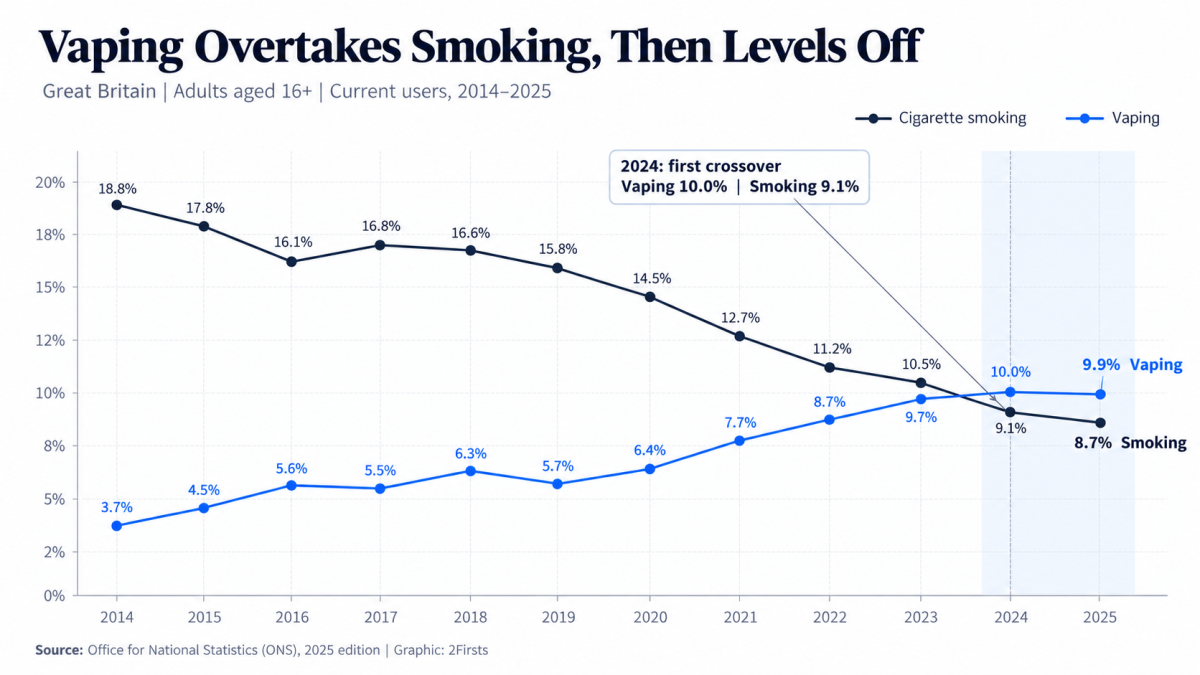
Vaping prevalence in Great Britain edged down to 9.9% in 2025 from 10.0% in 2024, with the number of adult users holding at approximately 5.4 million for a second consecutive year, according to the Office for National Statistics (ONS). E-cigarette use had risen from 6.4% in 2020 to 10.0% in 2024, when it exceeded cigarette smoking prevalence for the first time. Cigarette smoking continued to decline to 8.7% in 2025, widening the gap to 1.2 percentage points. Daily vaping declined slightly, while usage among adults aged 25–34 increased despite falling rates in other age groups.
DATA
Oct.14
Product | JT Refreshes Ploom CUBE Design and Expands Japan Retail Distribution, Targeting Younger Men and Female Users
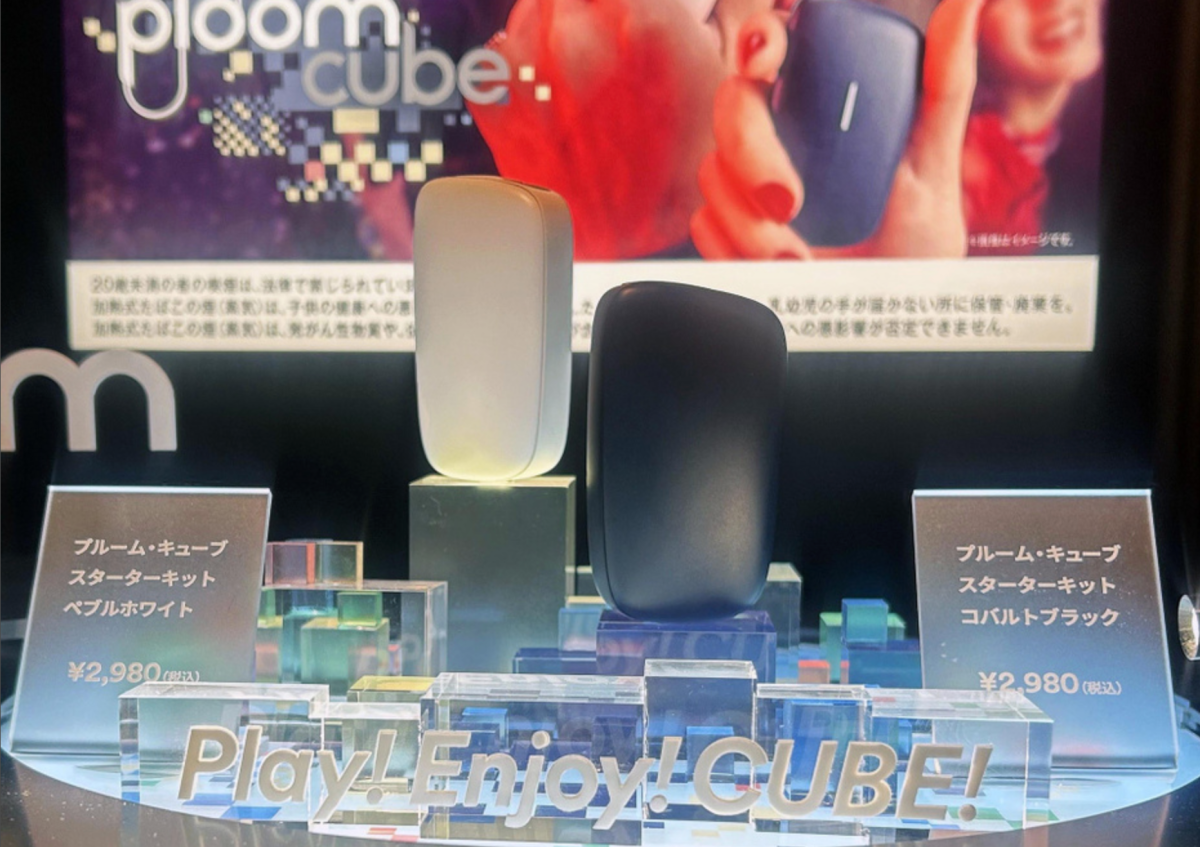
Japan Tobacco (JT) launched a refreshed Ploom CUBE design in Japan on September 8, 2026, with broader convenience-store and tobacco-retail distribution planned from October 13. The updated device retains the existing Rounded Cube form and heating platform while replacing four previous body colors with Pebble White and Cobalt Black. JT is also introducing new Front Panels and Fabric Back Covers, although the new accessories are not compatible with the previous Ploom CUBE design. The company says the update is intended to broaden appeal among younger male and female users.
Sep.09