Key Points
- Global Policy Template: The spread of e-cigarettes, heated tobacco products and nicotine pouches is testing whether tobacco control can rely on a single global policy model.
- Regional Adaptation: Rashidi says U.S., U.K. and EU experience remains relevant to Asia, but policies must account for local culture, healthcare systems, enforcement capacity and market structures.
- Illicit Market Risk: In markets with weak enforcement or porous borders, higher tobacco taxes may push smokers toward illicit cigarettes rather than quitting.
- Local Evidence Gap: Asian tobacco research needs to move beyond surveys and build more evidence from RCTs, real-world studies and clinical research.
- Clinical Cessation Systems: Nicotine addiction should be treated as a chronic relapsing medical condition, with doctors, pharmacists and counsellors playing a larger role in cessation and harm reduction.
2Firsts
July 8, 2026
As e-cigarettes, heated tobacco products and nicotine pouches expand across markets, policymakers face a long-running question: whether global tobacco control can rely on a universal policy template for regions with sharply different realities.
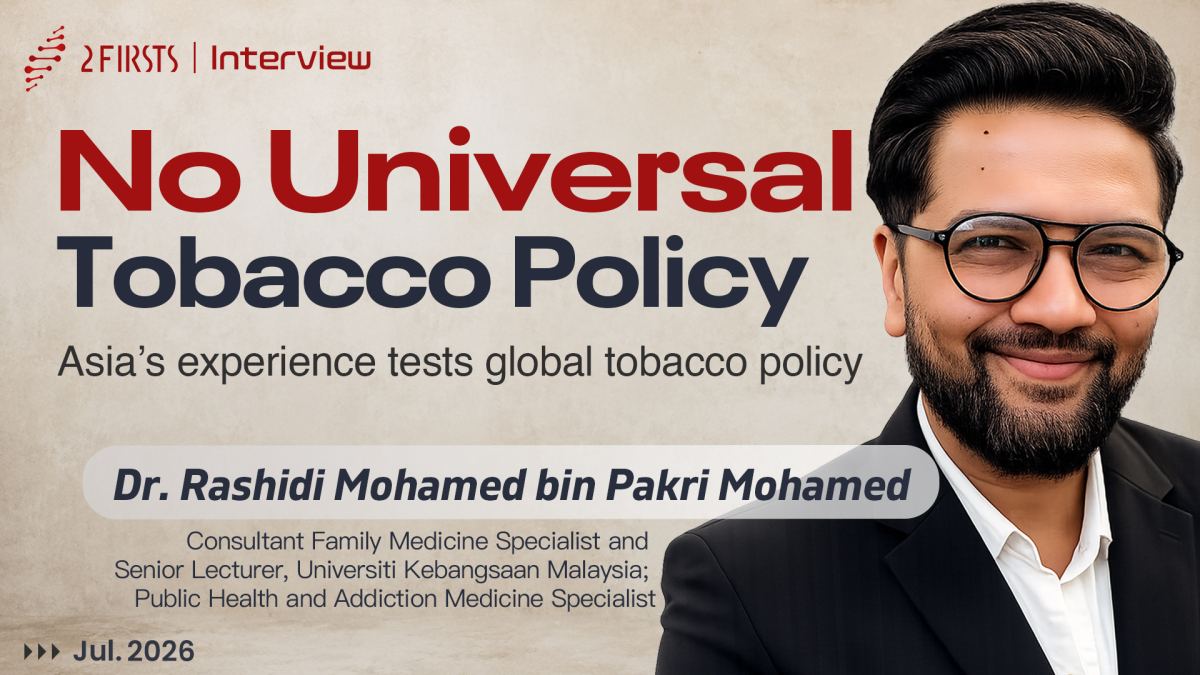
For Dr. Rashidi Mohamed bin Pakri Mohamed, a Consultant Family Medicine Specialist and Senior Lecturer at Universiti Kebangsaan Malaysia, also known as the National University of Malaysia, the answer is unlikely to be straightforward.
Rashidi holds an MD, a Doctor of Family Medicine degree and a PhD in Psychological Medicine. His work focuses on family medicine, addiction science, smoking cessation, nicotine dependence and evidence-based treatment approaches for substance use.
In mid-June, Rashidi spoke at a nicotine science forum held in Shenzhen, China, where he discussed global nicotine research and differences in research objectives, methodologies and regulation. Following the forum, 2Firsts conducted a written interview with him on tobacco control and tobacco harm reduction in Asian settings.
The central question, in Rashidi’s view, is not whether Asian regulators should reject Western experience. It is whether policies developed in the United States, the United Kingdom or the European Union can be transferred into Asian markets without losing effectiveness when they meet different cultures, healthcare systems, enforcement conditions and market structures.
Asia as a test case for regional tobacco control
Asia, Rashidi said, accounts for a large share of global tobacco use. But the region’s tobacco control challenge is not only a matter of scale.
In several Asian countries, tobacco or tobacco-related use includes products and practices such as bidi smoking and betel nut chewing. These forms of use are part of the local context in countries including India, Pakistan, Bangladesh, Thailand, Myanmar and Malaysia, and differ from the manufactured cigarette markets that often dominate Western policy debate.
The economic role of tobacco also complicates regulation. In some Asian countries and jurisdictions, tobacco production, exports and taxation remain significant to government revenue. Taxes on commercial branded cigarettes can be high, while some locally produced combustible products may be taxed differently.
That creates a policy environment in which public health goals intersect with fiscal interests, informal markets and enforcement capacity.
Rashidi also pointed to family structures as a factor in cessation. In many Asian communities, family-oriented interventions may be more effective than highly individualised models of addiction treatment. Family-based group support, he said, can be relevant in societies where family influence plays a central role in health decisions and recovery.
Many Western behavioural models, by contrast, place greater emphasis on individual autonomy, personal boundaries and self-discovery. For tobacco control, that difference may affect not only public messaging but also the design of cessation services.
Western models offer lessons, but may not travel unchanged
Rashidi drew a broad distinction between Western harm reduction models and the more restrictive approaches seen in parts of Asia.
Western countries, he said, have more often integrated harm reduction into public health and healthcare systems. In parts of Asia, policy has historically leaned more toward prohibition, enforcement and restrictive regulation.
He cited the Association of Southeast Asian Nations’ long-standing “drug-free region” orientation as part of that history. Harm reduction became important in efforts to reduce HIV/AIDS transmission, but smoking-related harm reduction has remained more limited in many Asian settings, he said.
More public resources have often been directed toward law enforcement and compulsory detention or rehabilitation centres than toward harm reduction innovation or research. Western countries, by comparison, have more often placed harm reduction within healthcare systems, with a focus on reducing deaths, supporting recovery and expanding treatment options.
Private-sector participation has also contributed to innovation in some harm reduction areas, Rashidi said, although Asian governments remain cautious about how such involvement should be assessed and governed.
For policymakers, the issue is one of policy transfer rather than policy rejection. Western experience may provide useful evidence and regulatory lessons, but Asian regulators still need to ask which elements can survive contact with local healthcare capacity, social behaviour, enforcement systems and consumer markets.
Tax, enforcement and illicit markets shape outcomes
One of the clearest policy challenges in Asia is the interaction between tobacco taxation and illicit markets.
Excise tax increases are widely used to make cigarettes less affordable. But in countries and jurisdictions with porous borders or weak enforcement, Rashidi said, higher taxes can push smokers toward illicit cigarettes or the shadow economy instead of quitting.
In that scenario, smokers may switch to cheaper, unregulated products, while smoking rates remain high and tax revenue falls. That can also reduce public funds available to treat tobacco-related disease.
Comprehensive tobacco control laws are important, Rashidi said, but their impact depends on effective enforcement. In lower- and middle-income countries, stronger taxation can be useful if illicit markets are contained.
The policy problem is not simply whether to raise taxes, tighten restrictions or introduce alternatives. It is how to protect young people from tobacco and nicotine initiation while giving adult smokers credible pathways away from combustible cigarettes.
That balance is especially difficult in markets where affordability, youth protection, traditional tobacco use, informal trade and limited cessation services all interact.
Alternative nicotine products raise evidence questions
Asian countries and jurisdictions have taken sharply different approaches to alternative nicotine products such as e-cigarettes, heated tobacco products and nicotine pouches.
Hong Kong, China, and Singapore have enacted complete bans on such products, while other Asian markets have chosen taxation and regulation. The contrast shows that there is no single Asian regulatory model.
Rashidi said policymakers should rely on independent, peer-reviewed evidence when deciding how alternative nicotine products fit into national tobacco control strategies.
The key questions are whether these products are effective for the intended population, whether their safety profile is understood, and whether they achieve their stated public health objectives.
In practice, that evidence may include data on toxicant exposure, nicotine delivery, switching behaviour among adult smokers, youth access, non-smoker initiation and continued dual use with cigarettes. Such evidence matters because a product that reduces exposure for some adult smokers could still create public health concerns if it attracts young people or non-smokers, or if it fails to move smokers away from combustible tobacco.
Rashidi did not argue that alternative products should be accepted or rejected as a category. His position was that regulators need local evidence to assess their potential role, risks and limitations in specific markets.
Clinical systems remain a weak link
Rashidi’s clinical background shapes another part of his argument: tobacco control cannot rely on regulation alone.
Healthcare providers, including doctors, pharmacists and counsellors, should play a central role in tobacco control and harm reduction policy, Rashidi said. Nicotine addiction, he said, is “a chronic relapsing medical condition” and should not be treated as a lifestyle choice.
That means healthcare systems need trained professionals, effective communication, behavioural support, pharmacotherapy and protected clinical time to deliver treatment.
Singapore and Japan have comparatively strong smoking cessation support systems, Rashidi said. Other Asian countries and jurisdictions still face funding constraints and struggle to provide comprehensive behavioural and pharmacological support.
The clinical gap is one reason why policy design may not translate into policy outcomes. Regulations can restrict products, tax cigarettes or authorise alternatives, but without accessible cessation services, adult smokers may have limited support in quitting or reducing harm.
Asia cannot be treated as one policy bloc
Rashidi cautioned against treating Asia as a single policy bloc.
“Treating Asia as a single entity forces regulators into a ‘one-size-fits-all’ model that simply does not map to reality,” he said.
A tobacco control policy that succeeds in Japan may not produce the same result elsewhere in the region because market structures, cultural practices, enforcement capacity, state revenue dependence and product categories vary widely.
In some countries and jurisdictions, tobacco tax revenue remains a significant consideration for government policy. In others, cultural practices such as shisha or waterpipe use are deeply embedded in social settings, particularly in parts of the Middle East and East Asia.
Japan and South Korea, where combustible cigarette sales have declined alongside the rise of heated tobacco products, may offer lessons on innovation in harm reduction, Rashidi said. But those experiences cannot simply be copied across Asia without accounting for local conditions.
For regulators, the relevant differences include market structure, enforcement capacity and the types of tobacco or nicotine products used in each market.
Beyond surveys: the need for local clinical evidence
Much of Asia’s tobacco research still relies on cross-sectional and longitudinal surveys, Rashidi said. Such observational studies are important for tracking smoking prevalence, youth initiation and product-use patterns, but they are less suited to testing whether a specific treatment, product or policy intervention produces a measurable outcome.
He called for more local clinical evidence, including randomised controlled trials and real-world studies. RCTs can test interventions under controlled conditions, while real-world evidence can show how cessation support, alternative products or regulatory measures perform in clinics, markets and everyday use.
In tobacco and nicotine research, such studies can help assess whether an alternative product or cessation intervention reduces exposure to harmful substances, changes smoking behaviour, supports quitting or creates unintended risks.
Rashidi also referred to pharmacokinetic data, which measure how nicotine is absorbed, distributed and cleared in the body. Such data can help researchers understand whether a product delivers nicotine in a way that may affect dependence, substitution or cessation.
Asian public health frameworks, he argued, need to “mature beyond observational data” by generating more local clinical and real-world evidence.
His broader view is that tobacco research in Asia should not stop at surveillance, but should also test interventions, products and policy outcomes in local populations.
Global rules, regional realities
At the global level, Rashidi said discussions around the Framework Convention on Tobacco Control and international research frameworks should better account for regional differences in regulation, culture, markets and healthcare systems.
He said it would be counter-productive to design Asian policies based only on Western studies.
A broad consensus between Asian and Western countries would be useful, he said, but global tobacco control policy should remain flexible enough to address the specific challenges encountered by different regions.
For Rashidi, the lesson from Asia is not that every market needs a separate rulebook. It is that common principles may require different policy tools depending on smoking patterns, healthcare capacity, enforcement, local evidence and the structure of the nicotine market.
That question is likely to become more difficult as e-cigarettes, heated tobacco products, nicotine pouches and other nicotine products move across markets with sharply different public health systems and regulatory capacities.
Asia is one test case. African and Latin American countries also face complex regional conditions that may not fit neatly into policy models developed in wealthier Western markets.
For global tobacco control, the challenge is no longer only whether countries should adopt or reject tobacco harm reduction. It is how to build international principles without treating the global market as a single policy environment.
2Firsts will continue to follow global discussions on tobacco control, tobacco harm reduction and nicotine policy. Experts interested in contributing analysis or perspectives may contact Alan Zhao at alan@2firsts.com.
Disclaimer
This article is provided solely for professional research, industry discussion, and informational purposes. Any references to brands, companies, products, technologies, or policies are made for factual reporting and analytical purposes only, and do not constitute endorsement, recommendation, promotion, or advertising by 2Firsts.
Nicotine-containing products, including but not limited to cigarettes, e-cigarettes, heated tobacco products, and nicotine pouches, carry significant health risks. Readers are responsible for complying with all applicable laws and regulations in their respective jurisdictions, including age restrictions and access limitations.
The information contained in this article should not be regarded as investment, legal, medical, regulatory, or commercial advice. While 2Firsts strives to ensure the accuracy and reliability of its content, it does not assume liability for any direct or indirect loss arising from errors, omissions, inaccuracies, or reliance on the information contained herein.
This article is not intended for individuals below the legal age for accessing tobacco or nicotine-related information in their jurisdiction.
Copyright Notice
This article is either original content produced by 2Firsts or content reproduced, translated, summarized, or adapted from third-party sources with attribution where applicable. The intellectual property rights of the original content remain with 2Firsts or the respective original rights holders.
No individual or organization may copy, reproduce, distribute, republish, modify, translate, or otherwise use this content without prior authorization. Any unauthorized use may result in legal action.
For copyright-related inquiries, corrections, or removal requests, please contact: info@2firsts.com.
AI-Assisted Translation and Editing Notice
Portions of this article may have been translated, edited, or reviewed with the assistance of artificial intelligence tools to improve efficiency and readability. Due to the limitations of AI-assisted translation and editing, discrepancies, omissions, or inaccuracies may exist when compared with the original source.
Where applicable, readers are advised to refer to the original source for the most complete and accurate information. If you identify any errors or believe that any content infringes upon your rights, please contact us at info@2firsts.com, and we will review and address the matter promptly.