Key Points
- UK POST published a briefing on vape components.
- Regulatory attention is expanding to hardware and whole devices.
- Power, coils and temperature affect aerosol output.
- Future standards may focus more on material evidence.
2Firsts
June 29, 2026
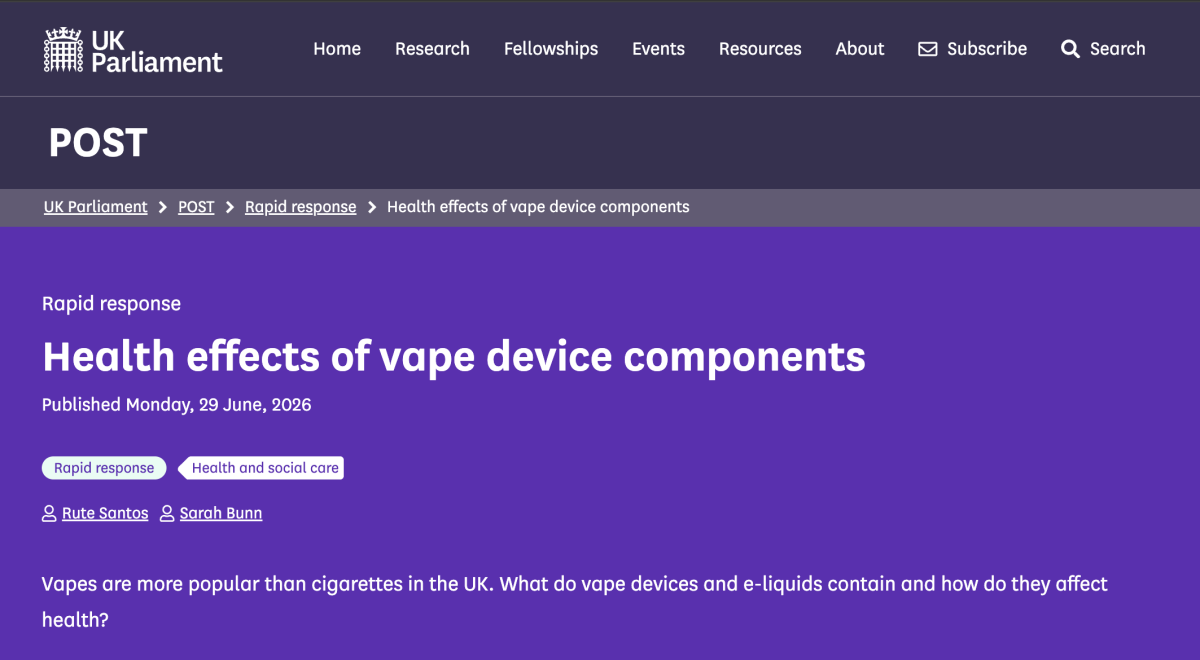
The UK Parliament’s Parliamentary Office of Science and Technology (POST) has published a briefing titled “Health effects of vape device components,” reviewing scientific evidence on vape device components, e-liquid ingredients, power settings, heating temperatures and potential health effects.
POST Provides Scientific Evidence for Parliament
POST is an independent research and knowledge exchange service based in the UK Parliament, providing evidence to members of both Houses on emerging and complex issues. The new publication is a “Rapid response” briefing designed to summarise current evidence and scientific uncertainty for policymakers.
The policy context is the Tobacco and Vapes Act 2026, which is now in force. POST says the Act restricts the accessibility of vapes and gives the government powers to regulate vaping product standards, e-liquid ingredients and e-liquid flavours. Its objective is to reduce vaping among children while maintaining access for adult smokers who use vapes to quit.
This distinction matters. POST is not an enforcement regulator or a product-approval agency. Its publication is not an administrative ban or a product safety determination. It is a scientific evidence briefing for Parliament and the policymaking process.
The more accurate news value is that the UK Parliament is treating vape device components and their health effects as a standalone evidence topic. That means the UK vape policy discussion is expanding from flavours, packaging, youth use and e-liquid ingredients toward hardware and whole-device systems.
Device Components Enter the Evidence Base
POST breaks down vape devices into several key components, including a mouthpiece, liquid tank or cartridge, heating element, microprocessor, switch and rechargeable lithium battery. The heating element, often described as an atomiser or coil, heats e-liquid and generates aerosol.
The briefing says battery power heats the coil, which heats the e-liquid in the tank and transmits aerosol through the mouthpiece. Device power, coil design, airflow, e-liquid composition, wick saturation and user puffing behaviour can all affect aerosol temperature and user experience.
POST lists typical temperature ranges under different power settings. Low-power devices, from 7 W to 15 W, can reach temperatures of up to about 190 C. Medium-power devices, from 15 W to 40 W, can reach about 190 C to 260 C. High-power devices above 40 W can exceed 260 C.
The briefing also says coil resistance affects aerosol temperature. Low-resistance coils permit higher temperatures, and the combination of power and coil resistance changes aerosol properties. High-power, low-resistance devices usually produce warmer, more richly flavoured aerosols, while low-power, high-resistance devices produce cooler aerosols and a smoother experience.
This section is directly relevant to the supply chain. UK vape debate has often focused on flavours, youth use and nicotine concentration. By reviewing power, coil resistance, airflow and heating design, POST is bringing hardware engineering parameters into the policy evidence base.
High Temperature and Material Release Draw Attention
POST says heating coils that vaporise e-liquid generate toxic and carcinogenic compounds, including aldehydes, free radicals, reactive oxygen species and metals. Some of these compounds are also produced by cigarettes and are linked to lung inflammation and long-term lung disease risks.
The briefing says evidence on how device settings affect long-term health remains limited. However, existing data have led scientists to infer that higher-temperature vapes create more toxic aerosols, making it reasonable to assume that more powerful devices may be more harmful.
POST also highlights interactions between e-liquids and device materials. It says e-liquids may contain impurities such as metals, phthalates and PFAS. These may originate from manufacturing processes, storage conditions or routine device use, when e-liquid interacts with materials such as metallic coils and plastic components.
This means regulatory attention may no longer be limited to the e-liquid formulation itself. Material selection, metal parts, plastic components, tank structure, wicking systems and heating stability may all influence final aerosol exposure.
For China’s vape supply chain, this direction is particularly important. A large share of global vape device manufacturing and component supply is based in China. If future UK product standards focus more on device materials, coil design, power control and manufacturing consistency, competition will move further from cost, appearance and capacity toward material compliance, engineering validation and toxicological evidence.
E-Liquids and Device Effects Interact
POST does not review hardware alone. It also discusses e-liquid ingredients. The briefing says a 2021 study of vapes sold in the UK found that e-liquids contained 17 ingredients on average and identified more than 1,500 different e-liquid ingredients in the products examined.
Common ingredients include vegetable glycerin and propylene glycol as flavouring carriers, nicotine, flavourings and other additives. POST notes that although vegetable glycerin and propylene glycol are widely used in pharmaceutical, cosmetic and food products, being safe to eat does not mean being safe to inhale.
The briefing also says VG and PG degrade when heated and generate toxic and carcinogenic compounds. High-VG liquids generally require higher temperatures to vaporise effectively, while PG-based solutions have been associated with increased generation of carcinogenic compounds.
On flavourings, POST says UK consumers can choose from more than 4,000 e-liquid flavours, with sweet, fruit and menthol products appealing to both young people and adults. It says flavouring ingredients are linked to poorer lung health, lung inflammation and increased aerosol toxicity, but the variety of ingredients, product formulations and limited research make it difficult to reach consensus conclusions on the health effects of flavoured e-liquids.
This further shows that vape health effects are not determined by a single ingredient. They depend on e-liquid formulation, heating temperature, device structure and user behaviour. For regulators, the more complete assessment object is the overall product system: device, liquid and use conditions.
UK Regulation May Move Toward Whole-Device Standards
In its policy considerations, POST says that although some existing requirements indirectly limit vape power output, there are currently no restrictions on device power or coil resistance. At the same time, the Tobacco and Vapes Act 2026 gives the government powers to regulate “technological features” of vaping products, including provisions related to software in vaping products.
This could become an important future regulatory entry point. Power control, temperature management, software settings, youth-appealing features, displays, lights, locking mechanisms and battery safety may all be considered in more detailed product standards.
For the industry, this means UK regulation may gradually expand from e-liquid regulation to whole-device regulation. UK vape controls have historically focused on nicotine concentration, tank capacity, age restrictions, advertising, packaging and flavours. The POST briefing shows that Parliament’s evidence base is now beginning to examine device engineering factors.
This direction shows some convergence with the U.S. FDA’s whole-product approach to premarket tobacco applications. FDA PMTA reviews commonly require information on product design, material characteristics, heating parameters, aerosol chemistry, toxicology, manufacturing consistency and quality systems. The UK may not copy the FDA system, but the scientific evidence focus is moving from e-liquids alone to whole-device systems.
For Chinese suppliers and international brands, future competition may not be limited to flavour, nicotine strength and packaging design. It may also depend on material documentation, power stability, heating profiles, impurity control, aerosol testing, batch consistency and traceable manufacturing data.
Industry Impact and Next Steps
From a 2Firsts industry perspective, the POST briefing sends three signals.
First, the UK Parliament is bringing the health effects of vape device components into the policy evidence base. Device components are no longer only an engineering issue; they are becoming a public health and regulatory issue.
Second, future UK vape regulation may place more emphasis on whole-device systems. Interactions among e-liquids, devices, materials, power, temperature and user behaviour may become an important part of product standards and risk assessment.
Third, China’s vape supply chain needs to prepare for higher evidence requirements. If the UK or other markets strengthen product standards, companies will need stronger capabilities in material selection, structural design, manufacturing consistency and toxicological data.
The briefing does not mean the UK has determined that all vape devices are harmful, nor does it immediately impose hardware restrictions. More accurately, it marks a more systematic parliamentary focus on device components and technological features within the vape regulatory evidence base.
Key issues to watch include how the UK government uses the powers under the Tobacco and Vapes Act 2026, whether it consults on technological features, power, coils, materials or product standards, and whether industry will be required to submit more detailed whole-device safety and toxicology evidence.
Overall, UK vape regulation is entering a more granular phase. For companies, compliance will increasingly extend from whether a product can be sold to how it is designed, what materials it uses, what temperatures it reaches and what aerosol it ultimately produces.
Cover Image source: UK Parliament
Disclaimer
This article is provided solely for professional research, industry discussion, and informational purposes. Any references to brands, companies, products, technologies, or policies are made for factual reporting and analytical purposes only, and do not constitute endorsement, recommendation, promotion, or advertising by 2Firsts.
Nicotine-containing products, including but not limited to cigarettes, e-cigarettes, heated tobacco products, and nicotine pouches, carry significant health risks. Readers are responsible for complying with all applicable laws and regulations in their respective jurisdictions, including age restrictions and access limitations.
The information contained in this article should not be regarded as investment, legal, medical, regulatory, or commercial advice. While 2Firsts strives to ensure the accuracy and reliability of its content, it does not assume liability for any direct or indirect loss arising from errors, omissions, inaccuracies, or reliance on the information contained herein.
This article is not intended for individuals below the legal age for accessing tobacco or nicotine-related information in their jurisdiction.
Copyright Notice
This article is either original content produced by 2Firsts or content reproduced, translated, summarized, or adapted from third-party sources with attribution where applicable. The intellectual property rights of the original content remain with 2Firsts or the respective original rights holders.
No individual or organization may copy, reproduce, distribute, republish, modify, translate, or otherwise use this content without prior authorization. Any unauthorized use may result in legal action.
For copyright-related inquiries, corrections, or removal requests, please contact: info@2firsts.com.
AI-Assisted Translation and Editing Notice
Portions of this article may have been translated, edited, or reviewed with the assistance of artificial intelligence tools to improve efficiency and readability. Due to the limitations of AI-assisted translation and editing, discrepancies, omissions, or inaccuracies may exist when compared with the original source.
Where applicable, readers are advised to refer to the original source for the most complete and accurate information. If you identify any errors or believe that any content infringes upon your rights, please contact us at info@2firsts.com, and we will review and address the matter promptly.