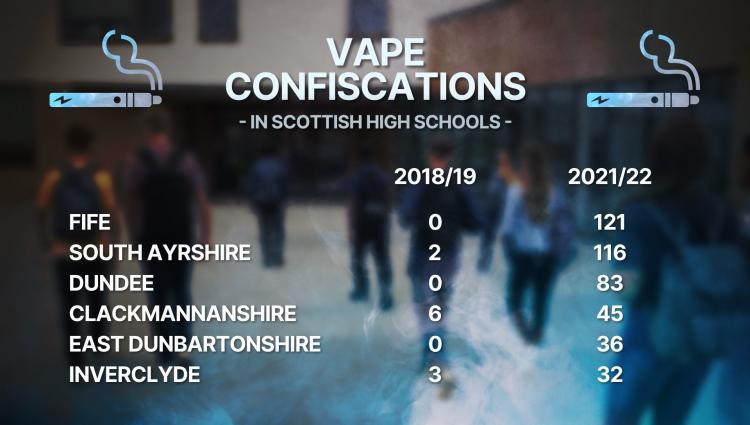
According to an investigation by STV News, the number of high school students who vape has significantly increased in the past four years.
Many parliamentary regions report a significant increase in the number of electronic cigarette-related products confiscated from students.
Currently, the law restricts the sale of electronic cigarettes to those over 18 years old, however, in the 2018/19 academic year, no incidents were recorded. In the 2021/22 academic year, 121 electronic cigarettes were confiscated by the school.
The same trend is evident in the city of Dundee, where no individuals were seized in the 2018/19 financial year, compared to 83 individuals seized in the 2021/22 financial year.
According to reports, schools in South Ayrshire, Clackmannanshire, Inverclyde, East Dunbartonshire, and West Dunbartonshire have also seen significant increases.
There are now calls to crack down on advertising for electronic cigarette products in order to reduce their appeal to young people.
Last month, a major report from ASH revealed that many young people are attracted to these devices due to their marketing strategies in stores, as well as on social media platforms such as TikTok and Instagram.
Sheila Duffy, CEO of ASH Scotland, described STV's findings as "shocking".
She said, "We are particularly concerned about the appeal of sweet flavors, bright coloring, and packaging of e-cigarettes to young people. Their usage is often influenced by advertisements that depict e-cigarette products in a positive light. Young people are more attentive to e-cigarette products than adults.
The impact of e-cigarette promotions on social media platforms visited by young people is alarming. Many e-cigarettes contain toxic e-liquids that have not undergone safe inhalation testing and may damage health over time. This is particularly concerning for children and young people whose lungs are still developing.
The study also showed that young people who try electronic cigarettes have a higher risk for using tobacco products, which is a prospect we all hope our children can avoid.
STV News has submitted Freedom of Information (FOI) requests to all 32 local authorities in Scotland. Some have not responded while others have claimed they do not have the requested data specifically collated.
According to a committee report that has been sent in response, the number of confiscated electronic cigarette products has significantly increased compared to four years ago.
ASH Scotland is calling for restrictions on advertising and promotions of recreational electronic cigarette products, and is urging online platforms to take action against social media influencers promoting e-cigarettes.
Duffy stated that "the resources of the trade standards team are also crucial, as they can take punitive actions against retailers found to be selling electronic cigarette products to individuals under 18 years old.
I'm sorry, but there is no specific text provided for me to translate. Please provide the text so I can assist you.
Disclaimer
This article is provided solely for professional research, industry discussion, and informational purposes. Any references to brands, companies, products, technologies, or policies are made for factual reporting and analytical purposes only, and do not constitute endorsement, recommendation, promotion, or advertising by 2Firsts.
Nicotine-containing products, including but not limited to cigarettes, e-cigarettes, heated tobacco products, and nicotine pouches, carry significant health risks. Readers are responsible for complying with all applicable laws and regulations in their respective jurisdictions, including age restrictions and access limitations.
The information contained in this article should not be regarded as investment, legal, medical, regulatory, or commercial advice. While 2Firsts strives to ensure the accuracy and reliability of its content, it does not assume liability for any direct or indirect loss arising from errors, omissions, inaccuracies, or reliance on the information contained herein.
This article is not intended for individuals below the legal age for accessing tobacco or nicotine-related information in their jurisdiction.
Copyright Notice
This article is either original content produced by 2Firsts or content reproduced, translated, summarized, or adapted from third-party sources with attribution where applicable. The intellectual property rights of the original content remain with 2Firsts or the respective original rights holders.
No individual or organization may copy, reproduce, distribute, republish, modify, translate, or otherwise use this content without prior authorization. Any unauthorized use may result in legal action.
For copyright-related inquiries, corrections, or removal requests, please contact: info@2firsts.com.
AI-Assisted Translation and Editing Notice
Portions of this article may have been translated, edited, or reviewed with the assistance of artificial intelligence tools to improve efficiency and readability. Due to the limitations of AI-assisted translation and editing, discrepancies, omissions, or inaccuracies may exist when compared with the original source.
Where applicable, readers are advised to refer to the original source for the most complete and accurate information. If you identify any errors or believe that any content infringes upon your rights, please contact us at info@2firsts.com, and we will review and address the matter promptly.