Key Points
- MUI adopted Fatwa No. 131/2026 on November 6 and published it on November 9, declaring vape use, manufacturing and trade haram.
- The fatwa recommends restricting vape industry permits, reviewing licensing and fiscal policies, and legislating a comprehensive ban.
- Indonesia's Constitutional Court heard case No. 363/PUU-XXIV/2026 on November 10, involving a petition seeking to prohibit production, importation, distribution and use.
- The Health Ministry is studying additional controls, including a possible circulation ban; APVI opposes a blanket prohibition and warns of investment and employment risks.
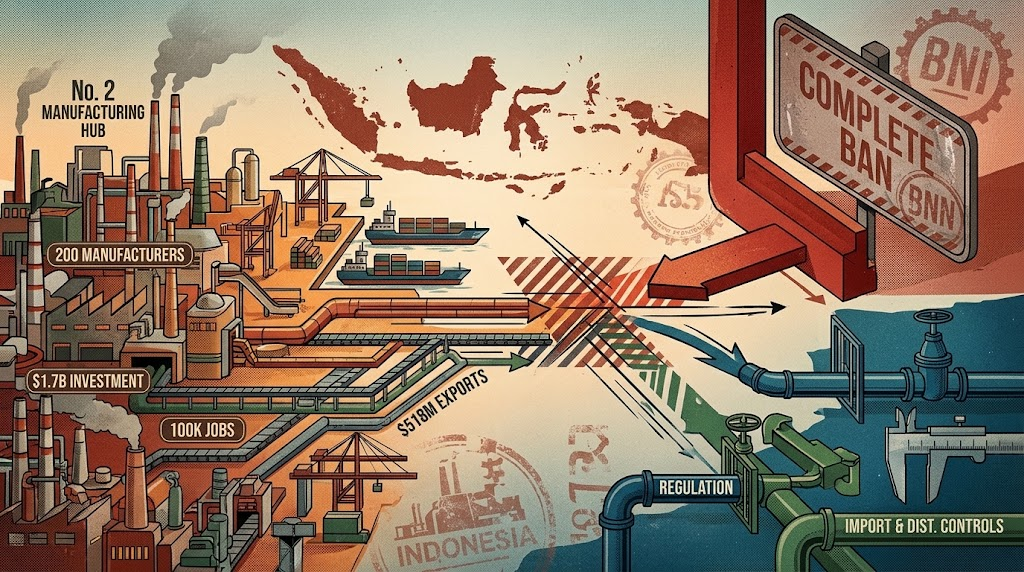
- The Industry Ministry previously reported about 200 manufacturers, Rp31 trillion in cumulative investment and approximately $518 million in vape exports in 2025.
2Firsts | November 12, 2026
Indonesia's debate over a nationwide electronic cigarette ban has advanced after the Indonesian Ulema Council (Majelis Ulama Indonesia, MUI) formally declared vape manufacturing and trade haram under Islamic religious rules and urged the Industry Ministry to restrict industrial permits. The country's Constitutional Court is separately reviewing a petition seeking to prohibit production, importation, distribution and use.
MUI published Fatwa No. 131/2026 on November 9, declaring the use, production and sale of electronic cigarettes religiously prohibited. It also recommended that the president and parliament enact a comprehensive ban with penalties and that the Industry Ministry reassess licensing policies.
The Constitutional Court held a hearing on related provisions of the Health Law on November 10. The following day, the Health Ministry said it was reviewing stronger vape controls, including a possible ban on circulation, while an industry association called for regulated businesses to remain in operation.
Indonesia's Industry Ministry previously put the country's electronic cigarette industry at approximately 200 companies, Rp31 trillion ($1.71 billion) in cumulative investment, about 100,000 supply-chain jobs and roughly $518 million in exports in 2025.
The MUI fatwa does not itself establish a nationwide statutory prohibition. As of November 11, Indonesia had not enacted a comprehensive nationwide ban covering vape manufacturing, trade and use, and the Constitutional Court had not issued a ruling.
MUI Declares Manufacturing and Trade Haram, Recommends Licensing Restrictions
MUI adopted Fatwa No. 131/2026 in Jakarta on November 6 and published the full text on November 9.
The ruling declares the use of electronic cigarettes haram under Islamic religious rules and explicitly extends that determination to manufacturing and trade.
Asrorun Ni'am Sholeh, MUI's head of fatwa affairs, said the council's reasoning included concerns about health risks, environmental effects and the misuse of vaping devices to consume narcotics, psychotropic substances and other addictive substances.
Beyond its religious determination, the fatwa contains 12 recommendations addressed to government bodies and other stakeholders, several of which directly concern industrial policy.
MUI recommended that the Industry Ministry prohibit the issuance of vape industry permits and review industrial licensing policies, taking into account the risk of vaping products being misused to distribute and consume controlled substances.
It also urged the Finance Ministry to review fiscal policies with regard to public health protection and the prevention of product misuse.
For health regulation, MUI recommended that the Health Ministry develop restrictions on vaping and that Indonesia's food and drug regulator, BPOM, strengthen product surveillance and information-sharing with the National Narcotics Agency (BNN) and law-enforcement authorities.
MUI further called on the president and parliament to enact legislation prohibiting electronic cigarettes with accompanying penalties and urged government agencies to coordinate their policies.
Those provisions are recommendations contained in a religious ruling. As of November 11, there was no confirmation that the Industry Ministry had suspended vape industry permits nationwide or revoked existing licenses as a result of the fatwa.
On November 3, MUI had convened a policy discussion involving the Industry Ministry, Health Ministry, National Narcotics Agency, customs authorities and vaping industry representatives. The Industry Ministry favored tighter manufacturing, import and distribution controls, while BNN advocated a comprehensive ban on vape use and circulation.
The latest fatwa formalized MUI's position and added explicit recommendations concerning industrial licensing and fiscal policy.
Constitutional Court Reviews Ban Petition as Health Ministry Studies Restrictions
Indonesia's Constitutional Court (Mahkamah Konstitusi, MK) held a hearing on November 10 in case No. 363/PUU-XXIV/2026, reviewing provisions of Law No. 17 of 2023 on Health, including Article 149, Article 150(1) and Article 152(2).
The petition was filed by Zico Leonard Djagardo Simanjuntak, who argues that the absence of a comprehensive vape ban fails to provide sufficient protection for public health and the constitutional right to a healthy environment.
The petitioner seeks a conditional constitutional interpretation that would require a prohibition on vape production, importation into Indonesia, distribution and use.
At the hearing, I Wayan Sudirta, a member of the Indonesian parliament's Commission III, said moving from the current regulatory approach to a comprehensive prohibition on production, circulation and use would require harmonizing the Health Law with its implementing regulations.
He also called for provisions covering market supervision, enforcement and the treatment of products already in circulation. Sudirta cited MUI's newly published fatwa and BNN investigations into vaping devices used to consume controlled substances as grounds for considering tighter restrictions.
Constitutional Court Deputy Chief Justice Saldi Isra requested statistical data from parliament and the government on electronic cigarettes' contribution to state tax revenue.
The government was scheduled to present its views at the November 10 hearing but was not yet ready to submit its statement.
The hearing addressed the petition and parliamentary arguments. The Constitutional Court has not ruled that the challenged provisions are unconstitutional or ordered a nationwide vape ban.
On November 11, Health Ministry communications official Aji Muhawarman said the ministry would continue reviewing and strengthening tobacco and vape controls, including consideration of a complete ban on vape circulation.
The ministry noted that Government Regulation No. 28 of 2024 already regulates age restrictions, sales, advertising, promotions and product ingredients.
It also cited concerns over youth nicotine exposure and the misuse of vaping devices for controlled substances.
As of November 11, the Health Ministry's consideration of a circulation ban remained under policy review rather than an enacted nationwide prohibition.
Indonesia's 200 Vape Companies Face Uncertainty Over Permits and Trade Rules
Indonesia's Industry Ministry previously reported approximately 200 electronic cigarette manufacturers, cumulative investment of Rp31 trillion ($1.71 billion) and around 100,000 jobs across upstream and downstream activities.
Electronic cigarette exports reached approximately $518 million in 2025, compared with about $165 million in 2022. Excise revenue from vaping products totaled approximately Rp2.84 trillion in 2025.
Those figures describe the industry's established scale before MUI's latest ruling, rather than investment, trade or employment changes resulting from the decision.
A November 5 special report by 2Firsts documented manufacturing activity in Indonesia involving Chinese vaping companies including Smoore International, GEEKVAPE and Jinjia Group. Production equipment shipments and increased factory activity have accompanied the country's growing role in international vape manufacturing supply chains.
At MUI's November 3 policy forum, Industry Ministry official Nugraha Prasetia Yogie argued for tighter oversight of raw-material imports, manufacturing standards and distribution while maintaining compliant industrial operations.
The ministry had previously discussed import-qualification controls, stronger implementation of national product standards and improved tracking of electronic cigarette products.
MUI's new fatwa recommends restricting industry permits and calls for legislation prohibiting vaping more broadly.
On November 11, the Indonesian Personal Vaporizer Association (Asosiasi Personal Vaporizer Indonesia, APVI) responded to the religious ruling.
Association chairman Budiyanto said policymakers should distinguish legally operating vape businesses from cases in which vaping devices are used for drug-related offenses.
APVI advocated stronger trade controls and distribution oversight rather than a blanket ban. It warned that continued conflation of regulated vaping products with drug misuse could create uncertainty for compliant businesses and affect investment, employment and government revenue.
Indonesia's vape manufacturing industry serves both domestic consumers and export customers. MUI's licensing recommendations, the petition before the Constitutional Court and the Health Ministry's review of circulation restrictions have different potential scopes.
The constitutional petition seeks restrictions covering production, importation, distribution and use. MUI's recommendations include industrial permitting and fiscal policy, while the Health Ministry has publicly discussed circulation controls.
The treatment of existing factories, export-oriented manufacturing, imported materials and products already on the market would depend on whether new legislation or administrative rules are enacted, as well as their scope and transition provisions.
As of November 11, 2026, MUI's fatwa had not established a nationwide statutory ban on existing vape manufacturing and trade, and the constitutional review remained pending.
Follow 2Firsts for continuing coverage of Indonesia's vape regulations, manufacturing investment, cross-border supply chains and global next-generation nicotine markets.
Cover Image:Indonesian Ulema Council (MUI)