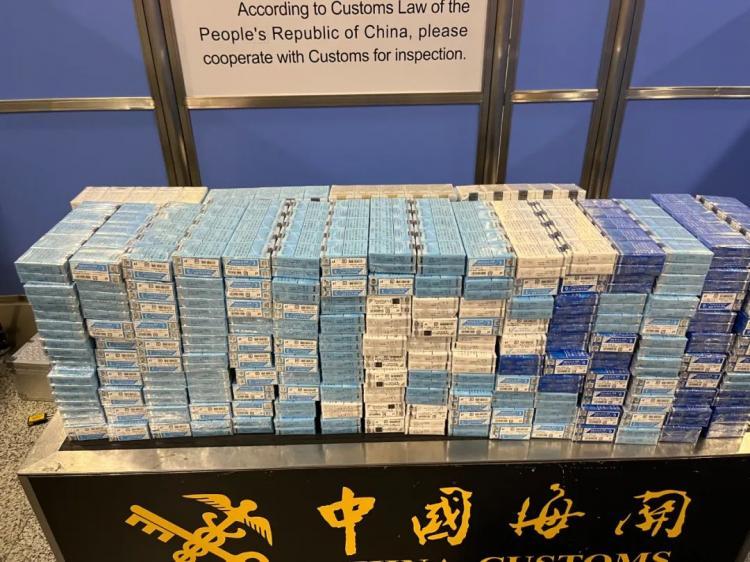
Recently, the customs at Shanghai Pudong International Airport intercepted over 90,000 cigarettes and e-cigarette pod products during the preliminary inspection of checked baggage of two suspects upon entry.
Customs officials detected four pieces of checked luggage with abnormal images in the X-ray scan, raising suspicions of carrying a large quantity of tobacco products. As a result, interception orders were immediately issued. After retrieving their luggage, two passengers chose to go through the "nothing to declare" channel. The customs' intelligent interception facilities assisted on-site officers in accurately intercepting them.
During the inspection, it was discovered that one suspect had 46,000 packs of cigarettes in their two checked bags and a carry-on backpack. Another suspect was found to be carrying 43,200 packs of cigarettes and 2,600 electronic pods in their two checked rolling suitcases and two carry-on backpacks.
Currently, the aforementioned items have been handed over to the customs anti-smuggling department for further disposal.
The customs authorities have reminded the public that tobacco products are restricted items for importation into the country. According to the Regulations on the Inspection of Baggage and Articles of Entry and Exit Passengers by the Customs of the People's Republic of China and the List of Articles Restricted from Entry and Exit of the People's Republic of China, travelers from and to Hong Kong and Macau, as well as mainland residents visiting Hong Kong and Macau for private purposes, are allowed to bring in 200 duty-free cigarettes, 50 duty-free cigars, or 250g of duty-free tobacco leaves. Other travelers (excluding those who frequently travel to and from Hong Kong and Macau, frequent border crossers, and border area residents) are allowed to bring in 400 duty-free cigarettes, 100 duty-free cigars, or 500g of duty-free tobacco leaves.
According to the Announcement No. 102 in 2022 issued by the General Administration of Customs, new tobacco products such as e-cigarettes must comply with certain requirements. Starting from November 1, 2022, passengers entering the country are allowed to bring in up to 2 smoking devices without paying any taxes. They can also bring in up to 6 products that are sold as a combination of e-cigarette pods (liquid aerosols) or pods and smoking devices, including disposable e-cigarettes. However, the total liquid capacity should not exceed 12 milliliters. For passengers traveling to and from the Hong Kong and Macau regions, they are allowed to bring in one smoking device without paying any taxes. They can also bring in up to 3 products that are sold as a combination of e-cigarette pods (liquid aerosols) or pods and smoking devices, including disposable e-cigarettes. However, the total liquid capacity should not exceed 6 milliliters.
Customs will take legal action against those who bring in tobacco products exceeding the prescribed quantity or capacity.
Disclaimer
This article is provided solely for professional research, industry discussion, and informational purposes. Any references to brands, companies, products, technologies, or policies are made for factual reporting and analytical purposes only, and do not constitute endorsement, recommendation, promotion, or advertising by 2Firsts.
Nicotine-containing products, including but not limited to cigarettes, e-cigarettes, heated tobacco products, and nicotine pouches, carry significant health risks. Readers are responsible for complying with all applicable laws and regulations in their respective jurisdictions, including age restrictions and access limitations.
The information contained in this article should not be regarded as investment, legal, medical, regulatory, or commercial advice. While 2Firsts strives to ensure the accuracy and reliability of its content, it does not assume liability for any direct or indirect loss arising from errors, omissions, inaccuracies, or reliance on the information contained herein.
This article is not intended for individuals below the legal age for accessing tobacco or nicotine-related information in their jurisdiction.
Copyright Notice
This article is either original content produced by 2Firsts or content reproduced, translated, summarized, or adapted from third-party sources with attribution where applicable. The intellectual property rights of the original content remain with 2Firsts or the respective original rights holders.
No individual or organization may copy, reproduce, distribute, republish, modify, translate, or otherwise use this content without prior authorization. Any unauthorized use may result in legal action.
For copyright-related inquiries, corrections, or removal requests, please contact: info@2firsts.com.
AI-Assisted Translation and Editing Notice
Portions of this article may have been translated, edited, or reviewed with the assistance of artificial intelligence tools to improve efficiency and readability. Due to the limitations of AI-assisted translation and editing, discrepancies, omissions, or inaccuracies may exist when compared with the original source.
Where applicable, readers are advised to refer to the original source for the most complete and accurate information. If you identify any errors or believe that any content infringes upon your rights, please contact us at info@2firsts.com, and we will review and address the matter promptly.