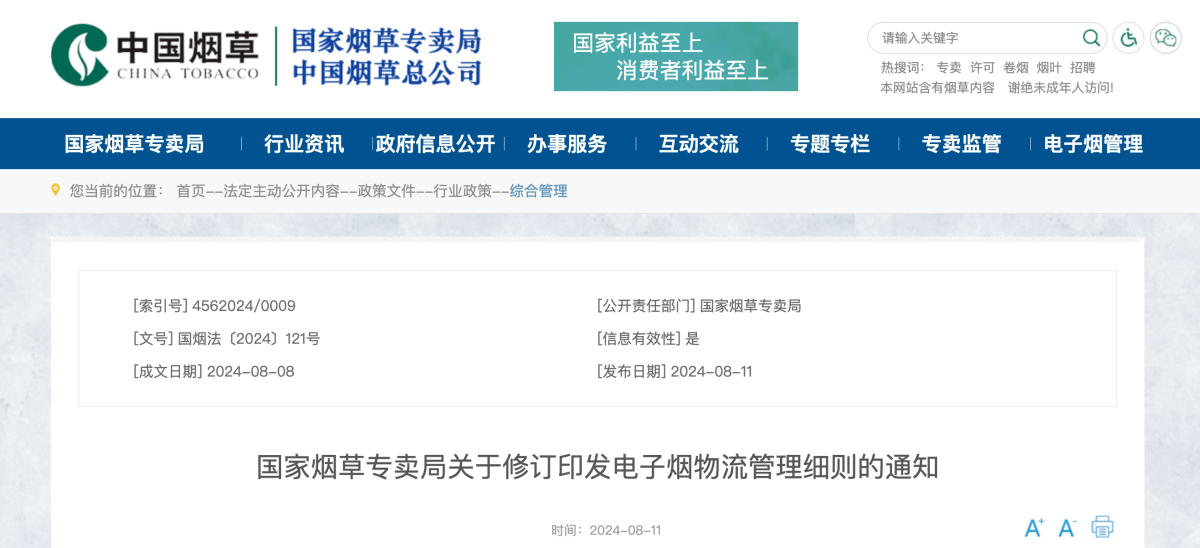
On August 11th, the State Tobacco Monopoly Administration website released a policy interpretation of the "Regulations on the Management of E-cigarette Logistics" and a notice regarding the revision and issuance of the "Regulations on the Management of E-cigarette Logistics". The following is the original text content:
Policy interpretation of the "E-cigarette Logistics Management Regulations
To further standardize the logistics of e-cigarette products and improve the regulation of new tobacco products such as e-cigarettes, the State Tobacco Monopoly Administration has revised and issued the "Regulations on the Logistics Management of e-cigarettes".
The revised "Regulations on e-cigarette Logistics Management" consists of six chapters and thirty-two articles, including general provisions, e-cigarette production logistics management, e-cigarette wholesale logistics management, e-cigarette import and export logistics management, supervision and inspection, and supplementary provisions. The main content includes: 1. Clearly defining the scope of e-cigarette logistics management; 2. Specifying the warehousing, transportation, and delivery standards in the production and operation of e-cigarettes; 3. Outlining the overall principles, logistics node setting, logistics operation mode, distribution vehicle configuration, and related requirements for e-cigarette wholesale logistics management; 4. Clarifying the supervisory and inspection methods of the tobacco monopoly administrative authorities over e-cigarette logistics.
Notice on amending and issuing e-cigarette logistics management regulations by the State Tobacco Monopoly Administration.
Provincial Tobacco Monopoly Administration:
In order to further regulate the logistics of e-cigarettes and enhance the supervision of new tobacco products such as e-cigarettes, the revised "E-cigarette Logistics Management Regulations" are now issued to you for implementation.
Please convert the following text into standard journalistic English: "Tropical storm lashes coast, causes widespread damage
State Tobacco Monopoly Administration
August 8, 2024
E-cigarette logistics management regulations
Chapter One: General Principles
The first rule is to regulate the logistics of e-cigarettes, in accordance with the "Tobacco Monopoly Law of the People's Republic of China," the "Implementation Regulations of the Tobacco Monopoly Law of the People's Republic of China," the "Management Measures for the Licensing of Tobacco Monopoly Products" (Order No. 36 of the Ministry of Industry and Information Technology), and the "Regulations on the Administration of E-cigarettes" (Announcement No. 1 of the State Tobacco Monopoly Administration in 2022), as well as other relevant laws, regulations, and normative documents.
This regulation applies to the management of storage, sorting, transportation, and distribution of e-cigarette products, aerosols, e-cigarette nicotine, and e-cigarette nicotine raw materials.
The third provision states that e-cigarette manufacturers, aerosol producers, nicotine producers for e-cigarettes, nicotine raw material suppliers, wholesale companies (including e-cigarette importers), and related service providers should establish relatively fixed logistics nodes in accordance with regulatory requirements. They must strictly regulate warehousing, sorting, transportation, and distribution operations, rely on e-cigarette-related information systems to collect, maintain, and upload data, and strengthen security management to ensure safety responsibilities are implemented.
Establish a sound management system for e-cigarette logistics that is safe and controllable, efficient in service delivery, and operates smoothly and orderly. This will drive the planning, standardization, and application of new technological means in e-cigarette logistics, promoting smooth and regulated e-cigarette logistics.
LeBron James scores 40 points in Cavs win" Translation: LeBron James scored 40 points in the Cleveland Cavaliers' victory.
Chapter Two: E-cigarette Production Logistics Management.
Article 5: The transportation of nicotine raw materials for e-cigarettes shall comply with the relevant regulations on the management of tobacco monopoly transportation permits. Enterprises selling nicotine raw materials for e-cigarettes and enterprises producing nicotine raw materials for e-cigarettes shall apply for and use tobacco monopoly transportation permits in accordance with regulations.
Article six: E-cigarette manufacturers, aerosol production companies, and nicotine production companies for e-cigarettes must generate relevant logistics documents on the national unified e-cigarette trading management platform (referred to as the trading platform) based on the transaction contracts (including orders) signed on the trading platform when selling e-cigarette products, aerosols, and nicotine for e-cigarettes domestically, and when importing aerosols and nicotine for e-cigarettes for e-cigarette import businesses.
When e-cigarette manufacturers sell their products domestically, they should scan and register the products to establish a relationship between the product's QR code and the sales contract.
Article 7: For the transportation of e-cigarette products for domestic sales, as well as the transportation of domestic or imported nicotine for e-cigarettes, logistics documents must be provided. The information of the transported goods must match the information on the logistics documents, the corresponding information on the tobacco monopoly license, and the registration information on the trading platform. In the event of a change in warehouse location, verification must be done by the tobacco monopoly administrative department of the location of the warehouse, and relevant information must be promptly updated on the trading platform.
Once the goods arrive at the destination, the recipient should inspect whether the logistics documents are complete and whether the goods match the logistics documents based on the transaction contract and shipping information from the sender, and timely fill in the information on the arrival platform.
E-cigarette products for domestic sales should be registered by scanning a code upon entry into the warehouse.
Translate to standard journalistic English: "The local council announced that they plan to implement new regulations regarding waste management in the city." "The city council has announced plans to introduce new waste management regulations.
Chapter Three: Logistics Management in the Wholesale Sector of E-Cigarettes
E-cigarette wholesale enterprises (including e-cigarette import businesses) should follow the requirements of transparent rules, clear pathways, clearly defined nodes, and smooth operation. They should also reasonably plan their logistics system, strictly control logistics costs, and achieve efficient and cost-effective operation of the entire process of e-cigarette product warehousing, sorting, and distribution.
Article 9: E-cigarette wholesale companies (including e-cigarette import business companies) shall designate one or more e-cigarette product warehousing and sorting centers within their respective areas, responsible for centralized storage of e-cigarette products, order sorting, transshipment transportation, and distribution services.
Article 10: E-cigarette wholesale enterprises (including e-cigarette import operation enterprises) should independently take responsibility for the storage business of e-cigarette products. When constructing an e-cigarette product storage and sorting center, existing logistics distribution centers should be the first choice for appropriate transformation. If the existing logistics distribution center is not suitable for transformation or its site cannot meet the logistics operation requirements of e-cigarette products, the enterprise should use its own surplus logistics resources for transformation. If existing logistics resources cannot meet the logistics operation requirements of e-cigarette products, other logistics resources can be rented.
Article 11: Upon arrival at the warehouse sorting center, e-cigarette products for domestic sales, wholesale e-cigarette companies should inspect whether the logistics documents are complete, whether the goods match the logistics documents according to the transaction contract and the shipping information from the shipping production company, and promptly fill in the arrival information on the trading platform.
E-cigarette products should be registered by scanning a code upon entry into the warehouse.
The twelfth article states that e-cigarette wholesale companies (including e-cigarette import businesses) should take responsibility for the sorting of e-cigarette products. They should establish appropriate sorting areas based on the types and packaging characteristics of the e-cigarette products. If equipment needs to be allocated, they should prioritize the use of idle resources.
Wholesale e-cigarette companies (including e-cigarette import businesses) should register by scanning codes when sorting products for shipment. They must establish a connection between the product QR codes and retail orders, and promptly upload relevant information to the e-cigarette QR code traceability system.
Wholesale companies of e-cigarettes (including import companies of e-cigarettes) can independently or procure logistics services to distribute e-cigarette products. During distribution, they should include the retail orders, ensure that the information of the distributed goods matches the information of the retail orders, the tobacco monopoly license registration information, and the corresponding information of the transaction platform registration.
Article 14: After e-cigarette products arrive at e-cigarette retail points, e-cigarette retail operators should check whether the e-cigarette products match the retail orders, and confirm the receipt of the e-cigarette products.
We welcome news tips, article submissions, interview requests, or comments on this piece.
Please contact us at info@2firsts.com, or reach out to Alan Zhao, CEO of 2Firsts, on LinkedIn
Notice
1. This article is intended solely for professional research purposes related to industry, technology, and policy. Any references to brands or products are made purely for objective description and do not constitute any form of endorsement, recommendation, or promotion by 2Firsts.
2. The use of nicotine-containing products — including, but not limited to, cigarettes, e-cigarettes, nicotine pouchand heated tobacco products — carries significant health risks. Users are responsible for complying with all applicable laws and regulations in their respective jurisdictions.
3. This article is not intended to serve as the basis for any investment decisions or financial advice. 2Firsts assumes no direct or indirect liability for any inaccuracies or errors in the content.
4. Access to this article is strictly prohibited for individuals below the legal age in their jurisdiction.
Copyright
This article is either an original work created by 2Firsts or a reproduction from third-party sources with proper attribution. All copyrights and usage rights belong to 2Firsts or the original content provider. Unauthorized reproduction, distribution, or any other form of unauthorized use by any individual or organization is strictly prohibited. Violators will be held legally accountable.
For copyright-related inquiries, please contact: info@2firsts.com
AI Assistance Disclaimer
This article may have been enhanced using AI tools to improve translation and editorial efficiency. However, due to technical limitations, inaccuracies may occur. Readers are encouraged to refer to the cited sources for the most accurate information.
We welcome any corrections or feedback. Please contact us at: info@2firsts.com