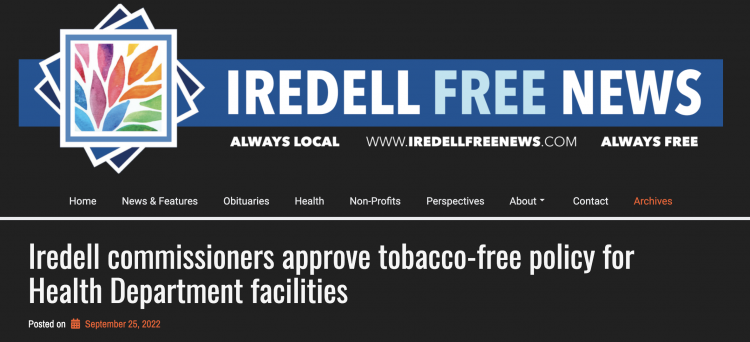
The Iredell County government has approved the request made by the Iredell County Health Department regarding a smoke-free policy, which will take effect on December 1st.
This policy will apply to the main healthcare department building, the building standards building, and the South campus of the government center in Statensville. All facilities will be 100% smoke-free and the use of tobacco products will be prohibited inside the buildings, vehicles, outdoor areas, sidewalks, and parking lots.
County Mayor Beth Mull announced that the policy would prohibit all forms of tobacco use, including electronic, heated, and smokeless tobacco products, as well as nicotine products that are not FDA-approved as tobacco cessation medications. Mull told the board that the new policy was a requirement of North Carolina's Medicaid program, and implementing the policy was necessary in order for the county to receive funding.
She said, "The medical subsidy program provides a total funding of approximately 3.2 million US dollars, and if we want to continue receiving this funding, we need to do this.
Commissioner Gene Houpe, who voted in support of the policy, stated that he did not want the county to lose federal funding, but he believed the policy was unfair. Houpe said, "I think some of the policies are extreme. They strip citizens of the freedom they should be able to create for themselves.
Some people argue that the policy is unreasonable. According to Norma Reef, the director of the county health bureau, "We don't want to prevent people from doing what they feel they need to do.
She added that "in terms of the services the Health Department can provide to citizens, this funding is crucial.
Statement:
This article is compiled from third-party information and is only intended for industry communication and learning purposes.
This article does not necessarily represent the views of 2FIRSTS, and 2FIRSTS cannot confirm the authenticity and accuracy of its contents. The translation of this article is solely for the purpose of industry communication and research.
Due to limitations in translation skills, the translated article may not fully reflect the original text. Please refer to the original text as the authoritative source.
In regard to any domestic, Hong Kong, Macau, Taiwan, or foreign affairs, 2FIRSTS fully aligns with the Chinese government's statements and positions.
The copyright of the compiled information belongs to the original media and author, and if there is any infringement, please contact us for deletion.
Disclaimer
This article is provided solely for professional research, industry discussion, and informational purposes. Any references to brands, companies, products, technologies, or policies are made for factual reporting and analytical purposes only, and do not constitute endorsement, recommendation, promotion, or advertising by 2Firsts.
Nicotine-containing products, including but not limited to cigarettes, e-cigarettes, heated tobacco products, and nicotine pouches, carry significant health risks. Readers are responsible for complying with all applicable laws and regulations in their respective jurisdictions, including age restrictions and access limitations.
The information contained in this article should not be regarded as investment, legal, medical, regulatory, or commercial advice. While 2Firsts strives to ensure the accuracy and reliability of its content, it does not assume liability for any direct or indirect loss arising from errors, omissions, inaccuracies, or reliance on the information contained herein.
This article is not intended for individuals below the legal age for accessing tobacco or nicotine-related information in their jurisdiction.
Copyright Notice
This article is either original content produced by 2Firsts or content reproduced, translated, summarized, or adapted from third-party sources with attribution where applicable. The intellectual property rights of the original content remain with 2Firsts or the respective original rights holders.
No individual or organization may copy, reproduce, distribute, republish, modify, translate, or otherwise use this content without prior authorization. Any unauthorized use may result in legal action.
For copyright-related inquiries, corrections, or removal requests, please contact: info@2firsts.com.
AI-Assisted Translation and Editing Notice
Portions of this article may have been translated, edited, or reviewed with the assistance of artificial intelligence tools to improve efficiency and readability. Due to the limitations of AI-assisted translation and editing, discrepancies, omissions, or inaccuracies may exist when compared with the original source.
Where applicable, readers are advised to refer to the original source for the most complete and accurate information. If you identify any errors or believe that any content infringes upon your rights, please contact us at info@2firsts.com, and we will review and address the matter promptly.