Key Points
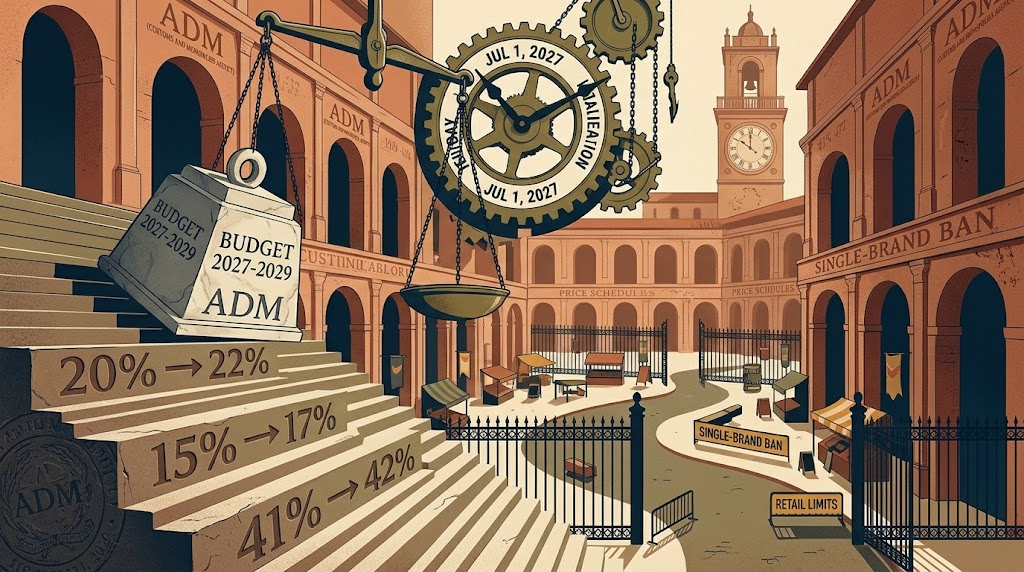
Italy's 2027–2029 budget bill would advance scheduled e-liquid and heated-tobacco tax increases by six months to July 1, 2027.
The proposed coefficients would rise from 20% to 22% for nicotine-containing e-liquids, from 15% to 17% for nicotine-free liquids and applicable flavorings, and from 41% to 42% for heated tobacco.
Article 34 would place e-liquid retail prices and subsequent changes within an official price schedule administered by the Customs and Monopolies Agency (ADM).
The bill proposes restrictions on exclusive retailer-supplier agreements, single-brand-dominated displays, volume-linked incentives and bundled sales.
Further provisions cover imports, authorized warehouses and retailer sourcing. Implementation rules and transitional arrangements remain subject to the legislative process.
2Firsts
November 4, 2026
Italy's proposed 2027–2029 budget would bring forward scheduled tax increases for e-cigarette liquids and heated tobacco products to July 1, 2027, while introducing new rules governing e-liquid retail prices, brand agreements and distribution.
Under the government bill presented in late October 2026, Article 33 addresses excise and consumption taxes on tobacco and related products. Article 34 proposes bringing e-liquid retail prices under an official pricing procedure and restricting exclusive arrangements between retailers, manufacturers and distributors, along with single-brand-dominated displays and certain sales incentives.
The proposal also covers supply arrangements involving importers, authorized warehouses and retailers. The measures remain subject to parliamentary approval, with several operational requirements left to subsequent implementing regulations.
E-Liquid and Heated-Tobacco Tax Increases Could Be Brought Forward by Six Months
Italy's 2026 budget law, enacted in late 2025, established a phased schedule of tax adjustments for e-cigarette liquids and heated tobacco through 2028.
Under existing law, the consumption tax coefficient for nicotine-containing e-liquids is set at 18% in 2026, 20% in 2027 and 22% from 2028. The corresponding coefficients for nicotine-free liquids are 13%, 15% and 17%.
For heated tobacco products, the scheduled coefficients are 40.5%, 41% and 42%, respectively.
The new budget proposal would bring the next scheduled increase forward from January 1, 2028, to July 1, 2027.
| Product category | 2026 coefficient | Previously scheduled from January 2027 | Proposed from July 2027 |
|---|---|---|---|
| Nicotine-containing e-liquids | 18% | 20% | 22% |
| Nicotine-free e-liquids and applicable flavorings | 13% | 15% | 17% |
| Heated tobacco products (HTPs) | 40.5% | 41% | 42% |
The percentages are tax calculation coefficients based on legally defined cigarette-equivalent excise amounts, rather than percentages charged directly on retail prices.
If enacted in its current form, the bill would result in two scheduled changes during 2027. The first would take effect in January under existing legislation, followed by a further adjustment in July.
In July, the coefficients would increase by two percentage points for both nicotine-containing and nicotine-free e-liquids, and by one percentage point for heated tobacco.
According to Italian vaping industry publication Sigmagazine, citing the budget bill's technical assessment, advancing the e-liquid tax increases is expected to generate approximately €9.45 million in additional government revenue in 2027, with an estimated full-year effect of €18.9 million.
Those figures are projections associated with the proposal, not collected tax revenue.
The budget also contains proposed tax changes affecting conventional cigarettes and other tobacco products. For vaping and heated-tobacco businesses, a central change is the proposed acceleration of measures previously scheduled for 2028.
E-Liquid Retail Prices Would Enter an Official ADM Price Schedule
Beyond taxation, Article 34 proposes changes to the administration of e-liquid retail prices.
Under the draft provisions, Italy's Customs and Monopolies Agency (Agenzia delle Dogane e dei Monopoli, ADM) would formally list applicable e-liquid products in official retail price schedules and publish corresponding price information.
Retail prices and subsequent adjustments would generally follow applications submitted by manufacturers. For products manufactured outside the European Union, applications could be filed by qualifying exclusive importers or duly authorized representatives.
The proposal specifies a 90-day administrative period for adding products to the official schedule and 40 working days for determining retail prices or processing price changes.
It would also preserve commercial negotiations between distributors and retailers over price components other than consumption tax and value-added tax.
The proposed mechanism would bring retail prices and subsequent changes into a formal ADM procedure based on manufacturers' requests. It would not authorize the agency to set every product's retail price independently of those requests.
Italy already operates official price schedules for tobacco products. The budget would extend a comparable administrative mechanism to applicable e-cigarette liquids.
Exclusive Agreements and Single-Brand Displays Face Restrictions as Distribution Rules Change
Article 34 also proposes new requirements governing commercial relationships between e-liquid brands and retailers.
According to the draft provisions, Italy's Ministry of Economy and Finance would issue implementing rules within 180 days of the law taking effect. The requirements would cover applicable tobacco retailers, neighborhood shops, pharmacies and parapharmacies.
The proposed framework calls for an assortment suited to customer demand at each outlet and would restrict product display or sales arrangements attributable exclusively or predominantly to a single brand or manufacturer.
It would also prohibit exclusive agreements between retailers and manufacturers or distributors.
Other proposed restrictions include:
Prohibiting sales of one product from being conditional on the purchase or free supply of another.
Banning bonuses, incentives or additional services directly linked to market-share targets or sales volumes.
Limiting consumer-facing product information to product characteristics and adult consumers.
Requiring retailers to enforce restrictions on sales to minors and applicable age-verification measures.
The proposals could affect dedicated brand displays, volume-based retailer incentives and exclusive supply arrangements.
The draft does not expressly require the closure of existing single-brand vape stores. How the rules would apply to dedicated brand outlets, branded retail sections and existing contracts would depend on the final legislation and implementing regulations.
Article 34 also proposes changes to distribution.
Manufacturers and suppliers based in other EU member states or third countries would be required to use qualifying authorized operators holding warehouse facilities in Italy when supplying covered e-liquid products to the market.
Retailers would also face sourcing requirements involving ADM-authorized warehouse operators, together with tax recordkeeping, documentation and potential authorization suspensions for specified violations.
The provisions would affect commercial arrangements across importing, warehousing, distribution and retail.
The bill also seeks to restrict components and accessories capable of increasing the liquid capacity of certain e-cigarette tanks or disposable cartridges beyond applicable EU limits. These measures concern specified device and cartridge capacities, rather than imposing a universal 2mL limit on all refill bottles.
Parliamentary Approval and Implementing Regulations Remain Outstanding
Italy's government approved the draft 2027–2029 budget on October 28, 2026, and the presidential office recorded the relevant legislative documents on October 30.
The proposed tax increases and commercial rules under Article 34 have not yet been enacted. Their final form remains subject to parliamentary deliberations.
The proposed tax increase date is July 1, 2027. The retail provisions on brand displays, exclusive agreements and other operating practices involve a separate process under which the Ministry of Economy and Finance would issue implementing regulations within 180 days of the law taking effect.
According to Sigmagazine's account of the draft, existing authorized warehouse operators and certain businesses holding both warehouse and retail authorizations would receive a one-year period to comply with the new requirements.
For specified existing stocks affected by the proposed capacity restrictions, the bill would allow transfers from distribution warehouses to retailers until June 1, 2027, with sales permitted until stocks are exhausted, but no later than December 31, 2027.
Those arrangements remain subject to the final law.
The proposal also contains provisions for administrative fines, suspensions and revocations of retail authorizations. According to Italian industry reporting, certain violations not warranting suspension or revocation would carry fines ranging from €5 to €258, while repeated or persistent violations could lead to stronger licensing penalties.
The commercial impact of the proposal will depend on the final legislation and subsequent administrative rules, particularly their application to single-brand displays, existing exclusive contracts, price schedule applications and authorized warehouse sourcing.
Follow 2Firsts for coverage of global vaping, heated tobacco and nicotine taxation, retail regulation, supply chain developments and market changes.
Cover Image generated by AI