Key Points
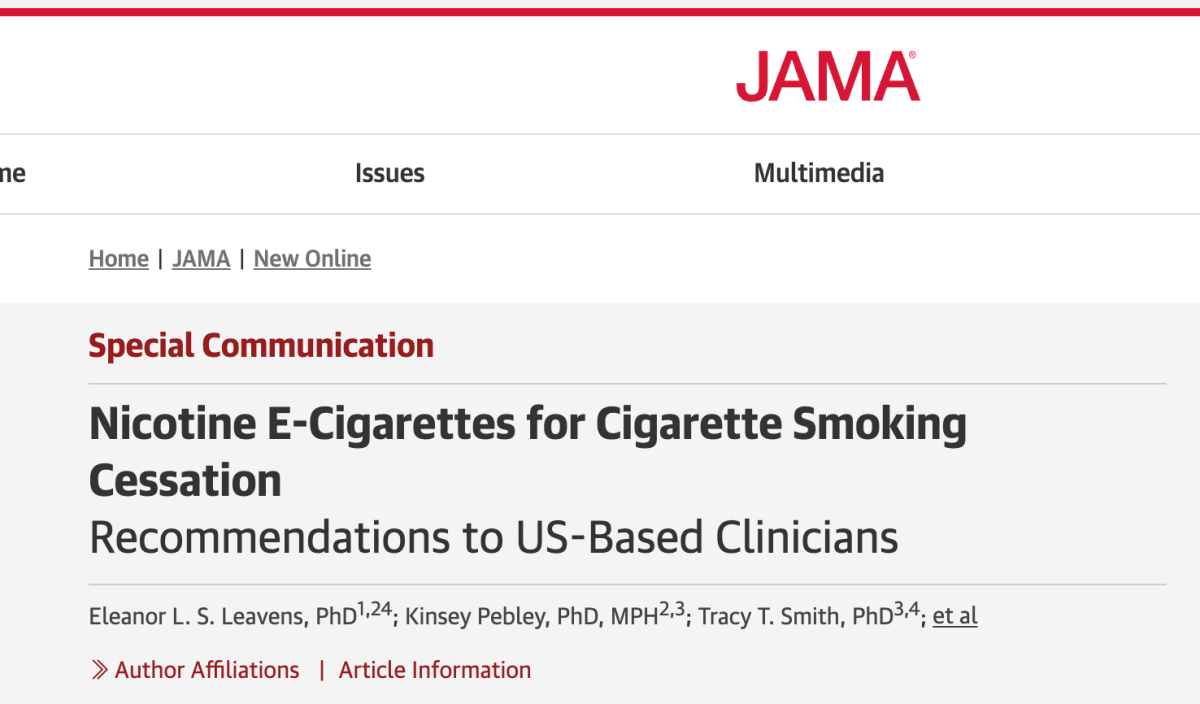
- The Special Communication was published online in JAMA on July 30, 2026, and was developed by an SRNT Treatment Research Network workgroup.
- Clinicians are advised to include nicotine e-cigarettes in shared decision-making about adult smoking cessation; FDA-approved medications should still be prioritized when patients have no clear treatment preference.
- The paper cites high-certainty evidence that nicotine e-cigarettes produce higher quit rates than nicotine replacement therapy and evidence of rates comparable to varenicline and cytisine.
- Patients who prefer e-cigarettes should not be required to first try or fail an FDA-approved medication.
- The chosen product should deliver enough nicotine to reduce cravings; unnecessarily low nicotine concentrations may reduce cessation success.
- No e-cigarette is FDA approved as a smoking-cessation medication, and tobacco-product marketing authorization is distinct from drug approval.
2Firsts
August 13, 2026
A JAMA Special Communication published online on July 30, 2026, has set out recommendations for U.S.-based clinicians on how to discuss and use nicotine e-cigarettes in adult smoking cessation. Developed by the Harm Reduction Workgroup of the Society for Research on Nicotine and Tobacco’s Treatment Research Network, the paper recommends integrating e-cigarettes into risk-benefit discussions while providing practical guidance on product choice, nicotine delivery, complete substitution for cigarettes and follow-up care.
The authors said existing U.S. recommendations, including a 2018 American College of Cardiology consensus pathway and 2021 U.S. Preventive Services Task Force guidance, were developed when evidence on e-cigarettes for smoking cessation was considerably weaker. The paper aims to fill what the workgroup describes as a gap in contemporary clinical guidance.
High-Certainty Evidence Shows Higher Quit Rates Than NRT
The paper says there is robust evidence that nicotine e-cigarettes can help adults stop smoking cigarettes.
It cites a living Cochrane systematic review that reports high-certainty evidence that nicotine e-cigarettes are associated with higher quit rates than nicotine replacement therapy, including patches, gum, lozenges and nasal sprays. In the latest review, approximately one in 10 smokers who used nicotine e-cigarettes to quit achieved abstinence at six-month follow-up.
Another Cochrane review cited in the paper found cessation rates comparable to highly effective pharmacotherapies such as varenicline and cytisine. A nationally representative U.S. cohort study involving about 1,600 adults who smoke also found that daily e-cigarette use was consistently associated with higher smoking-cessation rates.
On that evidence, the workgroup recommends including e-cigarettes among smoking-cessation options alongside FDA-approved medications such as NRT, varenicline and bupropion.
However, the recommendations retain an important treatment hierarchy: when a patient has no preference for one strategy over another, FDA-approved cessation medications should be prioritized.
If a patient prefers an e-cigarette after discussing the risks, benefits, costs and potential adverse effects of different options, clinicians are advised to support that choice. Patients should not be required to first try or fail an FDA-approved medication before using an e-cigarette for cessation.
Nicotine Delivery Should Be Sufficient to Replace Cigarettes
The paper moves beyond the broader question of whether vaping can support cessation and offers practical recommendations on product use.
Adults choosing e-cigarettes are advised to use products that have received marketing authorization from the U.S. Food and Drug Administration through its tobacco-product regulatory system.
The authors say there is currently insufficient evidence to identify an optimal device brand, flavor or nicotine dose for smoking cessation. Individual patients may need to try different products to find one that adequately substitutes for cigarettes.
A key consideration is nicotine delivery. The selected e-cigarette should provide enough nicotine to be satisfying and reduce cigarette cravings.
The authors warn that some smokers may choose nicotine concentrations that are lower than needed because of misconceptions that nicotine itself is the primary cause of smoking-related disease. According to the paper, insufficient nicotine can reduce cessation success and lead users to self-titrate by vaping more often or inhaling more deeply, potentially increasing exposure to non-nicotine aerosol constituents such as propylene glycol, vegetable glycerin, flavorants and their thermal degradation products.
The paper also notes that e-cigarettes typically deliver nicotine more rapidly than NRT and in a manner more similar to cigarettes. While that may create greater dependence and a higher likelihood of long-term use than NRT, it may also make e-cigarettes more satisfying substitutes for cigarettes and reduce relapse risk.
Rapid, Complete Substitution Is the Primary Goal
For adults who choose vaping to quit, the workgroup says the primary clinical objective should be complete cigarette abstinence rather than merely reducing the number of cigarettes smoked.
Patients are advised to use an e-cigarette when they would normally smoke or experience an urge to smoke, rather than vaping continuously throughout the day. Daily e-cigarette use has been associated with a greater likelihood of completely stopping smoking.
A period of dual use may occur while transitioning, but the authors recommend moving away from cigarettes as quickly as possible.
The paper says health risks remain even at relatively low levels of continued cigarette smoking, while evidence is mixed on whether dual use consistently reduces toxicant exposure. Complete substitution therefore remains the central goal.
After cigarette abstinence is achieved, clinicians and patients can consider longer-term objectives, including continued e-cigarette use for harm reduction or eventual nicotine abstinence. The authors say continued vaping can be supported if it is necessary to maintain complete abstinence from cigarettes, while emphasizing that e-cigarettes are not risk-free.
FDA Authorization Is Not Approval as a Cessation Drug
The Special Communication draws a clear distinction between two FDA regulatory pathways.
Some e-cigarettes have received marketing authorization through the FDA Center for Tobacco Products under the premarket tobacco product application process. That authorization allows them to be sold as consumer tobacco products under the population-level “appropriate for the protection of public health” standard.
However:
No e-cigarette has been FDA approved as a smoking-cessation treatment.
FDA-approved cessation medications are regulated by the Center for Drug Evaluation and Research and reviewed under standards that assess whether a product is safe and effective for individual users. E-cigarettes marketed as consumer tobacco products are reviewed under a different population-level public health standard.
The authors also state that, to their knowledge, no e-cigarette manufacturer has applied to CDER for approval of an e-cigarette as a smoking-cessation medication.
An FDA-authorized e-cigarette therefore has permission to be marketed as a tobacco product; it does not carry FDA approval as a treatment for nicotine dependence.
Complete Switching Can Substantially Reduce Toxicant Exposure
On relative risk, the paper says combustion is the primary driver of smoking-related harm, while nicotine is principally responsible for dependence rather than most smoking-related disease.
Completely substituting e-cigarettes for cigarettes is associated with marked reductions in exposure to carcinogens and other combustion-related toxicants, with levels of some toxicants reported to be as much as 90% lower than in cigarette smoking. The paper also cites the Cochrane living review as finding no apparent association between nicotine e-cigarettes and serious short-term adverse health effects.
The authors caution, however, that randomized trial and cohort data on e-cigarette use lasting longer than two years remain limited, preventing firm conclusions about long-term health effects. Pregnant individuals and people with chronic respiratory or cardiovascular conditions may require closer clinical monitoring.
U.S. Discussion Moves From Whether to Use Vaping to How
The recommendations were developed by 24 members of the SRNT Treatment Research Network with expertise spanning tobacco dependence, e-cigarettes, medicine, psychology, public health and health equity. The workgroup began regular discussions in 2025, reached consensus through review of the available literature, and received approval from the TRN Advisory Committee and the SRNT board of directors.
The paper is not FDA policy and is not a federal U.S. smoking-cessation guideline. It is an expert position manuscript developed by an SRNT working group on the basis of the available evidence.
Its significance lies in moving the U.S. clinical discussion beyond whether e-cigarettes can play a role in cessation toward a more detailed framework covering product selection, nicotine delivery, complete cigarette substitution and ongoing clinical management.
At the same time, the recommendations preserve clear treatment and regulatory boundaries: FDA-approved medications remain the preferred starting point when patients have no treatment preference, while FDA marketing authorization for an e-cigarette does not constitute approval as a smoking-cessation medication.
Follow 2Firsts for expert perspectives, industry insights and trends shaping the global nicotine sector.
Cover Image source: JAMA
Disclaimer
This article is provided solely for professional research, industry discussion, and informational purposes. Any references to brands, companies, products, technologies, or policies are made for factual reporting and analytical purposes only, and do not constitute endorsement, recommendation, promotion, or advertising by 2Firsts.
Nicotine-containing products, including but not limited to cigarettes, e-cigarettes, heated tobacco products, and nicotine pouches, carry significant health risks. Readers are responsible for complying with all applicable laws and regulations in their respective jurisdictions, including age restrictions and access limitations.
The information contained in this article should not be regarded as investment, legal, medical, regulatory, or commercial advice. While 2Firsts strives to ensure the accuracy and reliability of its content, it does not assume liability for any direct or indirect loss arising from errors, omissions, inaccuracies, or reliance on the information contained herein.
This article is not intended for individuals below the legal age for accessing tobacco or nicotine-related information in their jurisdiction.
Copyright Notice
This article is either original content produced by 2Firsts or content reproduced, translated, summarized, or adapted from third-party sources with attribution where applicable. The intellectual property rights of the original content remain with 2Firsts or the respective original rights holders.
No individual or organization may copy, reproduce, distribute, republish, modify, translate, or otherwise use this content without prior authorization. Any unauthorized use may result in legal action.
For copyright-related inquiries, corrections, or removal requests, please contact: info@2firsts.com.
AI-Assisted Translation and Editing Notice
Portions of this article may have been translated, edited, or reviewed with the assistance of artificial intelligence tools to improve efficiency and readability. Due to the limitations of AI-assisted translation and editing, discrepancies, omissions, or inaccuracies may exist when compared with the original source.
Where applicable, readers are advised to refer to the original source for the most complete and accurate information. If you identify any errors or believe that any content infringes upon your rights, please contact us at info@2firsts.com, and we will review and address the matter promptly.