Key Points
- New Nonclinical Evidence: A 2026 Toxicology Reports study found Nixodine-S, a formulation containing (S)-6-methylnicotine, showed a different cytotoxicity and receptor-activation profile from nicotine, but did not establish human safety, lower addiction potential or reduced disease risk.
- Market Ahead of Human Evidence: 6-MN-containing e-cigarettes and oral pouches are already being sold, while key evidence on human pharmacokinetics, abuse liability and finished-product toxicology remains limited.
- Mixed Scientific Picture: Independent studies using cells, e-liquids, aerosols and 3D human airway models have produced different toxicological findings, underscoring that 6-MN, formulated ingredients and finished products cannot be treated as the same research object.
- Supply-Chain Growth: 2Firsts data show China’s global exports under a nicotine-substitute-related customs category reached about $87.5 million in H1 2026, up 65.2% year on year, although the category cannot be directly equated with 6-MN exports.
- Regulatory Test: FDA is seeking explicit statutory authority over nicotine analogues, while researchers and industry participants are calling for clearer standards covering chemical identity, labeling, nonclinical testing, human evidence and finished-product assessment.
2Firsts
September 23, 2026
A new study of Nixodine-S, a formulation containing (S)-6-methylnicotine, has added fresh data to a question that is becoming increasingly relevant to the tobacco and nicotine industry: can nicotine itself be replaced?
Published in Toxicology Reports in August, the study found that Nixodine-S did not induce cytotoxicity under test conditions in which nicotine did, and that it produced a different activation profile across several nicotinic acetylcholine receptors. The work did not test humans or establish whether Nixodine-S reduces addiction, disease risk or other long-term health effects.
The research comes after products containing 6-methylnicotine, or 6-MN, have already appeared in e-cigarettes and oral pouches. Independent studies have found discrepancies between labelled and measured analogue content in products sold in the United States, while the U.S. Food and Drug Administration has proposed that Congress give it explicit authority over nicotine analogues.
Rick Avila, co-founder and CEO of Bonguard Naturals and a co-author of the Nixodine-S study, said the evidence needed to establish nicotine analogues as genuine substitutes remains incomplete.
“Until that exists, ‘alternative to nicotine’ is a hypothesis,” Avila told 2Firsts in a written interview, referring to human pharmacokinetic, abuse-liability and finished-product studies.

Nixodine-S study tests a different route
For years, much of the innovation in tobacco and nicotine products has focused on delivery — removing combustion, developing heating and aerosol technologies, changing product formats or modifying nicotine formulations.
Nicotine analogues open another route: changing the pharmacologically active molecule.
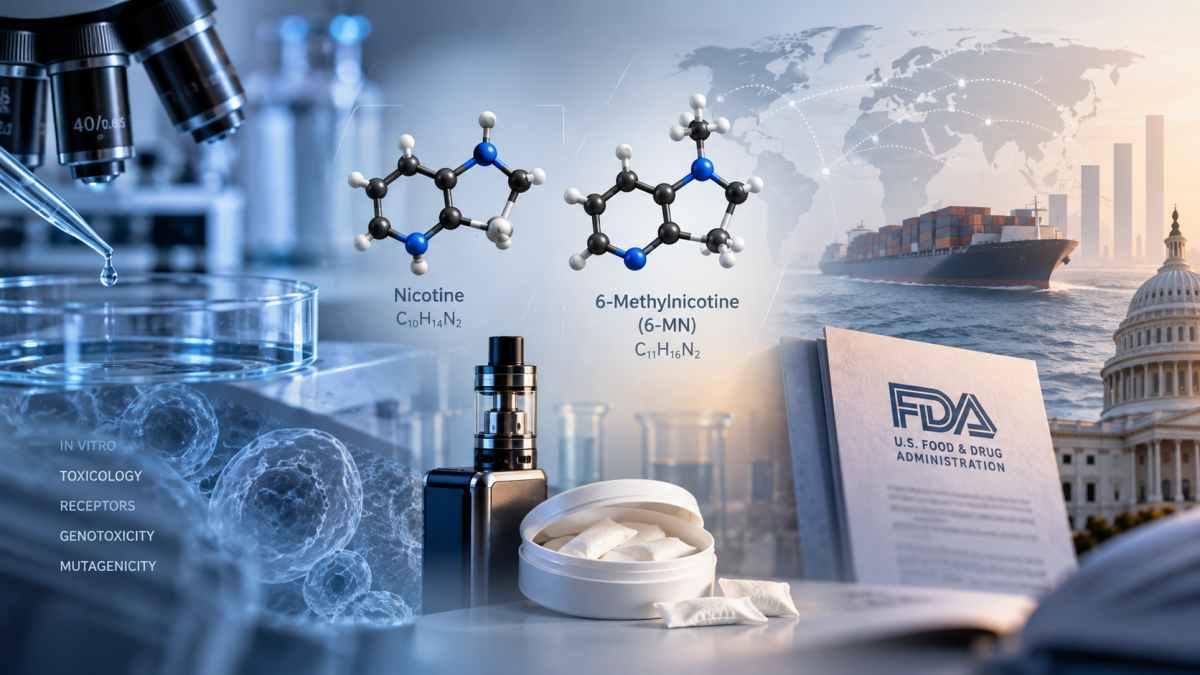
6-MN is structurally similar to nicotine, with an additional methyl group on the pyridine ring. Nixodine-S is more specific. It is a formulated concentrate containing the S-enantiomer of 6-MN and is intended as a volume-for-volume substitute for nicotine in the manufacture of vape or oral products. The formulation is therefore not interchangeable with neat 6-MN or with other commercial products containing the molecule.
The way Nixodine-S was developed is central to interpreting the new findings.
Historical tobacco-industry experiments cited in the paper found (S)-6-MN to be more acutely toxic than nicotine in intravenous mouse tests. Proprietary rat data used by the developers reached a similar conclusion. The researchers used those acute-toxicity results to determine the concentration of (S)-6-MN in Nixodine-S, rather than simply substituting pure 6-MN at the same concentration as nicotine.
In a neutral red uptake assay using BALB/c 3T3 cells, nicotine was cytotoxic, with an IC50 of 961.8 micrograms per millilitre. Nixodine-S was not cytotoxic at the volume-equivalent concentrations tested. Both nicotine and Nixodine-S were negative in the in-vitro micronucleus and Ames assays used to assess genotoxicity and mutagenicity.
The receptor results were also different. Nixodine-S showed comparable or somewhat greater potency than nicotine at the α3β4 and α4β2 receptors. At α6/3β2β3, however, nicotine was more than 19 times more potent under the test conditions, while Nixodine-S showed lower efficacy. The authors said those differences generate testable questions about reinforcement and abuse liability, rather than establishing differences in actual dependence in humans.
“Our paper doesn’t prove human safety, less addiction, or less disease — we’ve been clear about that,” Avila said.
The study was funded by Ready Mix Naturals LLC. Avila disclosed board, advisory, employment and equity relationships with Bonguard Naturals and is named on patents issued to Ready Mix Naturals. Five of the six authors are affiliated with McKinney Regulatory Science Advisors.
Independent studies find a more complex picture
Other research on 6-MN has produced findings that cannot be directly compared with the Nixodine-S study because researchers have used different chemicals, formulations, doses and exposure models.
A 2023 study published in Toxicology in Vitro using BEAS-2B human bronchial epithelial cells found the cells were more sensitive to the cytotoxic effects of 6-MN than nicotine. Its transcriptomic and protein analyses also found different effects on cancer-related pathways, some of which the authors interpreted as potentially favourable compared with nicotine.
Research has since moved from direct cell exposure toward e-liquids and aerosols. In 2025, researchers reported in Toxicology Letters that thermal degradation of 6-MN-containing e-liquids generated more reactive oxygen species than nicotine formulations and produced greater cytotoxicity and intracellular oxidative stress in a human bronchial epithelial cell model under the conditions tested.
A 2026 study in Toxicology used a three-dimensional EpiAirway human respiratory tissue model exposed to aerosols containing nicotine or 6-MN. The researchers reported differences in markers related to DNA damage, inflammation and epithelial function, as well as signs of epithelial remodelling after exposure to either aerosol. They concluded that their results did not support describing 6-MN as a safer alternative to nicotine.
The differences between those studies and the Nixodine-S paper are material. Nixodine-S is a diluted, formulated ingredient tested at volume-equivalent doses, while other studies have examined 6-MN itself, e-liquids containing it or aerosols generated from finished formulations.
Germany’s Federal Institute for Risk Assessment, or BfR, said in February that available data on 6-MN remained sparse and that there was not enough valid information on pharmacokinetics and inhalation toxicity to conduct a full health-risk assessment. The institute said it is participating in what it describes as the first independent human clinical study of the addictive potential of 6-MN, being conducted by Ludwig Maximilian University in Munich.
The study marks an important next step: most of the evidence now available comes from receptor assays, cells, animal data or laboratory exposure models rather than people.
Products are already on sale and supply chains are growing
Commercial development has moved faster.
A 2024 JAMA studytested e-cigarette products marketed as containing nicotine alternatives. Nine flavours labelled as containing 5% 6-MN contained only 5.8 to 6.3 milligrams per gram, around 87% to 88% less than the stated concentration. Researchers also found undeclared 6-MN in six of eight samples of another product line labelled as containing nicotinamide.
A JAMA Network Open study published in January 2026 examined 15 nicotine-analogue oral pouches from five brands purchased in the United States. Researchers detected (S)-6-MN in all 15. Among products with a stated analogue dose, measured 6-MN represented 4.0% to 16.5% of the amount claimed on the label. The researchers also documented claims including “nicotine free,” reduced addictiveness and exemption from FDA regulation.
“In parts of the market the products got ahead of the science,” Avila said.
He said he was particularly concerned about poorly labelled products and marketing that suggested the absence of nicotine automatically meant low risk.
Changes are also visible further upstream.
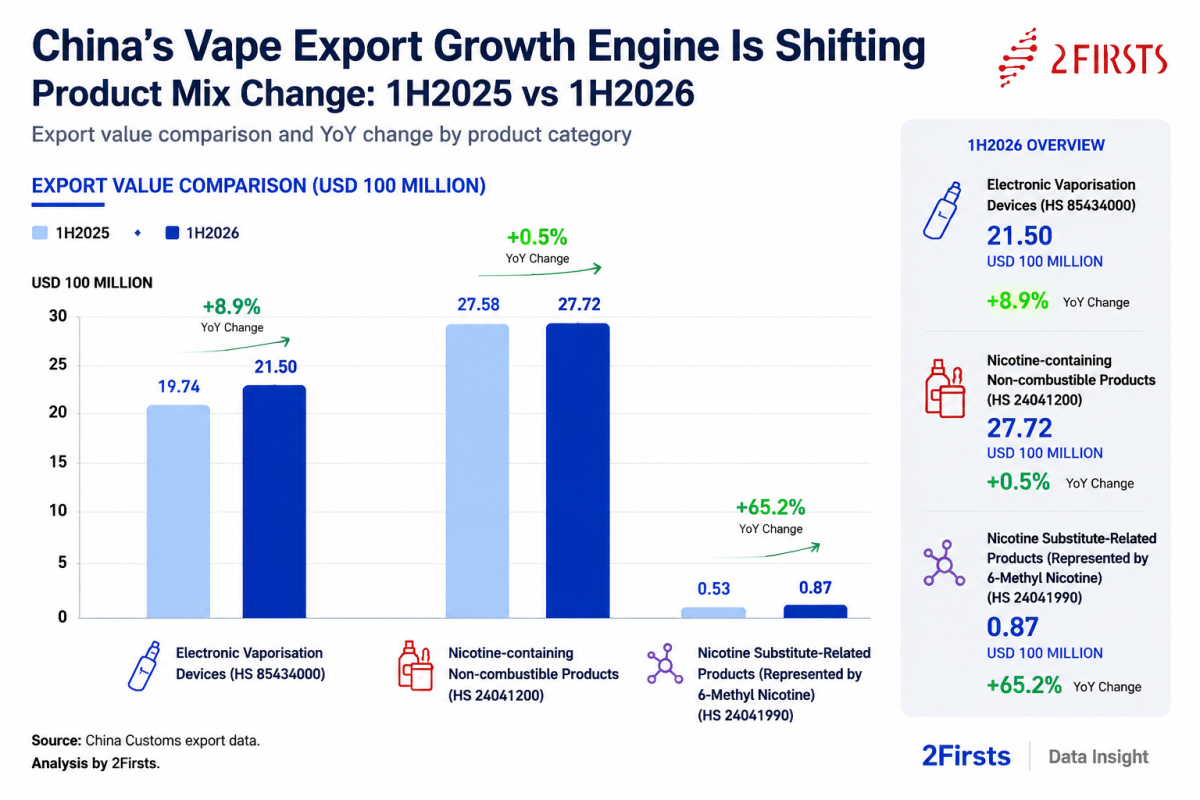
According to an earlier 2Firsts analysis of China Customs data,China’s global exports under HS24041990, a category covering other nicotine-substitute products intended for non-combustible use, reached about $87.5 million in the first half of 2026, up 65.2% year on year.
The category remains small compared with conventional vape hardware and nicotine-containing products. Nor can HS24041990 be treated as a direct measure of 6-MN exports: customs classifications do not identify individual chemical compounds. 2Firsts uses the category as an indicator for broader nicotine-substitute trade, which may include 6-MN-related products.
For Avila, the arrival of a different active substance should increase rather than lower the burden on manufacturers.
“Act like you’re putting a new active ingredient on the market, because you are,” he said.
He said developers should establish chemical identity and strength, conduct toxicology relevant to intended exposure, characterise finished products and disclose what has not yet been demonstrated.
FDA seeks new authority as human studies begin
The scientific challenge is accompanied by a regulatory one.
FDA said in its fiscal 2027 budget justification that nicotine analogues are not currently regulated as tobacco products simply because they contain an analogue. The agency proposed amending the Federal Food, Drug, and Cosmetic Act to define “nicotine analog” and regulate analogue-containing products similarly to tobacco products. The change would require congressional action. FDA’s document labels the proposal “Creating Parity Between Nicotine and Nicotine Analog in Statute.”
That issue becomes more complicated when the substance tested in a laboratory is not identical to the ingredient used by a manufacturer or the product used by a consumer.
“Look at the molecule, the bulk ingredient, and the finished product separately — they’re not the same thing,” Avila said.
For a molecule, researchers may examine receptor pharmacology, metabolism and intrinsic toxicity. A formulated ingredient introduces concentration, stereochemistry, purity, impurities and other constituents. A finished vape or oral pouch adds delivery, aerosol or oral chemistry and actual exposure.
Avila said regulators should require clear identity and labelling, meaningful nonclinical evidence and adult-only marketing, and should not permit reduced-risk or non-addictive claims without supporting data.
His own list of scientific priorities is shorter: human pharmacokinetics, human abuse-liability studies and toxicology on finished products. For Nixodine-S specifically, he said longer-duration toxicology using intended routes of exposure would also be needed before he would consider its risk profile more favourable than nicotine.
BfR’s human study addresses part of that gap, but results have yet to establish how 6-MN behaves in people or how its dependence potential compares with nicotine.
For tobacco and nicotine companies, analogues create an opportunity to move product development beyond another device, heating technology or nicotine formulation and toward a different active ingredient. That also means dealing with pharmacology, toxicology and regulatory questions that cannot be answered simply by adapting an existing nicotine product.
The Nixodine-S study adds another set of nonclinical data. Independent researchers are moving into aerosols, three-dimensional airway models and human research. The market, meanwhile, is already selling the products.
Whether 6-MN or other nicotine analogues eventually become credible alternatives to nicotine will depend on the evidence that follows.
2Firsts will continue to follow developments in nicotine analogues, including scientific research, products, industry activity and regulation.
Cover image generated by AI.

References
1. Smith ML, Costigan S, Campbell JP, Avila R, Weil RE, McKinney WJ. (2026).
Toxicological and pharmacodynamic evaluation of Nixodine-S [(S)-6-Methylnicotine] relative to (S)-nicotine.
Toxicology Reports, 17, 102330.
DOI: 10.1016/j.toxrep.2026.102330
https://www.sciencedirect.com/science/article/pii/S2214750026001320
2. Qi H, Chang X, Wang K, Xu Q, Liu M, Han B. (2023).
Comparative analyses of transcriptome sequencing and carcinogenic exposure toxicity of nicotine and 6-methyl nicotine in human bronchial epithelial cells.
Toxicology in Vitro, 93, 105661.
DOI: 10.1016/j.tiv.2023.105661
https://www.sciencedirect.com/science/article/abs/pii/S0887233323001108
3. Effah F, Sun Y, Friedman A, Rahman I. (2025).
Emerging nicotine analog 6-methyl nicotine increases reactive oxygen species in aerosols and cytotoxicity in human bronchial epithelial cells.
Toxicology Letters, 405, 9–15.
DOI: 10.1016/j.toxlet.2025.01.007
https://www.sciencedirect.com/science/article/pii/S037842742500013X
4. Effah F, Sengupta M, Sun Y, et al. (2026).
A comparative toxicological evaluation of nicotine and its analog 6-methyl nicotine in E-cigarette aerosol utilizing a 3D in vitro human respiratory model.
Toxicology, 522, 154421.
DOI: 10.1016/j.tox.2026.154421
https://www.sciencedirect.com/science/article/pii/S0300483X26000284
5. Erythropel HC, Jabba SV, Silinski P, et al. (2024).
Variability in Constituents of E-Cigarette Products Containing Nicotine Analogues.
JAMA, 332(9), 753–755.
DOI: 10.1001/jama.2024.12408
https://jamanetwork.com/journals/jama/fullarticle/2822083
6. Ciancio JR, Kumar L, Rastogi K, et al. (2026).
Nicotine Analogues in Oral Pouch Products and Associated Marketing Claims.
JAMA Network Open, 9(1), e2554883.
DOI: 10.1001/jamanetworkopen.2025.54883
https://jamanetwork.com/journals/jamanetworkopen/fullarticle/2844178
7. German Federal Institute for Risk Assessment (BfR). (2026).
6-methylnicotine in e-cigarettes: Insufficient data available – the BfR participates in investigation of addictive potential.
Opinion No. 013/2026, February 25, 2026.
8. U.S. Food and Drug Administration. (2026).
Fiscal Year 2027 Justification of Estimates for Appropriations Committees.
Legislative proposal: “Creating Parity Between Nicotine and Nicotine Analog in Statute.”
https://www.fda.gov/media/191778/download
9. 2Firsts Data. (2026).
China’s Vape Exports Rise 3.1% in H1 2026 as 6-Methyl Nicotine-Related Products Surge 65.2%.
July 20, 2026.