Landmark Tobacco Settlement: Quebec Lawyers to Pocket $630M in Fees

Dec.16.2024
Landmark Tobacco Settlement: Quebec Lawyers to Pocket $630M in Fees
Lawyers representing thousands of Quebec residents in two class-action lawsuits against major tobacco manufacturers seek over $9 billion.

According to a report in the National Post on December 14th, lawyers representing tens of thousands of Quebecois in two class action lawsuits against three major tobacco manufacturers will seek fees exceeding $900 million to compensate for their work on this landmark case spanning several decades.


Legal representatives for the class action lawsuit have stated that the court has received the application documents requesting approval to send notices to class action members informing them that the compensation sought involves over 175,000 hours of work.


The day before this action was announced, lawyers stated that the company's creditors, including representatives of the class action plaintiffs, had approved the settlement proposal. The proposal will require several companies to pay a total of 3.25 billion Canadian dollars in compensation.


More than $4 billion CAD has been allocated to the lawsuit plaintiffs, with the requested payment amount from the plaintiffs' lawyers accounting for 22% of this sum.


The proposal announced in October this year also plans for JTI-Macdonald Corporation, Rothmans, Benson & Hedges Inc., and Imperial Tobacco Canada Ltd. to pay over 24 billion Canadian dollars to provinces and territories in Canada, and over 2.5 billion Canadian dollars to Canadian smokers who did not participate in the lawsuit.


The proposal still requires approval from the court before implementation, and it is expected that a motion for approval of legal fees will be included in the hearing scheduled for the end of January.


The spokesperson stated that the total fees requested by the lawyers in the class action lawsuit amount to $906,180,000 CAD before taxes, including tens of millions of dollars in expenses incurred during the litigation process that began in the late 1990s, as well as fees for managing future claims processes.


Lawyer André Lesperance, representing some Quebec plaintiffs, stated in a declaration that...


The requested fees not only reflect the extraordinary scope of work and results achieved, but also demonstrate the lawyer and their team's unwavering dedication. They tirelessly and actively fought against the Canadian tobacco industry, bearing the costs and risks of litigation without any guarantee of payment. This commitment is purely driven by the pursuit of fair and just compensation for victims and their families.


We welcome news tips, article submissions, interview requests, or comments on this piece.

Please contact us at info@2firsts.com, or reach out to Alan Zhao, CEO of 2Firsts, on LinkedIn


Notice

1.  This article is intended solely for professional research purposes related to industry, technology, and policy. Any references to brands or products are made purely for objective description and do not constitute any form of endorsement, recommendation, or promotion by 2Firsts.

2.  The use of nicotine-containing products — including, but not limited to, cigarettes, e-cigarettes, nicotine pouchand heated tobacco products — carries significant health risks. Users are responsible for complying with all applicable laws and regulations in their respective jurisdictions.

3.  This article is not intended to serve as the basis for any investment decisions or financial advice. 2Firsts assumes no direct or indirect liability for any inaccuracies or errors in the content.

4.  Access to this article is strictly prohibited for individuals below the legal age in their jurisdiction.


Copyright


This article is either an original work created by 2Firsts or a reproduction from third-party sources with proper attribution. All copyrights and usage rights belong to 2Firsts or the original content provider. Unauthorized reproduction, distribution, or any other form of unauthorized use by any individual or organization is strictly prohibited. Violators will be held legally accountable.

For copyright-related inquiries, please contact: info@2firsts.com


AI Assistance Disclaimer


This article may have been enhanced using AI tools to improve translation and editorial efficiency. However, due to technical limitations, inaccuracies may occur. Readers are encouraged to refer to the cited sources for the most accurate information.

We welcome any corrections or feedback. Please contact us at: info@2firsts.com

Beyond IQOS ILUMA, PMI Expands Lower-Priced BONDS Heated Tobacco Platform: Seven Markets Added in Q3, With Rollouts in Japan, Europe and North Africa
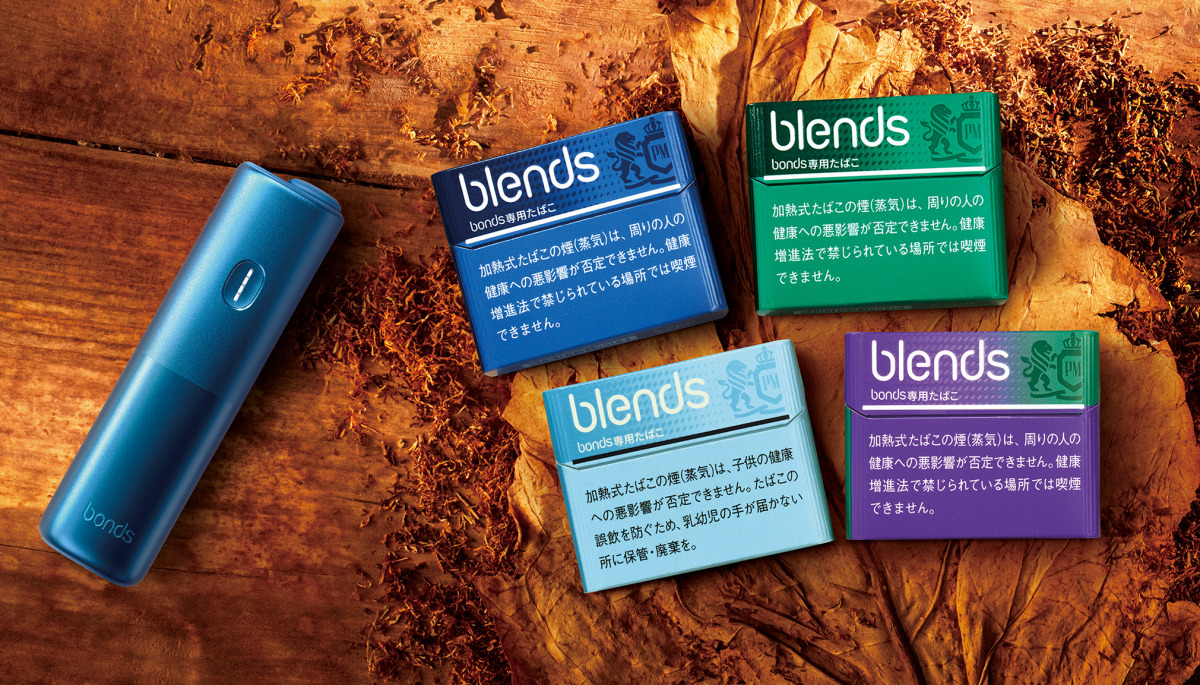
Philip Morris International (PMI) is expanding the international footprint of BONDS by IQOS, its lower-priced heated tobacco platform. The company's third-quarter 2026 SEC filing shows that BONDS devices and BLENDS tobacco sticks were available in 15 markets at the end of September, up from eight at the end of June. In November, PMI announced plans to extend sales from three to 17 Japanese prefectures and introduced BONDS in Spain and Morocco. The platform uses ROUNDHEAT external heating technology and proprietary tobacco sticks, separate from the IQOS ILUMA system. In Japan, BONDS retails for ¥2,980, approximately 25% below ILUMA i ONE, while BLENDS costs ¥570 per pack. PMI management says BONDS targets cigarette smokers who have not adopted heated tobacco. Separate sales and revenue figures remain undisclosed.
company
Nov.06
South Korea's Tobacco Plan Excludes 6-Methyl Nicotine as Customs Tightens Import Controls and Analog Liquid Imports Fall 83%
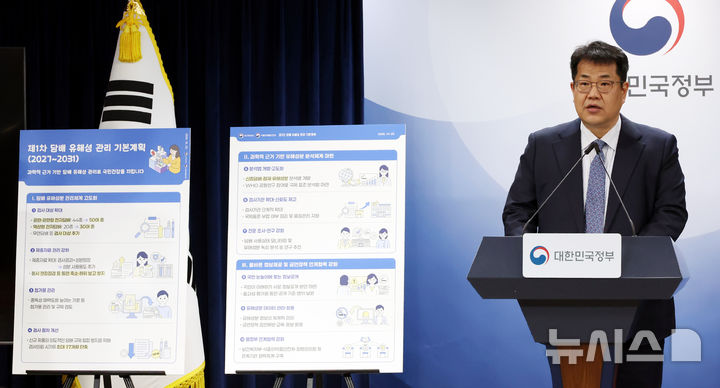
South Korea's government unveiled its first Tobacco Harm Management Basic Plan for 2027–2031 on October 29, 2026, proposing broader testing of vaping and heated tobacco products while excluding nicotine analogs such as 6-methyl nicotine. Synthetic nicotine came under tobacco regulation on April 24, and a June investigation found 6-methyl nicotine in 12 liquid inhalation products marketed as nicotine-free. Customs data released in September showed that imports of nicotine analog solutions fell 83.3%, from 12 metric tons in January–April to 2 metric tons in May–August. By September 20, imports had reached approximately 15 metric tons for the year, with 99.99% originating from China. Customs authorities have tightened pre-clearance testing and supply-chain documentation requirements, while the MFDS expects to complete its assessment of nicotine analog hazards by the end of 2026.
Regulations
Nov.04
Special Report|RLX Technology Consolidates European Distribution Business for First Time: Q3 2026 Revenue Rises Nearly 70%, Gross Margin Falls to 23.3%
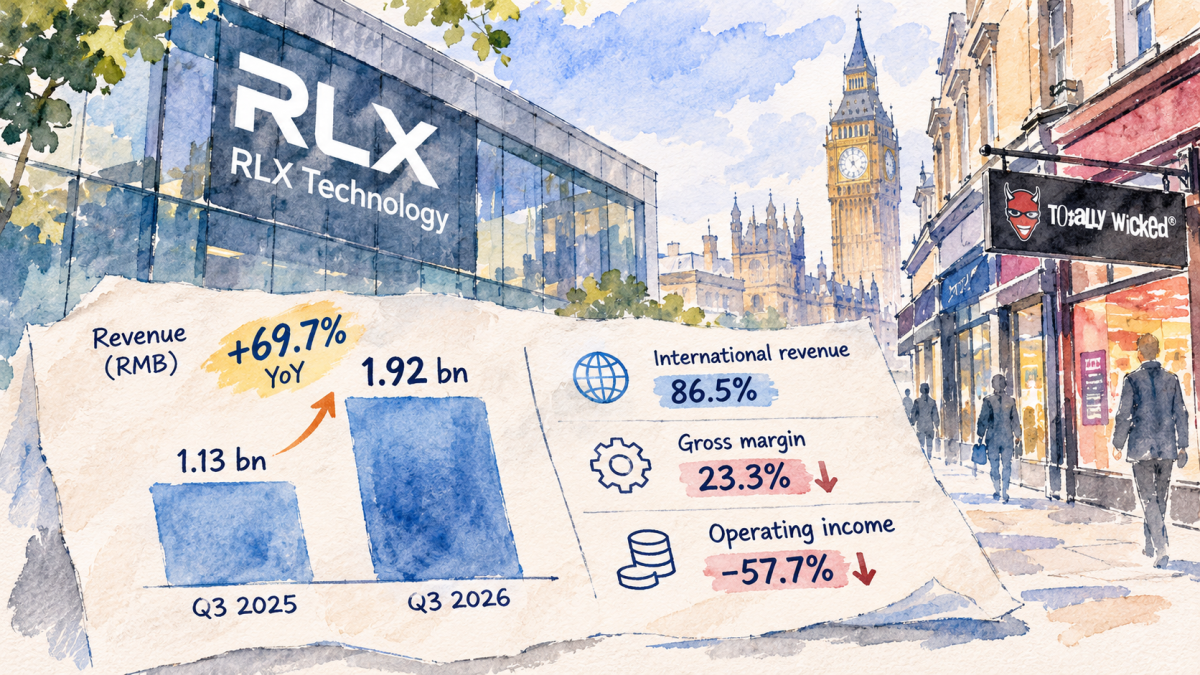
RLX Technology reported a 69.7% year-on-year increase in third-quarter 2026 revenue to RMB1.92 billion ($285.9 million), driven primarily by the consolidation of a newly acquired Western European distributor. International markets accounted for 86.5% of revenue. The acquisition followed RLX's RMB744 million purchase of controlling interests in UK vaping company Totally Wicked in 2025, expanding the group's directly controlled European retail and distribution operations. SEC filings also show that purchases from Shenzhen Smoore Technology Limited declined from 80% of RLX's total purchases in 2022 to 23% in 2025. Third-quarter gross margin fell to 23.3%, while GAAP operating income declined 57.7%.
Business
Nov.20
Special report|Indonesia's Vape Industry Has 200 Manufacturers and $1.7 Billion in Investment. Could a Regulatory Divide Derail Its Rise as the World's No. 2 Manufacturing Hub After Shenzhen?
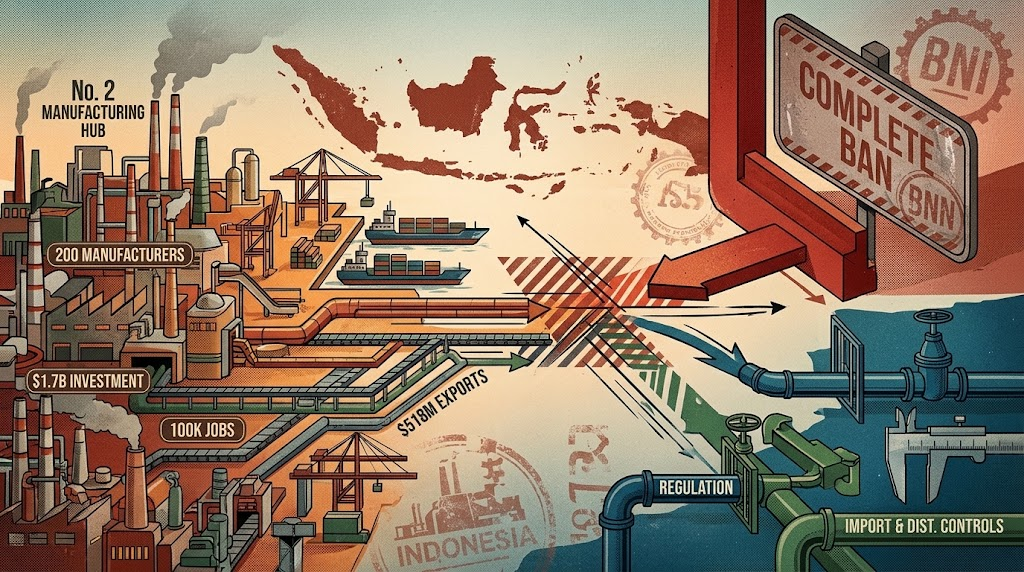
Indonesia's Ministry of Industry said at a November 3, 2026, policy forum that the country has about 200 electronic cigarette companies, Rp31 trillion (approximately $1.71 billion) in cumulative industry investment and around 100,000 jobs across the supply chain. The National Narcotics Agency is seeking a comprehensive ban on vape use and circulation, while the industry ministry favors tighter import, product-standard and distribution controls. Indonesia exported approximately $518 million in vaping products in 2025, and Chinese manufacturers including Smoore, GEEKVAPE and Jinjia Group have established local operations. An international logistics specialist interviewed by 2Firsts said more Chinese vape companies began production in Indonesia from the second half of 2025, accompanied by increased shipments of manufacturing equipment and investment in logistics facilities. The regulatory debate comes as Indonesia expands its role in international vaping manufacturing.
Special Report
Nov.05
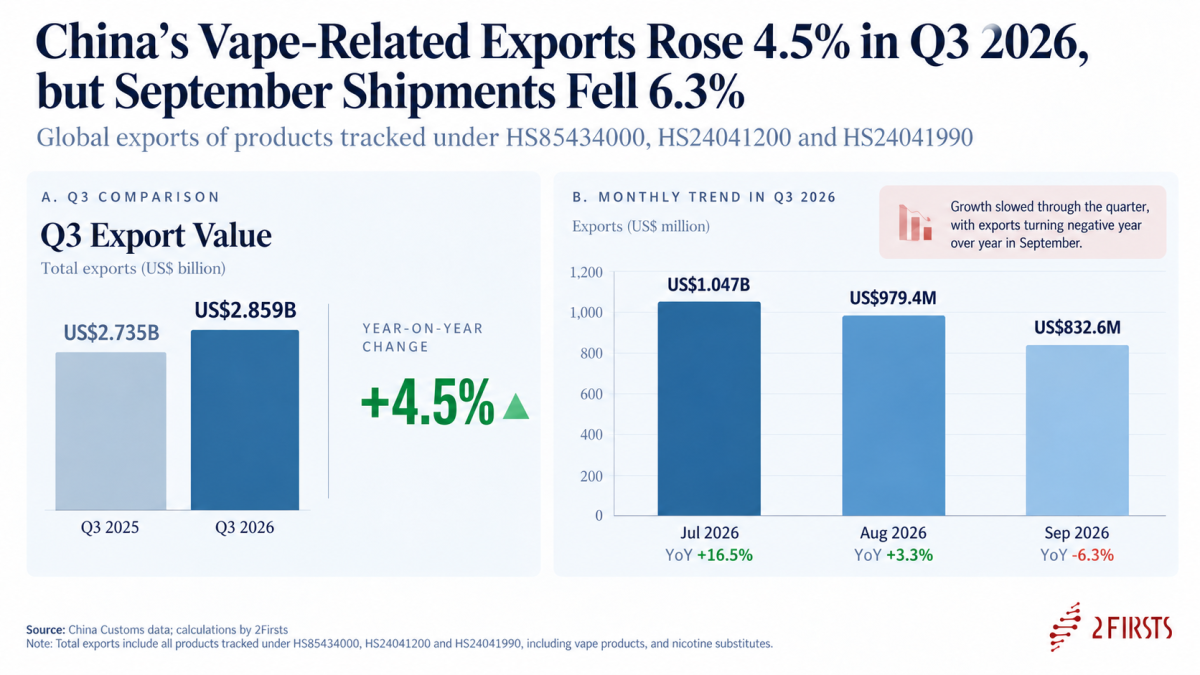
China’s Vape-Related Exports Rose 4.5% in Q3 2026 as 21.6% Growth in Shipments to the UK Offset a Decline in Shipments to the US
China's vape-related exports rose 4.5% year over year to $2.86 billion in the third quarter of 2026, led by stronger shipments to the United Kingdom as exports to the United States declined. UK-bound shipments increased 21.6%, adding $81.9 million, while US exports fell 5.2%, or $53.6 million. Growth weakened through the quarter, with September exports down 6.3% globally and 37.8% to the US. Nicotine-containing vape products accounted for more than 82% of the quarterly net increase, while device exports were nearly flat. Nine-month exports totaled $7.82 billion, up 4.0%.
DATA
Oct.26
NATO Executive Director David Spross Sees U.S. Vape Regulation Improving, Calls for More PMTA Authorizations and Warns of 2027 State Tax Pressure
The National Association of Tobacco Outlets is calling for more FDA marketing authorizations, greater transparency in the PMTA process and continued enforcement against unauthorized e-cigarettes, even as its executive director, David Spross, points to recent regulatory developments as signs of progress. At the state level, excise taxes, flavor restrictions and vapor product directories remain major issues for tobacco retailers. By August 2026, 17 states had enacted laws establishing state-managed e-cigarette directories or similar systems.
Innovation
Sep.29 by 2Firsts Perspectives