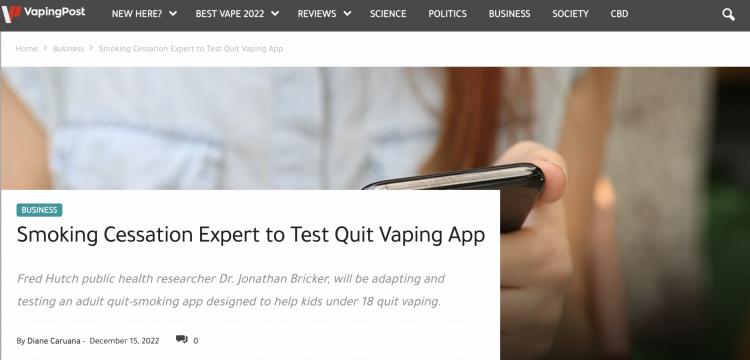
Mobile App to Help Teens Quit Nicotine Addiction

Dec.16.2022
Mobile App to Help Teens Quit Nicotine Addiction
Hutch's Reservoir Fund supports development of first-ever mobile app to help teenagers quit nicotine through a randomized control trial.

Hutch's Reservoir Fund is providing additional support to develop and test the first-ever mobile smartphone application aimed at helping teenagers quit nicotine through randomized controlled trials. The research will be funded over a two-year period by the Northwestern University Health System Institute for Health Research in the United States.


Bricker plans to adapt his digital therapy application Quit2Heal, designed to help adults quit smoking, into an age-appropriate application to assist young people in quitting smoking. He intends to conduct a randomized control trial next year, to compare his newly designed program with the National Cancer Institute's SmokeFreeTeen project.


According to Bricker, there are currently no verified programs that can help teenagers quit vaping. He stated that even though there is evidence of how many young people use e-cigarettes, there has not been any trials testing the efficacy of applications. E-cigarettes are easy to hide and have become increasingly common among adolescents, including those who were previously unlikely to smoke, such as athletes and academically-focused children.


Meanwhile, due to the hysteria surrounding e-cigarettes and their alleged association with EVALI, Apple removed all 181 e-cigarette related apps from the iOS App Store in 2019. Although Apple users who had already downloaded vaping apps were able to continue using them undisturbed, these apps were no longer available for download.


Some of these applications are highly useful and informative, providing news and/or practical functions such as allowing users to adjust the temperature and other settings on their devices. In response to Apple's actions, PAX Labs, the designer of vaporization technology and devices, has launched a new desktop application for its cannabis vaporizer, which clearly indicates its purpose.


The company stated in a press release, "This was built in response to Apple's removal of vaporizer-related apps from the App Store." Previously, Pax had launched Android and iPhone apps with these useful features, but they were naturally removed by Apple.


Disclaimer

This article is provided solely for professional research, industry discussion, and informational purposes. Any references to brands, companies, products, technologies, or policies are made for factual reporting and analytical purposes only, and do not constitute endorsement, recommendation, promotion, or advertising by 2Firsts.

Nicotine-containing products, including but not limited to cigarettes, e-cigarettes, heated tobacco products, and nicotine pouches, carry significant health risks. Readers are responsible for complying with all applicable laws and regulations in their respective jurisdictions, including age restrictions and access limitations.

The information contained in this article should not be regarded as investment, legal, medical, regulatory, or commercial advice. While 2Firsts strives to ensure the accuracy and reliability of its content, it does not assume liability for any direct or indirect loss arising from errors, omissions, inaccuracies, or reliance on the information contained herein.

This article is not intended for individuals below the legal age for accessing tobacco or nicotine-related information in their jurisdiction.


Copyright Notice

This article is either original content produced by 2Firsts or content reproduced, translated, summarized, or adapted from third-party sources with attribution where applicable. The intellectual property rights of the original content remain with 2Firsts or the respective original rights holders.

No individual or organization may copy, reproduce, distribute, republish, modify, translate, or otherwise use this content without prior authorization. Any unauthorized use may result in legal action.

For copyright-related inquiries, corrections, or removal requests, please contact: info@2firsts.com.


AI-Assisted Translation and Editing Notice

Portions of this article may have been translated, edited, or reviewed with the assistance of artificial intelligence tools to improve efficiency and readability. Due to the limitations of AI-assisted translation and editing, discrepancies, omissions, or inaccuracies may exist when compared with the original source.

Where applicable, readers are advised to refer to the original source for the most complete and accurate information. If you identify any errors or believe that any content infringes upon your rights, please contact us at info@2firsts.com, and we will review and address the matter promptly.

ATF Cancels Webloc Contract, Raising Questions Over Commercial Location Data in Enforcement
The U.S. Bureau of Alcohol, Tobacco, Firearms and Explosives (ATF) has stopped using Webloc, a commercial phone-tracking tool, after lawmakers, a prosecutor and a judge raised legal and privacy concerns over warrantless use of ad-tech location data, a development that may affect data-use boundaries in U.S. enforcement against illicit tobacco, nicotine products and cross-border distribution networks.
Jun.29
Malaysia Withdraws Appeal Against Liquid Nicotine Ruling as Vape Regulation Framework Enters New Phase
Malaysia’s government has withdrawn its appeal against a High Court ruling concerning the regulatory status of liquid nicotine used in vape and e-cigarette products, according to reports by New Straits Times, Free Malaysia Today and CodeBlue on August 18, 2026. The Kuala Lumpur High Court ruled on May 15 that the government’s decision to remove liquid nicotine from the scheduled poisons list under the Poisons Act 1952 was irrational and made without proper consultation with the Poisons Board. The withdrawal ends the government’s appeal process, while the future regulatory framework for nicotine vape products remains under discussion.
Aug.21
KT&G’s Lil Strengthens Market Lead in Korea as Heated Tobacco Share Reaches 47.4%
According to South Korea’s UpKorea, KT&G’s heated tobacco brand Lil reached a 47.4% share of Korea’s heated tobacco stick market in the first quarter of 2026. The company is expanding its next-generation products (NGP) business through product development, technology investment and overseas growth. KT&G reported NGP sales of 890.1 billion won (approximately US$650 million) in 2025, up significantly from 279.3 billion won in 2020. Lil products are now available in 34 markets, while KT&G continues building its technology portfolio through patents and multiple product platforms.
Jul.23
Russian Strikes Destroy JTI and Imperial Brands Ukraine Warehouses, With Losses Reaching Tens of Millions of Hryvnias
According to Ukrainska Pravda, Russian strikes on the Kyiv region during the night of Aug. 4-5, 2026, damaged warehouses storing products of Japan Tobacco International (JTI) and Imperial Brands Ukraine. JTI said a finished goods warehouse in Kyiv Oblast was destroyed, with no employees injured, and that it did not expect disruptions to retail supplies. Imperial Brands Ukraine said products stored at warehouses of distributors and retail partners were affected and estimated losses from the strikes at “tens of millions of Ukrainian hryvnias” (roughly hundreds of thousands of U.S. dollars).
JTI
Aug.07
JTI Makes Third Bet on South Korea as Ploom AURA Enters a Market Dominated by lil and IQOS
Japan Tobacco International is stepping up its heated tobacco push in South Korea with Ploom AURA. Since its official launch in April 2026, the device's limited First Edition and Glacier White version have sold out, while distribution has expanded across Seoul, Incheon, Gyeonggi Province and airport duty-free channels. The rollout marks JTI's third major attempt to build a stronger heated tobacco position in South Korea, following Ploom TECH in 2019 and Ploom X Advanced in 2024. At the group level, JT plans to invest about ¥800 billion, approximately $5 billion, in reduced-risk products from 2026 through 2028, with heated products and Ploom identified as its primary investment priority.
Aug.14
2Firsts Data | China’s U.S. Vape Exports Have Yet to Regain Previous Growth Momentum in H1 2026, but Hardware Grew 15.2% and 6-Methyl Nicotine-Related Products Rose 234.7%
China’s vape exports to the U.S. reached approximately $1.58 billion in the first half of 2026, remaining broadly stable from a year earlier but still below previous growth momentum. 2Firsts’ analysis of China Customs data shows that the U.S. market has not simply returned to its previous trajectory after the enforcement shock and inventory-driven swings of 2025. Instead, export momentum is shifting across product categories. Vaping devices and atomization hardware increased 15.2% year over year, while 6-methyl nicotine-related and other nicotine substitute products surged 234.7%. Meanwhile, traditional nicotine-containing vaping products continued to face pressure.
Jul.22