Key Points
- The National Technical Committee on Standardization of E-cigarettes (NTC) has announced an open call for 2026 national standardization projects.
- The initiative is directed by the State Administration for Market Regulation (SAMR) and the State Tobacco Monopoly Administration (STMA).
- Applications are invited in areas including basic standards, general technical standards, manufacturing, storage and circulation, and testing and evaluation methods.
- Submissions must ensure scientific validity, originality, and accuracy, avoiding overlap with existing standards.
- The first submission round ends on December 31, 2025, and the second on June 30, 2026.
- Paper and electronic copies must be submitted to the Secretariat of the National Technical Committee on E-cigarettes, located at the Shanghai New Tobacco Product Research Institute Co., Ltd.
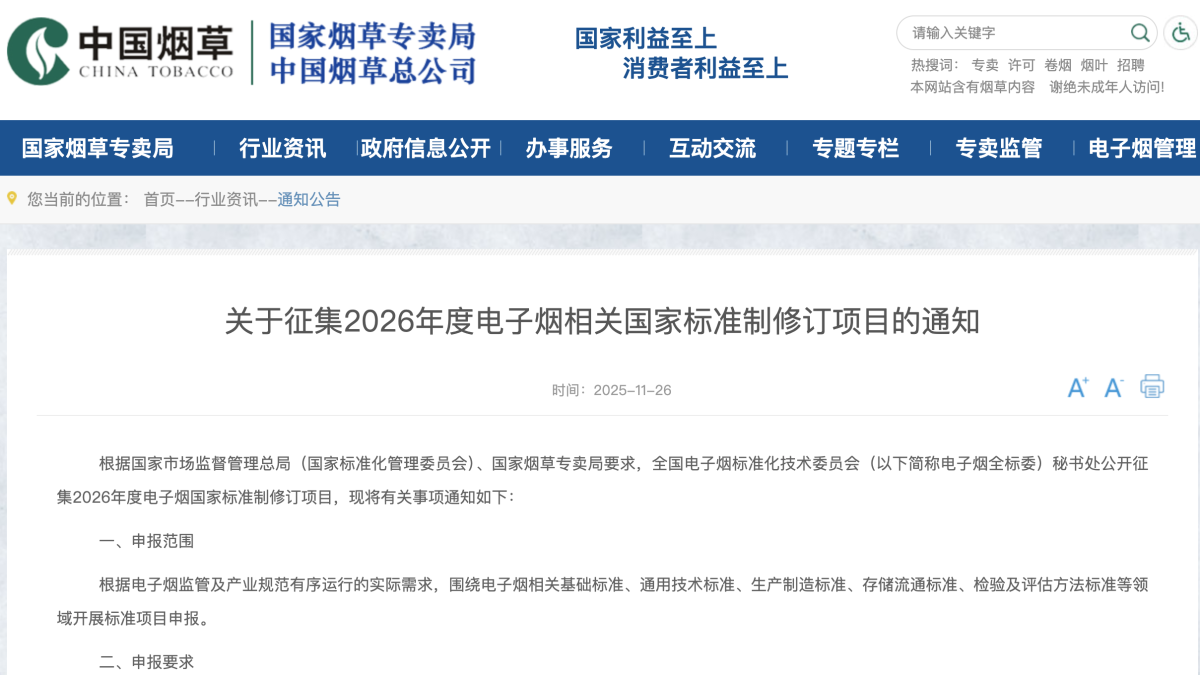
2Firsts reprint from the State Tobacco Monopoly Administration, November 27, 2025 —In accordance with the requirements of the State Administration for Market Regulation (Standardization Administration of China) and the State Tobacco Monopoly Administration, the National Technical Committee on Standardization of E-cigarettes (NTC) Secretariat has issued an open call for proposals for the 2026 national standardization projects related to e-cigarettes.
The initiative aims to support regulatory needs and ensure orderly development within the e-cigarette industry. Proposed projects may cover basic standards, general technical standards, manufacturing standards, storage and circulation standards, and testing and evaluation methods.
Application Requirements
- Projects must align with national goals for standardization and must not overlap or conflict with existing standards.
- Submitting organizations must conduct sufficient research to establish the necessity, feasibility, and scientific validity of their proposals.
- Required materials include electronic and printed versions of the National Standard Project Proposal, Application Form, Draft Standard, and Preliminary Research Report, all formatted according to GB/T 1.1.
- The submitting organization must affix its official seal to all application documents.
- Any issues regarding patents or cooperative projects must be coordinated and resolved prior to submission.
- Funding will primarily come from the applicant organization, though relevant authorities may provide financial assistance according to Ministry of Finance regulations.
Submission Process
Applications will be conducted in two rounds:
- First round: from the publication of this notice until December 31, 2025;
- Second round: deadline June 30, 2026.
- All submissions must include three printed copies and one electronic copy, to be sent to the Secretariat of the National Technical Committee on Standardization of E-cigarettes:
- Shanghai New Tobacco Product Research Institute Co., Ltd.
The notice reiterates that this initiative forms part of China’s ongoing efforts to enhance the regulatory foundation of its e-cigarette industry and promote standardized, safe, and transparent practices across all stages of production and distribution.
Image source: State Tobacco Monopoly Administration.
We welcome news tips, article submissions, interview requests, or comments on this piece.
Please contact us at info@2firsts.com, or reach out to Alan Zhao, CEO of 2Firsts, on LinkedIn
Notice
1. This article is intended solely for professional research purposes related to industry, technology, and policy. Any references to brands or products are made purely for objective description and do not constitute any form of endorsement, recommendation, or promotion by 2Firsts.
2. The use of nicotine-containing products — including, but not limited to, cigarettes, e-cigarettes, nicotine pouchand heated tobacco products — carries significant health risks. Users are responsible for complying with all applicable laws and regulations in their respective jurisdictions.
3. This article is not intended to serve as the basis for any investment decisions or financial advice. 2Firsts assumes no direct or indirect liability for any inaccuracies or errors in the content.
4. Access to this article is strictly prohibited for individuals below the legal age in their jurisdiction.
Copyright
This article is either an original work created by 2Firsts or a reproduction from third-party sources with proper attribution. All copyrights and usage rights belong to 2Firsts or the original content provider. Unauthorized reproduction, distribution, or any other form of unauthorized use by any individual or organization is strictly prohibited. Violators will be held legally accountable.
For copyright-related inquiries, please contact: info@2firsts.com
AI Assistance Disclaimer
This article may have been enhanced using AI tools to improve translation and editorial efficiency. However, due to technical limitations, inaccuracies may occur. Readers are encouraged to refer to the cited sources for the most accurate information.
We welcome any corrections or feedback. Please contact us at: info@2firsts.com