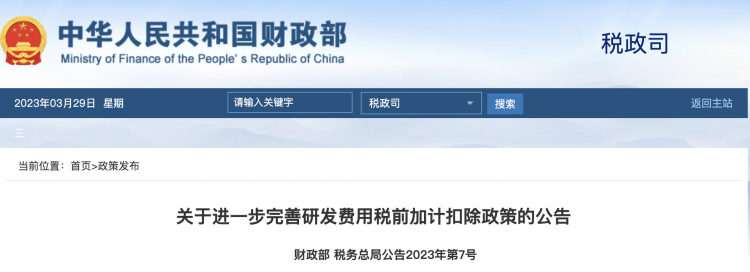
On March 26th, the Ministry of Finance of the People's Republic of China issued a notice on further improving the pre-tax deduction policy for research and development expenses.
The announcement stated that for enterprises conducting research and development activities, if the actual R&D expenses incurred have not been included in the current profit and loss statement because no intangible assets have been formed, they will be allowed to deduct the actual incurred expenses based on regulations and additionally deduct 100% of the amount before tax starting from January 1, 2023. For those that have formed intangible assets, they will be allowed to amortize them before tax at 200% of the intangible asset cost starting from January 1, 2023.
Below is the full text of the announcement.
Announcement on Further Improving the Pre-Tax Deduction Policy for Research and Development Expenses
Announcement No.7 of the Ministry of Finance and the State Taxation Administration for the Year 2023.
To further encourage companies to increase their research and development investment and better support technological innovation, we are announcing the policy regarding pre-tax deduction for enterprise research and development expenses.
Companies that incur research and development (R&D) expenses during R&D activities, but do not generate intangible assets that can be included in current gains or losses, will receive an additional 100% deduction from taxable income starting January 1, 2023, on top of the actual deductible expenses reported according to regulations. For those that do generate intangible assets, starting January 1, 2023, the intangible assets cost will be amortized before tax at 200%.
Secondly, companies that are eligible for the R&D expense additional deduction policy must adhere to other policy guidelines and management requirements as detailed in the "Circular of the Ministry of Finance, State Administration of Taxation, and Ministry of Science and Technology on Improving the Pre-tax Additional Deduction Policy for Research and Development Expenses" (CaiShui [2015] No. 119) and the "Circular of the Ministry of Finance, State Administration of Taxation, and Ministry of Science and Technology on Issues Related to the Pre-tax Additional Deduction Policy for Overseas R&D Expenses Commissioned by Enterprises" (CaiShui [2018] No. 64) and other relevant documents.
The announcement will take effect on January 1st, 2023. It repeals three other announcements, including the "Announcement of the Ministry of Finance and State Administration of Taxation on Further Improving the Policy of Pre-tax Deduction for Research and Development Expenses" (No. 13 of 2021), the "Announcement of the Ministry of Finance, State Administration of Taxation and Ministry of Science and Technology on Further Increasing the Pre-tax Deduction Rate for Research and Development Expenses of Technology-based Small and Medium-sized Enterprises" (No. 16 of 2022), and the "Announcement of the Ministry of Finance, State Administration of Taxation and Ministry of Science and Technology on Strengthening the Deduction of Tax Prepaid Support for Technological Innovation" (No. 28 of 2022).
This is to hereby announce.
The Ministry of Finance and the State Administration of Taxation.
March 26th, 2023.
Reference:
Announcement on further improving the pre-tax additional deduction policy for research and development expenses.
Disclaimer
This article is provided solely for professional research, industry discussion, and informational purposes. Any references to brands, companies, products, technologies, or policies are made for factual reporting and analytical purposes only, and do not constitute endorsement, recommendation, promotion, or advertising by 2Firsts.
Nicotine-containing products, including but not limited to cigarettes, e-cigarettes, heated tobacco products, and nicotine pouches, carry significant health risks. Readers are responsible for complying with all applicable laws and regulations in their respective jurisdictions, including age restrictions and access limitations.
The information contained in this article should not be regarded as investment, legal, medical, regulatory, or commercial advice. While 2Firsts strives to ensure the accuracy and reliability of its content, it does not assume liability for any direct or indirect loss arising from errors, omissions, inaccuracies, or reliance on the information contained herein.
This article is not intended for individuals below the legal age for accessing tobacco or nicotine-related information in their jurisdiction.
Copyright Notice
This article is either original content produced by 2Firsts or content reproduced, translated, summarized, or adapted from third-party sources with attribution where applicable. The intellectual property rights of the original content remain with 2Firsts or the respective original rights holders.
No individual or organization may copy, reproduce, distribute, republish, modify, translate, or otherwise use this content without prior authorization. Any unauthorized use may result in legal action.
For copyright-related inquiries, corrections, or removal requests, please contact: info@2firsts.com.
AI-Assisted Translation and Editing Notice
Portions of this article may have been translated, edited, or reviewed with the assistance of artificial intelligence tools to improve efficiency and readability. Due to the limitations of AI-assisted translation and editing, discrepancies, omissions, or inaccuracies may exist when compared with the original source.
Where applicable, readers are advised to refer to the original source for the most complete and accurate information. If you identify any errors or believe that any content infringes upon your rights, please contact us at info@2firsts.com, and we will review and address the matter promptly.