Electronic Cigarette Waterproof Background: After the introduction of the new standards for electronic cigarettes, the IPX4 waterproof requirements have become a mandatory issue that needs to be addressed by all manufacturers in the industry.
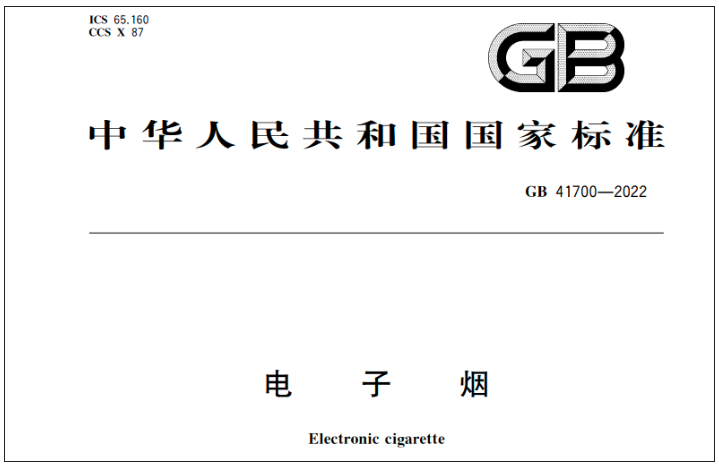
On April 8th of this year, the new national standard for electronic cigarettes was announced by the State Administration for Market Regulation and released on the website of the National Standardization Management Committee. This new standard, which will be the basis for regulating production, will be enforced as of October 1st, 2022, according to China National Standard No. 4 of that year. The responsibility for monitoring compliance with this standard will fall to the State Administration for Market Regulation.
The new national standard for electronic cigarettes includes waterproofing features.
On May 15th, 2022, GB417-2022 waterproof standards were implemented.
Should meet the requirements for IPX4 protection level specified in Chapter 6 of GB/T4208-2017.
Interpretation: After undergoing an IPX4 waterproof test, electronic cigarettes were found to function normally. IPX4 waterproof rating means that it is splash-resistant and not dust-resistant, meaning that liquids can be splashed on its surface from any direction without causing any damage (can be used normally during heavy rain or in bathrooms).
According to GB417-2022, section 6.1.5, electronic cigarettes undergo a waterproof test for their components.
Follow the guidelines set out in section 14.2.4 of GB/T4208-2017. Inspect to determine if there is any risk of ignition or explosion. After performing a waterproof test, fully discharge the electronic cigarette before recharging it to full capacity. Inspect again to determine if there is any risk of ignition or explosion.
Analysis: Waterproof Test - In a pipe-style water spray test apparatus, a fully charged and turned-on e-cigarette is placed on a sample stand with an appropriate radius pipe. The height of the turntable is at the diameter position of the pipe. The sample is placed on the turntable with its top no more than 200mm away from the nozzle. The sample stand does not rotate.
Adjust water flow according to IPX4 requirements: Water flow is calculated based on the number of spray holes, with each hole providing a flow rate of 0.07 (1+5%) L/min. The testing involves a spray rotation speed of 2×360°, which takes approximately 12 seconds to complete. The experiment is conducted for a duration of 10 minutes. Real-life testing involves subjecting the electronic cigarette device to a 360° downpour similar to that of a showerhead for 10 minutes.
Test Results: The tested product has passed the 4-level waterproof test as it is able to discharge and charge normally without any incidents of fire, explosion, flashing lights, microphone feedback, or short circuits during use.
Waterproof measures for electronic cigarette devices.
The electronic cigarette device has an IPX4 waterproof rating, which means it can be waterproofed from two angles:
The overall structure is waterproof.
The electronic cigarette prototype board is outsourced for production, and a protective "invisible" film is added through a nano-coating process.
Waterproofing in e-cigarettes is a commonly overlooked technological aspect. Due to the presence of air holes and the need for airflow through the mouthpiece to activate the e-cigarette, achieving complete structural waterproofing is a challenge. Addressing this issue requires a significant investment of time, effort, manpower, and resources, which could lead to increased material and labor costs.
As more and more electronic cigarette companies obtain tobacco monopoly production licenses and a batch of electronic cigarette products that meet the national standard for "Electronic Cigarettes" have successfully passed technical evaluations, it means that the compliant production of electronic cigarette products is picking up pace.
How to achieve the new national standard IPX4 waterproof technology in a more efficient, cost-effective, and less labor-intensive way to obtain a production permit? Applying waterproof coatings to the solution board is a viable option.
Nanocoating comparative test
During a level four waterproof test of an electronic cigarette device, the lights began to flash and a short circuit occurred.
The finished product of the prototype has undergone a technology nano-coating treatment, passing a level 4 testing process without any flashing lights or short circuit occurrences.
The semi-finished product underwent a level 4 waterproof test and experienced flashing lights and short circuits.
The circuit board has undergone nanocoating treatment. When tested without components, it passed a water resistance test at level 4. The semi-finished tobacco product also passed a level 4 water resistance test.
The experiment yielded the following results:
If the structure is not properly handled, water can enter through the cartridge port or Type-C connector, causing a high probability of short circuiting electronic components.
After the finished prototype board undergoes coating treatment, it will not short-circuit even when exposed to water and can provide complete protection against condensation and oil leakage. Therefore, if the prototype board is coated, it can easily pass the 4-level waterproof test for electronic cigarettes.
This article contains excerpts or reprints from third-party sources whose copyright belongs to the original media and author. If there is any infringement, please contact us to delete it. Any unit or individual that wishes to reproduce must contact the author directly and refrain from direct reproduction.
Disclaimer
This article is provided solely for professional research, industry discussion, and informational purposes. Any references to brands, companies, products, technologies, or policies are made for factual reporting and analytical purposes only, and do not constitute endorsement, recommendation, promotion, or advertising by 2Firsts.
Nicotine-containing products, including but not limited to cigarettes, e-cigarettes, heated tobacco products, and nicotine pouches, carry significant health risks. Readers are responsible for complying with all applicable laws and regulations in their respective jurisdictions, including age restrictions and access limitations.
The information contained in this article should not be regarded as investment, legal, medical, regulatory, or commercial advice. While 2Firsts strives to ensure the accuracy and reliability of its content, it does not assume liability for any direct or indirect loss arising from errors, omissions, inaccuracies, or reliance on the information contained herein.
This article is not intended for individuals below the legal age for accessing tobacco or nicotine-related information in their jurisdiction.
Copyright Notice
This article is either original content produced by 2Firsts or content reproduced, translated, summarized, or adapted from third-party sources with attribution where applicable. The intellectual property rights of the original content remain with 2Firsts or the respective original rights holders.
No individual or organization may copy, reproduce, distribute, republish, modify, translate, or otherwise use this content without prior authorization. Any unauthorized use may result in legal action.
For copyright-related inquiries, corrections, or removal requests, please contact: info@2firsts.com.
AI-Assisted Translation and Editing Notice
Portions of this article may have been translated, edited, or reviewed with the assistance of artificial intelligence tools to improve efficiency and readability. Due to the limitations of AI-assisted translation and editing, discrepancies, omissions, or inaccuracies may exist when compared with the original source.
Where applicable, readers are advised to refer to the original source for the most complete and accurate information. If you identify any errors or believe that any content infringes upon your rights, please contact us at info@2firsts.com, and we will review and address the matter promptly.