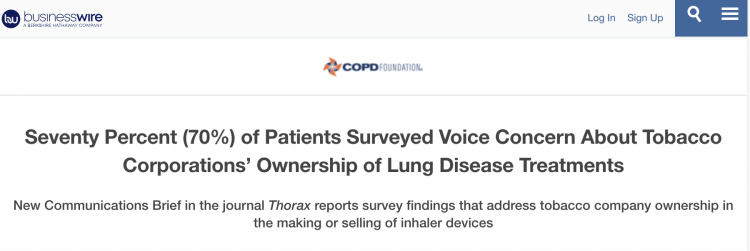
In an international survey conducted earlier this year, 70% of respondents expressed either "concern" or "serious concern" about devices used to treat lung diseases when tobacco companies profit from them through inhalers, drugs, or other means. The results of the study are reported in a communication brief titled "Pharmaceutical Industry's Ownership of Tobacco Business: An International Survey of Patients with Respiratory Diseases," which has been published in the official journal of the British Thoracic Society, Chest.
In an international survey, 70% of respondents stated that they feel "annoyed" when tobacco companies profit from inhalers, medications or other devices used to treat lung diseases.
The survey enabled individuals with chronic lung disease to voice their opinions in conversations about tobacco companies owning companies that develop tools and medications to treat respiratory illnesses. In early 2022, a total of 1,196 individuals who reported using inhalers completed the survey. According to the survey results reported in Thorax, a majority of patients were highly concerned with tobacco companies having financial interests in medication or equipment companies and profiting from life-saving treatments.
The COPD Foundation, Global Allergy and Airways Patient Platform (GAAPP), and Australian Lung Foundation collaborated to conduct a survey of patients with chronic lung disease in English, Spanish, and German from January to March 2022. All responses were kept confidential, and no personal identification information was collected. The majority of respondents (68%) were from North America, although they represented a broader global area. Additionally, most respondents were former smokers (73%), with 11% currently smoking and 15% indicating they had never smoked.
Following the acquisition of pharmaceutical company Vectura by Philip Morris International (PMI) in 2021, patient advocacy groups are calling for clarity on patients' attitudes towards tobacco organizations holding stakes in companies that manufacture respiratory inhalation devices. Vectura has developed several widely used medical delivery devices and/or formulations for inhalation therapy in patients with chronic lung diseases, including chronic obstructive pulmonary disease (COPD) and asthma.
We have joined a series of global patient advocacy groups, academic organizations, and relevant individuals in protesting the sale of Vectura to PMI," said Dr. Ruth Tal-Singer, President and CEO of the COPD Foundation and co-author of Thorax. "Furthermore, as we stated in Thorax, the acquisition of Vectura has led to medical associations banning the organization from participating in conferences and publications.
According to Tal-Singer, the missing piece in global advocacy work is the patient voice, which the Foundation considers crucial for dialogue.
Linda Walsh, Chief Community Engagement Officer, discussed the idea of an international patient survey with the COPD360 Community Engagement Committee (COPD360CEnCo), which is composed of patients and caregivers, on behalf of the foundation.
Our vision is to gather different perspectives from at least 1,000 respondents with various lung diseases," said Walsh. "Our community fully supports this survey. After all, patient voices are at the core of our foundation's mission. Allowing patients to share their life experiences related to lung diseases enables us to prioritize research and innovation on what matters most so we can make breakthroughs in treating chronic lung diseases. As the majority of patients demand transparency and ethically-funded treatment options, we must elevate their voices to a level that can create lasting and meaningful change," she added.
In addition to multiple choice questions, the survey also collected responses from 750 patients in free text format, to the following question: "In your own words, what is your opinion on tobacco companies profiting from inhalers and/or drugs for lung diseases?" 78% of respondents answered negatively, with statements such as:
They have won on both ends, the cause and the treatment." "Smoking can lead to lung disease. They should not profit from the diseases they cause. It is morally wrong," said Dr. Byron Thomashow, the Chief Medical Officer of the Chronic Obstructive Pulmonary Disease Foundation and co-author of the Thorax Brief. "They have made a lot of money; they should research and develop treatments for those who use their products." According to Dr. Thomashow, many of the surveyed patients expressed interest in switching inhaler brands if they knew tobacco companies were manufacturing or selling them.
According to Dr. Thomashow, "48% of respondents indicated that they would like transparency around drug ownership and are willing to switch to treatment options not supported by tobacco companies." He noted that this was an unexpected finding, as many of his own patients had expressed a preference for sticking with medications that had worked for them. However, socioeconomic and systemic factors, such as insurance coverage, healthcare system limitations, and convenience, strongly influence patients' ability to make treatment choices, he added.
Tal-Singer stated, "This patient survey supports the position statement issued by professional organizations and provides information for our advocacy efforts towards transparency in determining who benefits from drug sales during shared decision-making between patients and clinicians.
Statement:
This article is compiled from third-party information and is intended for industry professionals for learning and knowledge sharing purposes.
This article does not reflect the views of 2FIRSTS, and 2FIRSTS cannot confirm the authenticity or accuracy of the content. The article has been translated solely for the purpose of industry research and communication.
Due to limitations in the translator's proficiency level, the translated article may not express the original article accurately. Please refer to the original article for accuracy.
2FIRSTS maintains complete alignment with the Chinese government on any domestic, Hong Kong, Macau, Taiwan and foreign-related expressions and positions.
Copyright of compiled information belongs to the original media and author. If there is any infringement, please contact us for deletion.
Disclaimer
This article is provided solely for professional research, industry discussion, and informational purposes. Any references to brands, companies, products, technologies, or policies are made for factual reporting and analytical purposes only, and do not constitute endorsement, recommendation, promotion, or advertising by 2Firsts.
Nicotine-containing products, including but not limited to cigarettes, e-cigarettes, heated tobacco products, and nicotine pouches, carry significant health risks. Readers are responsible for complying with all applicable laws and regulations in their respective jurisdictions, including age restrictions and access limitations.
The information contained in this article should not be regarded as investment, legal, medical, regulatory, or commercial advice. While 2Firsts strives to ensure the accuracy and reliability of its content, it does not assume liability for any direct or indirect loss arising from errors, omissions, inaccuracies, or reliance on the information contained herein.
This article is not intended for individuals below the legal age for accessing tobacco or nicotine-related information in their jurisdiction.
Copyright Notice
This article is either original content produced by 2Firsts or content reproduced, translated, summarized, or adapted from third-party sources with attribution where applicable. The intellectual property rights of the original content remain with 2Firsts or the respective original rights holders.
No individual or organization may copy, reproduce, distribute, republish, modify, translate, or otherwise use this content without prior authorization. Any unauthorized use may result in legal action.
For copyright-related inquiries, corrections, or removal requests, please contact: info@2firsts.com.
AI-Assisted Translation and Editing Notice
Portions of this article may have been translated, edited, or reviewed with the assistance of artificial intelligence tools to improve efficiency and readability. Due to the limitations of AI-assisted translation and editing, discrepancies, omissions, or inaccuracies may exist when compared with the original source.
Where applicable, readers are advised to refer to the original source for the most complete and accurate information. If you identify any errors or believe that any content infringes upon your rights, please contact us at info@2firsts.com, and we will review and address the matter promptly.