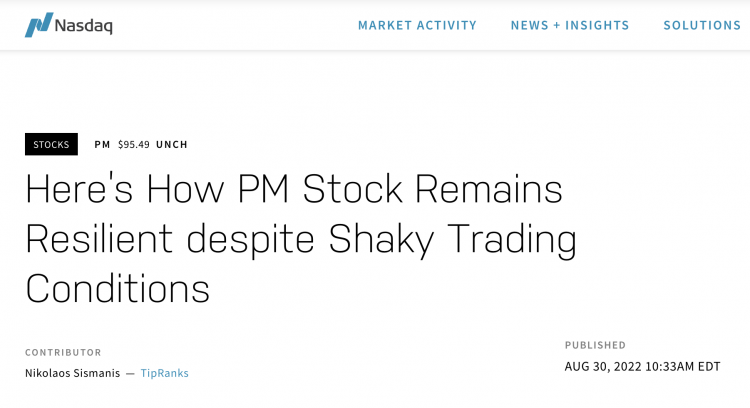
Philip Morris' (PM) flexible business model has once again demonstrated its ability to generate significant results, driven by the non-elastic product category characterized by stable demand and arbitrary pricing.
Despite this, the significant international exposure of the Philip Morris Company is constrained by the potential macroeconomic and geopolitical risks of the current volatile market, as all of its cash flows come from outside the United States.
The company is currently facing two major issues: Russia's ongoing invasion of Ukraine, which has disrupted operations in the affected regions, and the fluctuation of the US dollar. As all of the company's cash flows come from currencies other than the US dollar, it is experiencing a serious foreign exchange headwind, which is putting further pressure on its highest and lowest targets.
At first glance, Philip Morris's second quarter performance may appear somewhat lackluster. However, when placed in context, we can see why the company has once again delivered a strong quarter. In the second quarter results, Philip Morris announced a net income of $7.83 billion, a 3.1% increase from the same period last year. Additionally, while shipment volume was only expected to grow by 1.1%, the actual growth rate was 3.0%.
In formal terms, the company largely excludes sales related to Russia and Ukraine in order to provide a fair annual assessment amid ongoing conflict.
The overall growth in shipments stems from a 2.4% increase in shipments of traditional cigarettes and a 7.4% increase in shipments of heated tobacco products. However, these figures require some additional context. Specifically, as anticipated in April, unit shipments of heated tobacco products in the second quarter were negatively impacted by shipping times in Japan.
Specifically, approximately two billion units are expected to be shipped in the second half of this year, as the company deals with the cancellation of its heating tobacco production plans in Russia. The current global logistics bottleneck is also another negative factor contributing to this situation. However, in the second quarter, market sales of heating tobacco units actually increased by 19.9%, even indicating an acceleration compared to the first quarter.
Interestingly, cigarette sales have increased despite a decrease in the number of smokers. This means that investors can take comfort in the fact that cigarette consumption hasn't decreased as rapidly as some may have anticipated, highlighting the continued resilience of the product category.
As previously mentioned, the company is currently being affected by strong forex headwinds due to all of its cash flow coming from outside the United States. However, its projected earnings per share, calculated with a fixed currency, are expected to increase by 5.6% year-over-year. This further demonstrates the company's ability to maintain strong profits in a high inflation environment, as demand for tobacco products is highly inelastic.
Overall, despite ongoing wars and currency headwinds, the company's performance remains consistent, to the extent that management has actually raised its outlook for the fiscal year 2022, now forecasting a constant currency EPS of $6.09 to $6.20. This means an increase of 10% to 12% from last year's $5.53.
The dividend provided by the Phillip Morris company is a vital component of its investment case, as well as a main reason why investors continue to stay committed to it despite its anti-ESG nature. Ensuring its coverage is crucial for the company. Due to the expectation of strong results, investors don't need to worry about any unfortunate circumstances.
In fact, during the post-profit earnings call, management reiterated their unwavering commitment to a progressive dividend policy and expressed anticipation that the acquisition of Swedish Match will bring additional cash flow.
Despite a recent slowdown in dividend growth rate, the recent per-share dividend growth rate is at 4.2%. However, the 5.2% yield should be enough to please income-oriented investors. With four declared dividends of $1.25, investors can expect another dividend increase in mid-September.
Additionally, with the increase in cigarette shipments, strong pricing, and satisfactory profit margins, the dividend payout ratio will further increase.
Furthermore, as tobacco sales increasingly contribute to the total revenue, profit margins continue to expand. In the 2021 fiscal year, Philip Morris' adjusted operating income profit margin increased from 29.6% to 33.2%.
According to management, the midpoint of this year's expected earnings per share will have a dividend payout ratio of 81.3%.
Disclaimer: 1. The content of this article is compiled from third-party information, and is only intended for communication and learning within the industry. 2. This article does not represent the views of 2FIRSTS, nor can 2FIRSTS confirm the truthfulness and accuracy of its content. The compilation of this article is only intended for communication and research within the industry. 3. Due to limitations in the translation process, the compiled article may not reflect the exact same expressions as its original source. Please refer to the original article for accuracy. 4. 2FIRSTS fully aligns itself with the Chinese government's views and stance regarding any domestic, Hong Kong, Macau, Taiwan, or foreign related statements. 5. The copyright of the compiled information belongs to the original media and author. If there is any infringement, please contact us for deletion.
Disclaimer
This article is provided solely for professional research, industry discussion, and informational purposes. Any references to brands, companies, products, technologies, or policies are made for factual reporting and analytical purposes only, and do not constitute endorsement, recommendation, promotion, or advertising by 2Firsts.
Nicotine-containing products, including but not limited to cigarettes, e-cigarettes, heated tobacco products, and nicotine pouches, carry significant health risks. Readers are responsible for complying with all applicable laws and regulations in their respective jurisdictions, including age restrictions and access limitations.
The information contained in this article should not be regarded as investment, legal, medical, regulatory, or commercial advice. While 2Firsts strives to ensure the accuracy and reliability of its content, it does not assume liability for any direct or indirect loss arising from errors, omissions, inaccuracies, or reliance on the information contained herein.
This article is not intended for individuals below the legal age for accessing tobacco or nicotine-related information in their jurisdiction.
Copyright Notice
This article is either original content produced by 2Firsts or content reproduced, translated, summarized, or adapted from third-party sources with attribution where applicable. The intellectual property rights of the original content remain with 2Firsts or the respective original rights holders.
No individual or organization may copy, reproduce, distribute, republish, modify, translate, or otherwise use this content without prior authorization. Any unauthorized use may result in legal action.
For copyright-related inquiries, corrections, or removal requests, please contact: info@2firsts.com.
AI-Assisted Translation and Editing Notice
Portions of this article may have been translated, edited, or reviewed with the assistance of artificial intelligence tools to improve efficiency and readability. Due to the limitations of AI-assisted translation and editing, discrepancies, omissions, or inaccuracies may exist when compared with the original source.
Where applicable, readers are advised to refer to the original source for the most complete and accurate information. If you identify any errors or believe that any content infringes upon your rights, please contact us at info@2firsts.com, and we will review and address the matter promptly.