Key Points
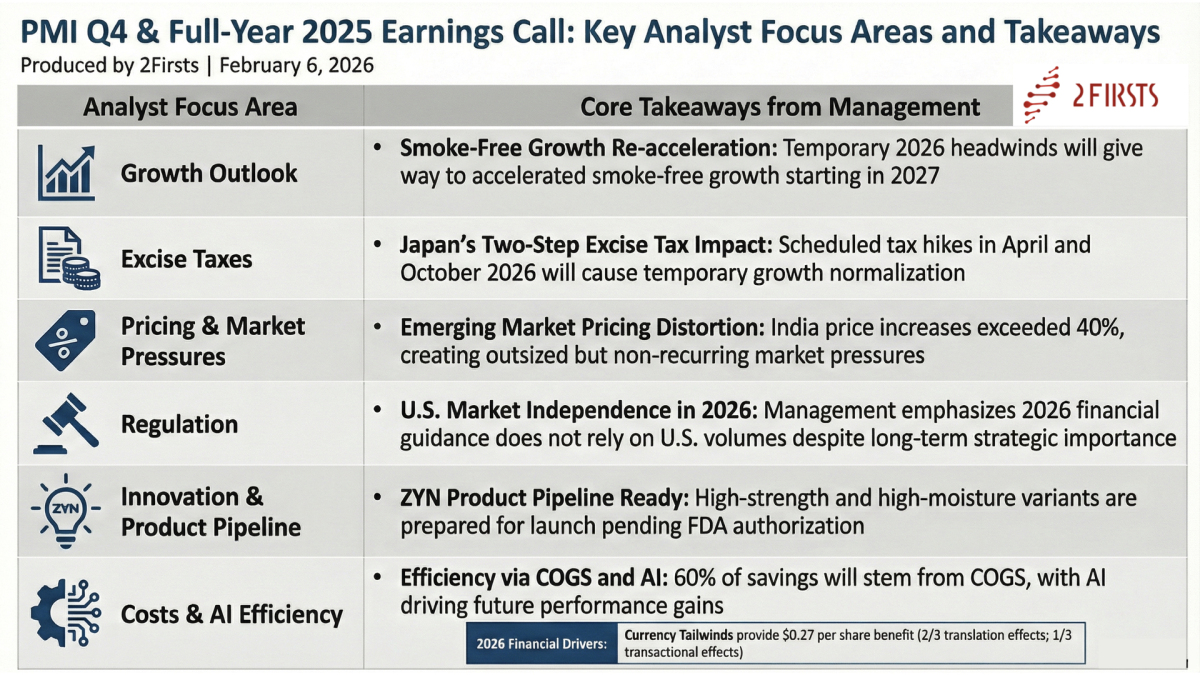
- [Smoke-Free Growth] PMI said Japan’s tax cycle will create transitional headwinds in 2026, but expects smoke-free growth to re-accelerate beyond that period.
- [Japan Taxes] The company highlighted two excise tax increase steps in Japan in 2026, scheduled for April and October, describing the impact as temporary.
- [U.S. Outlook] PMI said its 2026 guidance is not heavily dependent on the U.S., while confirming that the market is included in its medium-term investment and volume plans.
- [ZYN Strategy] PMI said it is ready to launch new ZYN products with higher nicotine strength and higher-moisture variants, pending FDA authorization.
- [Costs & AI] The company reaffirmed its cost-saving focus, with around 60% of savings coming from COGS, and said AI is expected to further enhance efficiency over time.
2Firsts, Feb 6, 2026
Philip Morris International (PMI) on Friday held its fourth-quarter and full-year 2025 earnings call at 9:00 a.m. EST, outlining its 2026 outlook and medium-term growth expectations while addressing analyst questions on Japan’s excise-driven pricing cycle, U.S. regulatory timing, smoke-free growth visibility, currency tailwinds and cost efficiency.
The call was opened by James Bushnell, Vice President of Investor Relations and Financial Communications, who introduced Jacek Olczak, Group Chief Executive Officer, and Emmanuel Babeau, Group Chief Financial Officer. Babeau presented the company’s financial performance and forward-looking guidance, while management fielded questions from analysts during an extended Q&A session.
In its earnings presentation, PMI reported another year of growth in 2025, driven primarily by smoke-free products including heated tobacco units, oral nicotine and e-vapor. The company said smoke-free products continued to increase their contribution to revenues and operating income, while combustible products remained a key source of cash flow supporting investment and shareholder returns.
PMI reiterated its medium-term financial ambitions, including a target of around $45 billion in operating cash flow over the 2026–2028 period, alongside its commitment to a progressive dividend policy.
Analysts focus on growth durability and market-specific headwinds
During the Q&A session, analysts focused on the durability of PMI’s smoke-free growth trajectory, the impact of fiscal and pricing developments in Japan, the company’s positioning in the United States pending regulatory approvals, innovation priorities for IQOS and ZYN, foreign exchange impacts and cost-efficiency initiatives.
Management repeatedly described several of the pressures embedded in its 2026 guidance as transitory, while emphasizing that broader geographic participation, portfolio expansion and operational discipline underpin its medium-term growth expectations.
Smoke-free growth expected to re-accelerate beyond 2026
Stifel analyst Matt Smith questioned the drivers behind PMI’s expectation that smoke-free volume growth would re-accelerate beyond 2026, and asked how the United States factors into the company’s longer-term planning given its status as a new market.
Management said the expected re-acceleration is largely linked to the tax and pricing cycle in Japan. The company noted that Japan has historically experienced tobacco excise increases followed by cigarette price increases, a sequence that PMI believes will weigh on growth in 2026. However, management said fiscal treatment is expected to normalize thereafter, allowing growth dynamics to return to a more symmetrical pattern from 2027 onward.
On the United States, PMI said the market remains highly competitive and strategically important, but added that the company is awaiting authorizations from the U.S. Food and Drug Administration to bring its portfolio into closer alignment with consumer expectations. Management also pointed to “outsized” excise increases in markets such as India and Mexico, noting that price increases in India exceeded 40%, which it said have distorted normal pricing actions. PMI stressed that such developments are not expected to recur in 2027 and 2028.
IQOS performance and competition in Japan
Morgan Stanley analyst Eric Serotta asked how PMI is thinking about IQOS heated tobacco unit shipments versus in-market sales within its 2026 smoke-free volume guidance, and how competition in Japan has evolved following recent price increase filings by competitors.
Management acknowledged that competitive activity in Japan has increased, but said the strength of the IQOS brand and the rollout of IQOS ILUMA have enabled PMI to hold share and manage growth. The company said it avoids providing highly granular geographic forecasts due to competitive dynamics.
Management added that while Japan has shown signs of deceleration, it remains pleased with overall IQOS performance. PMI highlighted accelerating momentum in other markets, including Italy, Germany and Spain, while citing Romania and Bulgaria as complementary growth markets. It also pointed to continued progress in Indonesia, the Philippines, the Gulf region, Mexico and Taiwan, China.
Clarifying the role of the U.S. in guidance assumptions
In a follow-up question, Serotta asked whether PMI’s 2026–2028 guidance assumes that the U.S. market is excluded in 2026 but included in the later years of the plan period.
Management said its planning assumptions incorporate potential U.S. market entry within the broader period covered by the guidance. However, it emphasized that the 2026 growth algorithm is not heavily dependent on U.S. volumes. At the same time, PMI said the U.S. is included in its investment plans and expected volume outlook.
Japan pricing, elasticity and growth drivers
Goldman Sachs analyst Bonnie Herzog asked about PMI’s expectations for volume elasticity in Japan following a price increase applied for on top of scheduled excise tax hikes, and whether incremental pricing would be sufficient to support margin expansion. She also asked what growth drivers underpin PMI’s ability to deliver its top- and bottom-line guidance after several years of strong momentum.
Management said consumer prices in Japan will begin to be affected from April 1, with two excise increase steps scheduled for 2026, one in April and one in October. The company cautioned that these changes may not immediately result in margin expansion, depending on pricing strategy and market conditions. PMI said its approach is to pass through pricing while working toward margin expansion over a longer period.
On growth drivers, management said the company is ready to launch new ZYN products, including higher nicotine strength and higher-moisture variants, depending on the timing of regulatory authorization from the FDA. These potential launches were described as part of PMI’s broader portfolio evolution rather than a guaranteed near-term outcome.
Innovation cycle and ZYN promotional strategy
UBS analyst Faham Baig asked about innovation priorities as IQOS ILUMA approaches its fifth year on the market, and which technical attributes could further improve consumer conversion. He also questioned whether the recent absence of ZYN promotions in the U.S. reflects a deliberate shift ahead of ZYN Ultra or a change in the balance between trial and volume capture.
Management said IQOS ILUMA is approaching its five-year mark and acknowledged that Baig’s assumptions around future innovation were broadly aligned with PMI’s internal thinking. However, the company declined to provide specific technical details, citing competitive reasons.
On ZYN, management said the reduction in promotional intensity during the third and fourth quarters was a deliberate decision. PMI outlined three elements it views as critical to long-term success in the U.S.: sustained investment in brand equity, a portfolio that reflects evolving consumer preferences — including higher nicotine strengths — and the ability to command a price premium associated with a trusted brand.
Currency tailwinds and cost efficiency
Baig also asked about PMI’s currency guidance, which he noted was more favorable than expected, and requested details on the underlying drivers and hedge rates.
Management said PMI is benefiting from negative transactional currency impacts recorded in 2025 that are not expected to repeat in 2026 under current foreign exchange conditions. Of the $0.27 per share currency benefit referenced in guidance, approximately two-thirds is attributed to translation effects and one-third to transactional effects.
The company added that its hedging program continues to provide support, particularly with respect to the Japanese yen, while noting that movements in the euro have also influenced results.
U.S. excise tax proposals and public health concerns
Gerald of Inigo asked about proposed excise tax increases on nicotine pouches in New York and whether PMI expects other U.S. states to adopt similar measures.
Management said it believes such proposals reflect a short-sighted approach, arguing that higher excise taxes on products that are better alternatives for smokers could undermine real public health objectives.
Cost savings and the role of artificial intelligence
Deutsche Bank analyst Damian McNeela asked PMI to quantify expected cost savings beyond its current targets and to explain how artificial intelligence could contribute to efficiency gains.
Management said additional savings are not explicitly included in the guidance provided, but reiterated its ambition to remain highly efficient. PMI said roughly 60% of its cost savings are expected to come from cost of goods sold, with the remainder from selling, general and administrative expenses.
The company added that artificial intelligence is expected to play an increasingly important role in driving efficiency and performance over time, although it did not provide quantified targets.
Outlook
The earnings call underscored PMI’s view that 2026 represents a year of transition, with tax-driven pricing actions and regulatory timing creating near-term pressure in certain markets. Management reiterated confidence that these factors are temporary, and said it expects broader geographic participation, portfolio innovation and operational discipline to support renewed growth momentum beyond 2026.
At the close of the call, Chief Executive Jacek Olczak briefly joked that the session was “a live human broadcast rather than digital AI,” before correcting a data point, drawing light laughter from participants.
This report is based on a review of the earnings call recording. While every effort has been made to ensure accuracy, readers are welcome to contact 2Firsts should any clarification be required.
For more updates and coverage on Philip Morris International (PMI), follow 2Firsts.
(Cover image source: PMI website)