Philip Morris International: Over $20 Billion Invested in the U.S. Since 2022; IQOS ILUMA to Launch Pending FDA Authorization

Jan.16
Philip Morris International: Over $20 Billion Invested in the U.S. Since 2022; IQOS ILUMA to Launch Pending FDA Authorization
Philip Morris International (PMI) said its U.S.-related investments have topped $20 billion since 2022, when it entered the U.S. market through its roughly $19 billion acquisition of Swedish Match. The company also said it plans to launch its heated tobacco product IQOS ILUMA in the United States pending authorization from the U.S. Food and Drug Administration (FDA).

Key points


  • Investment mix: Philip Morris International (PMI) says it has invested more than $20 billion in the United States since 2022, centered on its $16 billion acquisition of Swedish Match and more than $1 billion in follow-on spending on U.S. manufacturing and operations.


  • Jobs and output: The company says infrastructure projects in three states will create about 2,500 jobs and generate roughly $800 million in annual economic output (company estimate).


  • Regulatory footprint: PMI says its affiliates account for 80% of the U.S. FDA’s “modified risk tobacco product” (MRTP) authorizations, while its heated tobacco device IQOS ILUMA is still awaiting FDA authorization for entry into the U.S. market.


2Firsts | Jan 16, 2026


Philip Morris International (PMI) said in a statement released via Business Wire on Jan. 15, 2026 at 8:30 a.m. Eastern Standard Time that its U.S.-related investments have exceeded $20 billion since 2022, largely tied to acquisitions and additional spending on U.S. manufacturing capacity, commercial rights, infrastructure and jobs.
 

Philip Morris International: Over $20 Billion Invested in the U.S. Since 2022; IQOS ILUMA to Launch Pending FDA Authorization
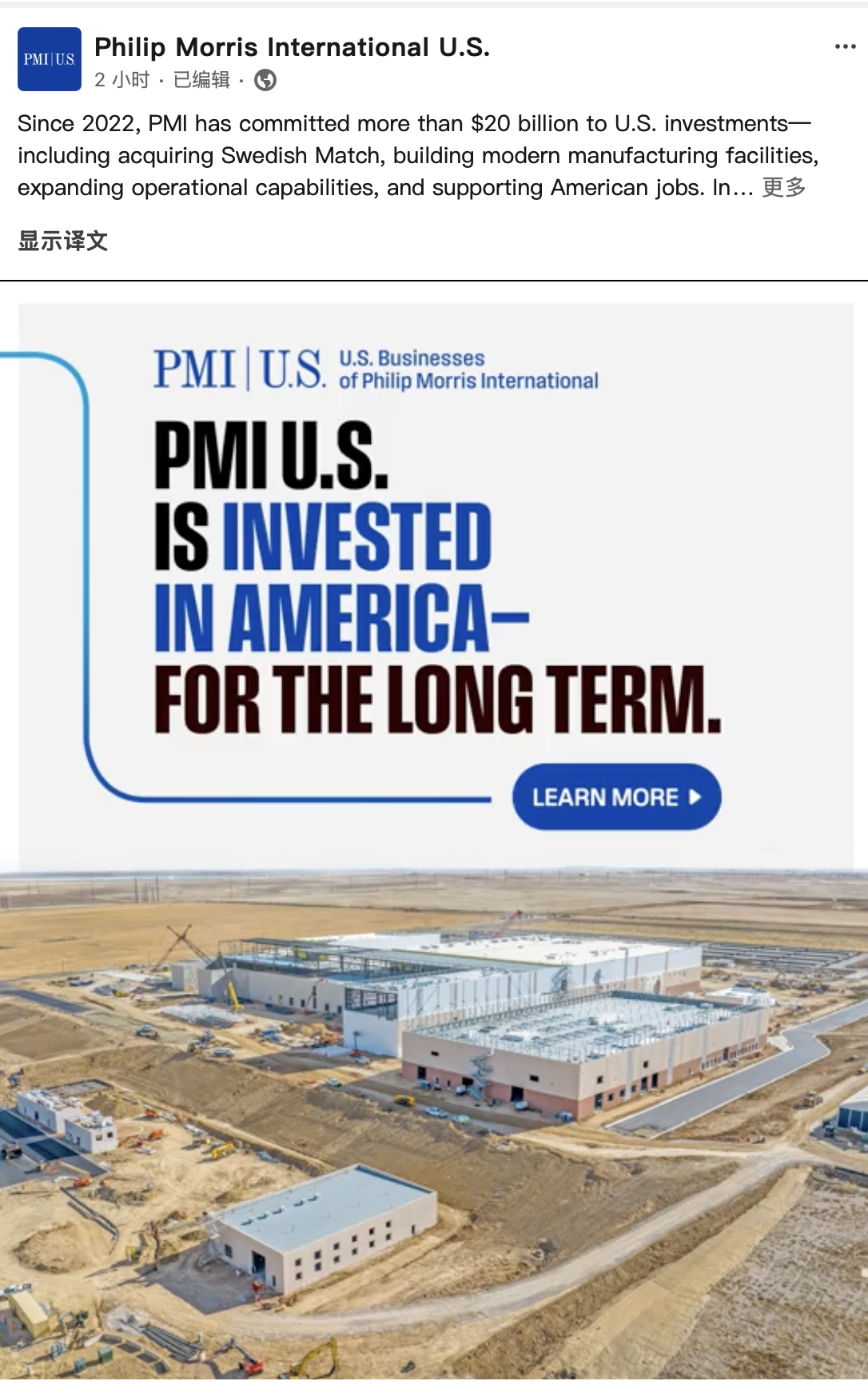
Promotional poster and production facility image released by PMI U.S. | Source: PMI U.S. (Facebook screenshot)


Swedish Match deal and follow-on spending


PMI said about $19 billion of the total was recorded in 2022, including its acquisition of Swedish Match, which it valued at $16 billion. The company said Swedish Match generates “most” of its revenue in the United States.


PMI said that since completing the Swedish Match acquisition, its U.S. subsidiary has invested more than $1 billion in U.S. manufacturing, operational capabilities and personnel costs as of Sept. 30, 2025.


According to 2Firsts’ analysis, Philip Morris International includes its acquisition of Swedish Match in its U.S.-related investments primarily because the business is heavily centered on the U.S. market. Although Swedish Match is headquartered in Sweden, most of its revenues are generated in the United States, driven largely by its ZYN nicotine pouch portfolio. The acquisition also provided PMI with established U.S.-based manufacturing, regulatory and commercial infrastructure, followed by further investments in U.S. operations and employment.


Three-state projects and economic impact


The company said infrastructure investments in Colorado, Kentucky and North Carolina are expected to create more than 1,000 direct jobs and 1,500 indirect jobs, and to generate more than $800 million in sustained annual economic impact, according to the company’s estimate.


IQOS ILUMA and FDA authorizations


On the regulatory and product front, PMI said it plans to introduce its heated tobacco product IQOS ILUMA in the United States after receiving authorization from the U.S. Food and Drug Administration (FDA).


PMI also said that as of Jan. 15, its affiliates hold 80% of FDA-granted MRTP authorizations and 41% of FDA-issued marketing granted orders under the premarket tobacco product application (PMTA) pathway, including for the ZYN nicotine pouch brand, according to the company.


Charitable donations


PMI’s U.S. business said it has donated more than $35 million to charities since 2022. It said donations in 2025 were close to $12 million, spanning 47 states and Washington, D.C., and nearly 600 nonprofit organizations.


Editor’s note


PMI’s disclosure highlights continued emphasis on expanding its U.S. footprint in next-generation tobacco products and reinforcing a narrative of local investment and regulatory execution. Further momentum in 2026 will depend on both regulatory developments and the pace of commercial rollout.


Cover image source: PMI U.S. (Facebook screenshot)


We welcome news tips, article submissions, interview requests, or comments on this piece.

Please contact us at info@2firsts.com, or reach out to Alan Zhao, CEO of 2Firsts, on LinkedIn


Notice

1.  This article is intended solely for professional research purposes related to industry, technology, and policy. Any references to brands or products are made purely for objective description and do not constitute any form of endorsement, recommendation, or promotion by 2Firsts.

2.  The use of nicotine-containing products — including, but not limited to, cigarettes, e-cigarettes, nicotine pouchand heated tobacco products — carries significant health risks. Users are responsible for complying with all applicable laws and regulations in their respective jurisdictions.

3.  This article is not intended to serve as the basis for any investment decisions or financial advice. 2Firsts assumes no direct or indirect liability for any inaccuracies or errors in the content.

4.  Access to this article is strictly prohibited for individuals below the legal age in their jurisdiction.


Copyright


This article is either an original work created by 2Firsts or a reproduction from third-party sources with proper attribution. All copyrights and usage rights belong to 2Firsts or the original content provider. Unauthorized reproduction, distribution, or any other form of unauthorized use by any individual or organization is strictly prohibited. Violators will be held legally accountable.

For copyright-related inquiries, please contact: info@2firsts.com


AI Assistance Disclaimer


This article may have been enhanced using AI tools to improve translation and editorial efficiency. However, due to technical limitations, inaccuracies may occur. Readers are encouraged to refer to the cited sources for the most accurate information.

We welcome any corrections or feedback. Please contact us at: info@2firsts.com

South Korean Lawmaker Jeong Jin-wook Pushes Synthetic Nicotine Vape Probe, Highlighting Supply Chain and Tax Concerns
South Korean lawmaker Jeong Jin-wook has again called for stronger government action against liquid synthetic nicotine vape manufacturers and sellers, alleging that some businesses may have avoided regulation through product labeling changes and corporate restructuring. According to Newsworks, JNILBO and other Korean reports, Jeong has held his third press conference on the issue, calling for a government-wide investigation. The dispute involves whether synthetic nicotine products should fall under tobacco regulations, tax implications and supply-chain transparency. South Korean government agencies have previously said some estimates of potential tax losses cannot be verified due to limited sales data.
Jul.27
Tobacco Companies Are Redesigning Nicotine Products. BAT Wins Three Red Dot Awards
According to BAT and the Red Dot Design Award website, BAT’s glo Hilo Plus, Vuse Pro One Box and Vuse Ultra x McLaren F1 Team Limited Edition received Red Dot recognition in the Product Design 2026 competition.BAT said the awards reflect not only the design quality of the individual products but also the development of design as a core internal capability across industrial design, user experience and sustainability. Red Dot’s product pages describe glo Hilo Plus as a two-part tobacco heater with a pen and charging case, plus a touch-sensitive AMOLED display. Vuse Pro One Box is described as a rechargeable e-cigarette with replaceable pods, USB-C charging and a switchable VapourBoost mode. Vuse Ultra x McLaren F1 Team Limited Edition brings motorsport-inspired design elements into a compact e-cigarette device and includes exchangeable batteries.
Jul.17
BAT New Categories Revenue Rises 18% in H1 2026 as Broad Portfolio Offers More Ways to Win—and Lose
British American Tobacco’s New Category revenue rose 18% at constant rates in the first half of 2026. Nicotine-pouch brand Velo expanded rapidly, while Vuse recovered as U.S. enforcement against illicit e-vapor products strengthened. Heated-tobacco platform glo remained under pressure, and cigarettes continued to provide most of the group’s profit and cash. Compared with PMI and JT, BAT has more routes to growth—but also greater regulatory, investment and execution risks across its broader portfolio.
BAT
Jul.30
BREAKING | China’s Tobacco Regulator Summons iMiracle Over Suspected Compliance Breaches
Based on public records reviewed by 2Firsts, this is the first time China’s State Tobacco Monopoly Administration has publicly announced regulatory talks with an e-cigarette company.
Jul.29
Nicotine Pouches Gain Ground in U.S. Convenience Stores as Vape Unit Sales Fall 14%
According to convenience retail publication CStore Decisions, U.S. convenience store tobacco categories are undergoing a structural shift. Based on Circana OmniMarket Total U.S. Convenience data for the 52 weeks ending June 14, 2026, cigarettes remained the largest category with $50.8 billion in sales, but unit sales declined 5.3%. Electronic smoking devices and vaping products also declined, while modern oral nicotine products continued to grow, with nicotine pouch sales rising 29% in dollars and 17% in units. Retailers said changing consumer preferences are reshaping tobacco product assortments at convenience stores.
Regulations
Aug.07
CCPIT Says Trade Friction Index for China-Related Electronics Sector Remains High, With Vape Products Among Areas of Focus
China Council for the Promotion of International Trade (CCPIT) held its July regular press conference on July 31, 2026, releasing the May 2026 Global Economic and Trade Friction Index. CCPIT spokesperson Yang Fan said the global trade friction index stood at 95 in May, remaining at a medium-to-high level. By industry, the electronics sector recorded the highest trade friction index among 13 monitored industries. In China-related trade frictions, the index stood at 93, with electronics products including drones, chips and vape products among areas where friction remained elevated.
Aug.03