Shenzhen Longgang District Bureau First Destroyed Illegal E-cigarettes in Public

Regulations by eastobacco.com
Apr.11.2023
Recently, Shenzhen Longgang District Tobacco Monopoly Bureau, in conjunction with public security, market supervision, and other departments, publicly destroyed the illegal e-cigarettes involved in the case for the first time.
Shenzhen Longgang District Bureau First Destroyed Illegal E-cigarettes in Public


To further create a good consumption environment and deter criminals, the Longgang District Tobacco Monopoly Bureau of Shenzhen City, in conjunction with public security, market supervision, and other departments, publicly destroyed the illegal e-cigarettes involved in the case for the first time.


The Longgang District Bureau strictly follows the relevant regulations and procedures for destruction and disposal and researches and formulates a careful work plan in advance. On the day of destruction, under the escort of the staff throughout the process, the transport vehicle full of items involved in the case arrived safely at the centralized destruction site on time for destruction. This action adheres to "green, low-carbon, and environmental protection." Because of the particularity of e-cigarette products, they are dismantled and separated one by one by special equipment. The dismantled cigarette pipes, plastic nozzles, batteries, and other accessories are classified individually and then destroyed, recycled, and reprocessed. Public security, internal management, and other personnel supervise the destruction and disposal process. A law enforcement recorder also records the whole process. In this operation, more than 70,000 e-cigarettes were destroyed. The amount involved in the case is more than 6 million yuan. In addition, 30,000 counterfeit and smuggled cigarettes and one laser coding machine were destroyed and disposed of.


*The content excerpted or reproduced in this article comes from a third-party, and the copyright belongs to the original media and author. If any infringement is found, please contact us to delete it. Any entity or individual wishing to forward the information, please contact the original author and refrain from forwarding directly from here.


From Nicotine Salts to Cocrystals: China’s Shenzhen Huabao institute explores a more stable form for sustained nicotine release
China-based Shenzhen Huabao Collaborative Innovation Technology Research Institute Co., Ltd. has filed a patent application for a nicotine-ascorbic acid cocrystal, exploring a new solid-state form of nicotine. The patent proposes applications across e-liquids, heated tobacco sticks, oral tobacco, chewing tobacco and snuff. In nicotine pouch tests disclosed in the filing, cocrystal formulations showed less than a 6% decline in nicotine content after three months of accelerated storage and a release profile combining early-stage release with sustained delivery over 60 minutes. The filing reflects exploration of nicotine forms beyond conventional nicotine base and nicotine salts.
Aug.13
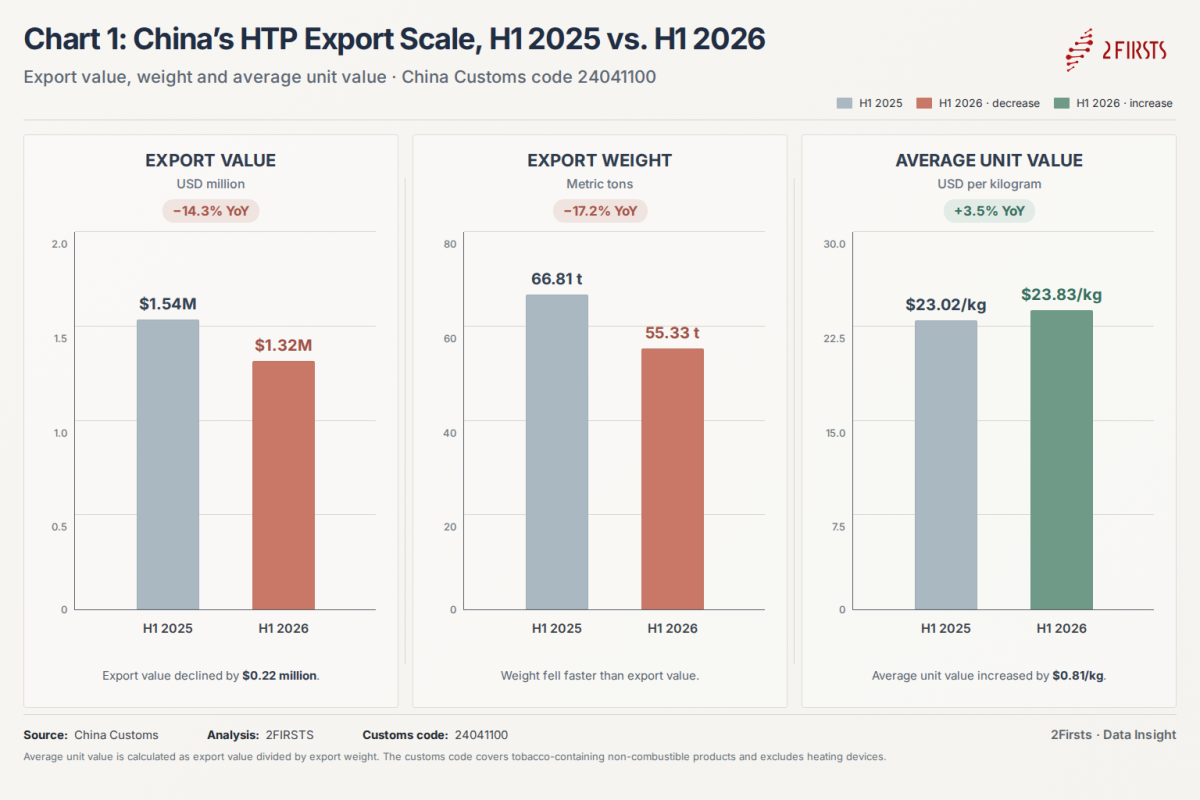
China’s HTP Exports Fell 14.3% in H1 2026 as Russia and Belarus Accounted for 76% Lead
In H1 2026, China’s HS 24041100 exports stood at $1.32 million, down 14.3% YoY, with volume falling 17.2% to 55.33 tons. Market distribution shifted drastically amid overall export drops. Exports to Russia and Belarus totaled $1 million, taking 76.0% of all shipments versus 29.5% in H1 2025. Belarus became the top destination with export value jumping 177.5%, while the Philippines, Singapore and Indonesia’s combined share slumped from 49.3% to 11.2%.Domestically, Yunnan led exporter registrations; Jiangsu and Shanghai were key suppliers, yet Anhui and Sichuan had no exports. Heavy concentration means order or declaration changes for Russia/Belarus greatly affect national aggregate data. The data shows customs entry points (not end markets), covering tobacco consumables only, excluding heating equipment and the complete HTP supply chain.
Aug.11