Smoore Donates 800 million RMB to Tibet Earthquake Relief

Jan.14.2025
Smoore Donates 800 million RMB to Tibet Earthquake Relief
Chinese e-cigarette companies donate 800 million RMB to earthquake victims in Tibet, supporting relief efforts and reconstruction.

On January 14th, the official WeChat account of Smoore announced that they will donate 5 million RMB to the earthquake-stricken area in Dingri County, Shigatse, Tibet through the Chinese Red Cross. The donation will be specifically used for earthquake relief efforts and post-disaster reconstruction.

Smoore Donates 800 million RMB to Tibet Earthquake Relief
Smoore Announcement | Image Source: Social Media Account


January 14, 2025


Faced with various disasters, Chinese e-cigarette companies have conducted various forms of charity actions such as donations multiple times.


On January 8th, Geekvape's official social media account announced that Geekvape teamed up with Heaven Gifts to donate 3 million yuan to the Tibet Autonomous Region Red Cross and professional charity partners. The donation will be used to support emergency relief and long-term reconstruction efforts following disasters.


Welcome to submit articles, contact for interviews, or publish comments to 2Firsts. Please contact: info@2firsts.com, or connect with 2Firsts CEO Alan Zhao on LinkedIn.


We welcome news tips, article submissions, interview requests, or comments on this piece.

Please contact us at info@2firsts.com, or reach out to Alan Zhao, CEO of 2Firsts, on LinkedIn


Notice

1.  This article is intended solely for professional research purposes related to industry, technology, and policy. Any references to brands or products are made purely for objective description and do not constitute any form of endorsement, recommendation, or promotion by 2Firsts.

2.  The use of nicotine-containing products — including, but not limited to, cigarettes, e-cigarettes, nicotine pouchand heated tobacco products — carries significant health risks. Users are responsible for complying with all applicable laws and regulations in their respective jurisdictions.

3.  This article is not intended to serve as the basis for any investment decisions or financial advice. 2Firsts assumes no direct or indirect liability for any inaccuracies or errors in the content.

4.  Access to this article is strictly prohibited for individuals below the legal age in their jurisdiction.


Copyright


This article is either an original work created by 2Firsts or a reproduction from third-party sources with proper attribution. All copyrights and usage rights belong to 2Firsts or the original content provider. Unauthorized reproduction, distribution, or any other form of unauthorized use by any individual or organization is strictly prohibited. Violators will be held legally accountable.

For copyright-related inquiries, please contact: info@2firsts.com


AI Assistance Disclaimer


This article may have been enhanced using AI tools to improve translation and editorial efficiency. However, due to technical limitations, inaccuracies may occur. Readers are encouraged to refer to the cited sources for the most accurate information.

We welcome any corrections or feedback. Please contact us at: info@2firsts.com

Philippines Mandates Safety Certification for Nicotine Pouches, Gives Industry 12 Months to Comply
The Philippines Department of Trade and Industry has placed nicotine pouches under mandatory product certification through Department Administrative Order No. 26-07, Series of 2026. Nicotine pouches must obtain a Philippine Standard, or PS, license before they can be manufactured, imported, packed, distributed or sold in the country. The regime requires testing for nicotine content, pH and water activity, while packaging must disclose nicotine strength, ingredients, allergens, batch information, the PS certification mark and prescribed health warnings. Existing market participants have a 12-month transition period to comply.
Regulations
Oct.12
Imperial Brands Plans to Cut Nearly 18% of Workforce as German Plant Closure and Polish Outsourcing Drive Restructuring
Imperial Brands disclosed on November 17, 2026, that its global manufacturing and organisational restructuring is expected to reduce between 4,200 and 4,600 roles by the end of 2030, equivalent to approximately 16%–18% of its workforce at the end of 2025. The first phase covers 2,100 roles with departures confirmed or subject to consultation, while a further 2,100–2,500 positions are expected to be eliminated by 2030. The company is proceeding with the closure of its Langenhagen factory in Germany, has sold its manufacturing facility in Taiwan, and has transferred selected finance, procurement and supply-chain operations in Poland to Capgemini. The restructuring programme is expected to cost approximately £740 million, with Imperial targeting at least £320 million in annual cost savings by 2030.
company
Nov.18
Reynolds Puts Nearly 183,000 U.S. Contracted Outlets Under Age-Verification Rules, Covering 94% of Volume — Can It Shift an Unauthorized Vape Market?
Reynolds American says nearly 183,000 U.S. retail outlets are under contract, with its Retail Marketing Plan Contract covering about 94% of company volume and requiring point-of-sale age verification. The company combines those contracts with We Card, TruAge, NACS-linked infrastructure and POS integration, while enhanced Vuse Pro retail rules add ID scanning, purchase limits and stronger underage-sales accountability. The initial Vuse Pro rollout targets about 50,000 stores. The system is taking shape as unauthorized vapor products remain dominant in parts of the U.S. market: a 2026 study estimated they accounted for 69.4% of tracked brick-and-mortar e-cigarette dollar sales in December 2025.
Special Report
Oct.15
Russia's Vape Ban Decisions Reach 17 Regions With 39 More Considering Laws, Putting Over 3,000 St. Petersburg Retail Outlets in Focus
Russia's regional vape retail restrictions are expanding. State Duma Speaker Vyacheslav Volodin said on November 7 that 17 regions had adopted decisions to ban vape sales, while another 39 were preparing or considering similar legislation. On November 12, lawmakers in Leningrad Oblast and the Republic of Karelia adopted bans scheduled to begin on March 1, 2027. A day earlier, St. Petersburg unanimously approved a five-year ban proposal in its first reading. The city has 615 specialist vape shops and more than 2,400 other retail outlets selling vaping products alongside other goods. Under Federal Law No. 186-FZ, enacted in June 2026, Russian regions may prohibit retail sales of electronic nicotine delivery systems and related liquids between March 2027 and March 2032. The legislation also restricts licensed suppliers from delivering covered products to retail premises in regions where bans apply.
Regulations
Nov.13
DATA|UK Retail Research Group IGD Says Convenience Tobacco and Vape Sales Fell 10.6%, With 15.4% Market Share Versus Alcohol's 15.1%; Top Rank at Risk in 2027
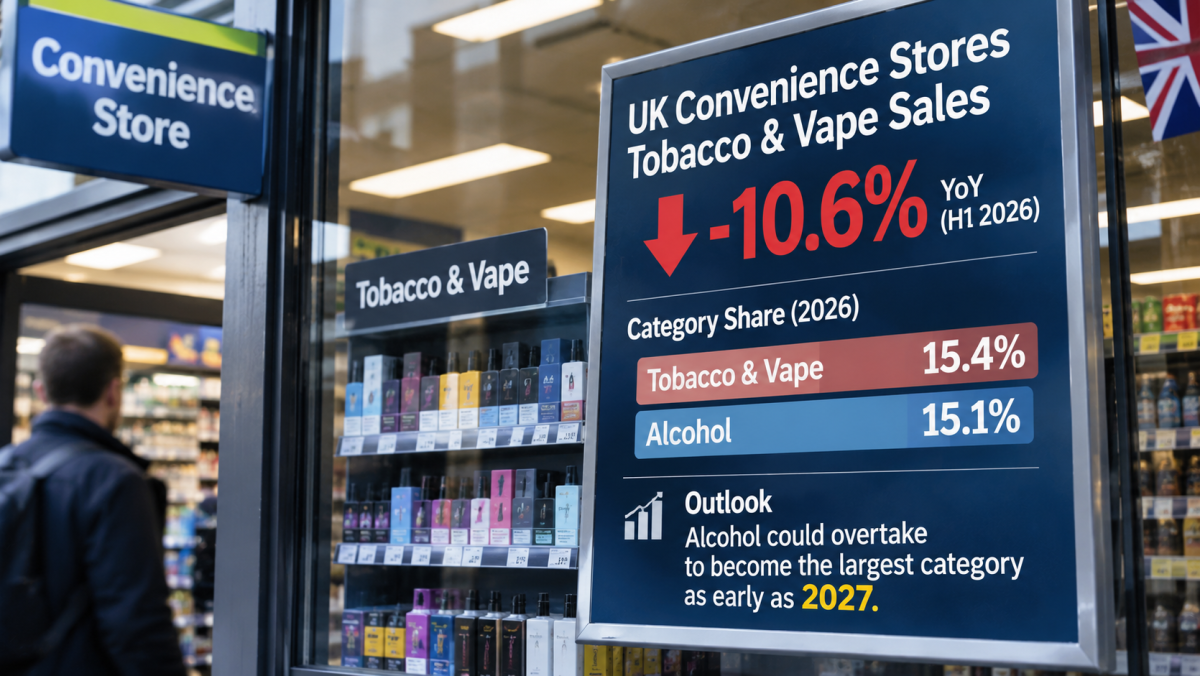
Combined tobacco and vaping sales in UK convenience stores fell 10.6% year over year in the first half of 2026, making the category a major drag on channel performance, according to retail research organization IGD. Total convenience sales declined 1.2%, while sales excluding tobacco and vaping increased 0.7%. IGD's 2026 category-share figures show tobacco and vaping accounting for 15.4% of convenience sales, compared with 15.1% for alcohol. The organization forecasts alcohol could overtake tobacco and vaping as the largest category by sales value as early as 2027 if current trends continue. IGD expects the convenience market to increase from £48.6 billion in 2026 to £54.9 billion in 2031, a 2.5% compound annual growth rate, or 3.4% excluding tobacco and vaping.
DATA
Nov.11
FDA Appoints Former Tobacco Enforcement Deputy Jessica Zeller as Director as Agency Weighs PMTA Framework Changes
The U.S. Food and Drug Administration (FDA) has named Jessica Zeller director of the Center for Tobacco Products' (CTP) Office of Compliance and Enforcement (OCE), effective November 1, 2026. Zeller, the office's inaugural deputy director, returns from medical device manufacturer Edwards Lifesciences with more than 20 years of regulatory and legal experience. The appointment follows CTP leadership changes and adjustments to tobacco regulation. Bret Koplow became permanent CTP director in September; the FDA revised enforcement priorities for unauthorized e-cigarettes and nicotine pouches in May and announced faster PMTA review procedures. On September 28, the agency said it would evaluate changes to the existing PMTA regulatory framework, including potential rulemaking to replace it.
FDA
Oct.20 by 2Firsts Perspectives