Disclaimer
This article compiles information and analysis from an industry perspective on China’s “Healthy China” strategy and is intended solely for industry research.
It does not discuss, evaluate or predict Chinese national policies.
Any statements regarding Chinese government policies should be interpreted according to official government releases.
Key Points
- Policy framework: China’s 2026 “Two Sessions” reviewed the draft 15th Five-Year Plan, which proposes a health-first development strategy and calls for strengthening the Patriotic Health Campaign, highlighting the country’s long-term public-health priorities.
- Public-health governance: The Patriotic Health Campaign remains a longstanding mechanism in China’s public-health system, incorporating health education, smoking restrictions in public places and broader health-promotion measures.
- Industry context: While the plan does not target specific sectors, its emphasis on health-first governance provides a broader policy backdrop for observing the development of the tobacco and next-generation nicotine industries.
- Policy discussion dimension: Within this framework, discussions around tobacco control and the continued reduction of tobacco-related harm—including reducing smoking prevalence, expanding public smoking bans and examining lower-risk alternatives—may be evaluated against clearer public-health priorities.
2Firsts, March 8, 2026, Shenzhen
China’s Government Work Report and the draft Outline of the 15th Five-Year Plan for National Economic and Social Development (2026–2030) released during the country’s annual legislative meetings place a health-first development strategy among the key priorities for public-health governance.
While the policy documents do not refer to specific industries, the strategic framework outlined in the plan provides a new policy context for observing potential developments in China’s tobacco and next-generation nicotine sectors.
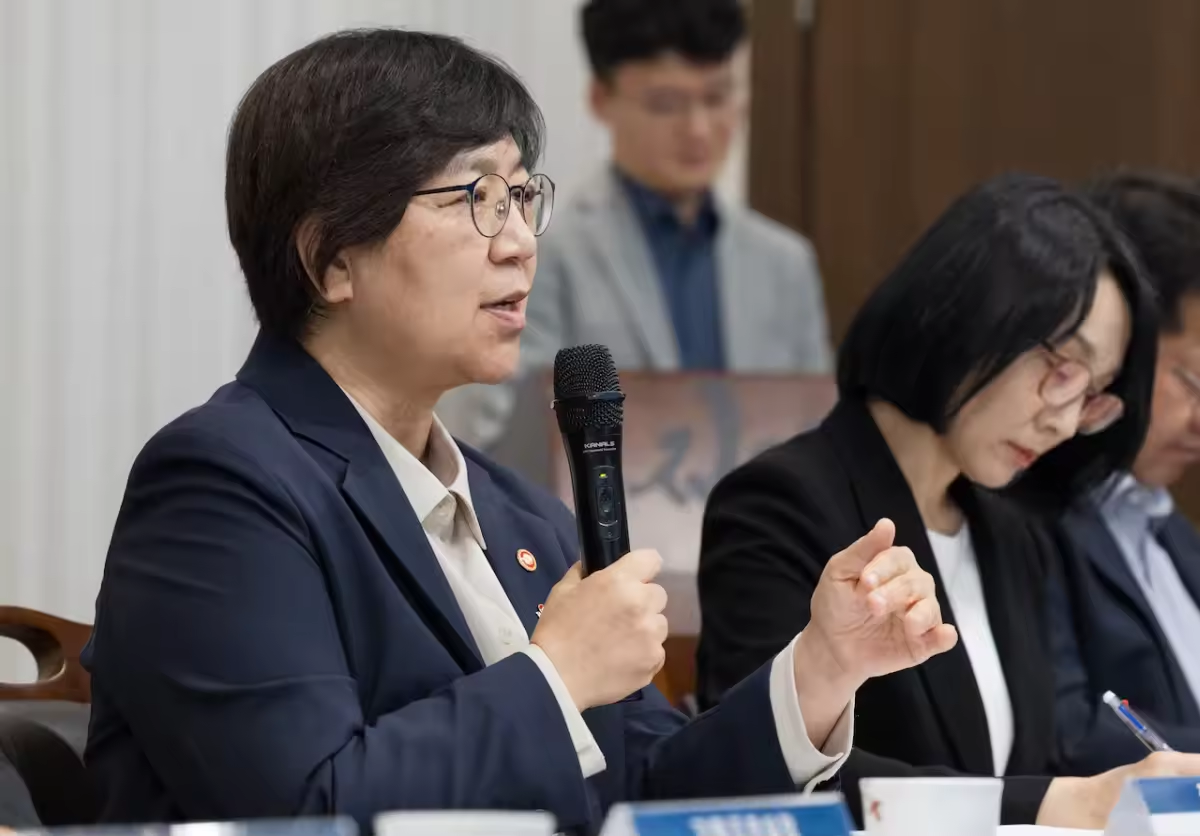
From March 4 to March 12, China convened the fourth session of the 14th National People’s Congress and the fourth session of the 14th Chinese People’s Political Consultative Conference in Beijing—collectively known as the “Two Sessions.”
The meetings released the annual Government Work Report and reviewed the draft 15th Five-Year Plan outline. The Two Sessions are widely regarded as an important window into China’s macro-policy direction.

Health-First Strategy in National Planning
The draft 15th Five-Year Plan proposes implementing a health-first development strategy, improving the policy framework for health promotion, strengthening the Patriotic Health Campaign and further enhancing the public-health and healthcare systems.
These policy directions reflect China’s broader effort to strengthen health governance and place greater emphasis on prevention, health promotion and long-term health management.
Patriotic Health Campaign and Tobacco Control
The Patriotic Health Campaign, referenced in the Government Work Report, is one of China’s longest-running public-health governance mechanisms.
Launched in 1952, the campaign initially focused on disease prevention and sanitation improvements. Over time it evolved into a long-term institutional framework covering environmental sanitation, public-health education and broader health-promotion initiatives.
In 2015, China’s State Council issued the Opinions on Strengthening Patriotic Health Work in the New Era, which called for expanded health education and health promotion, nationwide fitness programs and the implementation of tobacco-control measures, including comprehensive smoking bans in public places.
These policy arrangements indicate that tobacco control has long been incorporated into China’s broader public-health governance framework, with the Patriotic Health Campaign serving as one of its key implementation mechanisms.
Policy Context for the Tobacco and Nicotine Industry
Although the draft Outline of the 15th Five-Year Plan for National Economic and Social Development does not include specific policies targeting tobacco or nicotine products, as China’s top-level development plan for the next five years its policy orientation provides an important context for observing developments in related industries.
Alan Zhao, Co-founder and CEO of 2Firsts, said the health-first development strategy provides a higher-level policy framework for observing the future regulation, product positioning and market development of both traditional tobacco and next-generation nicotine products in China.
“The 15th Five-Year Plan’s emphasis on a health-first development strategy provides a higher-level policy framework for observing how China’s tobacco and next-generation nicotine industries may evolve in terms of regulation, product strategies and market development,” Zhao said.
“Although the document does not propose specific industry measures, the policy language is worth attention because it may encourage deeper discussions around these issues and offer new perspectives for possible institutional or industry adjustments in the future.”
Zhao noted that within China’s policy system, development plans across different sectors and industries are typically further refined under the overarching framework of the national Five-Year Plan. As a result, when formulating the “15th Five-Year Plan” for public health and for the tobacco industry itself, how to implement the health-first development strategy within industry development may become an important topic of discussion within the sector.
He added that the policy language surrounding the health-first strategy and the Patriotic Health Campaign also provides a new perspective for discussions on the regulatory framework and development path of next-generation tobacco products.
This does not imply that the current policy documents establish specific industry directions. Rather, they provide a broader framework for policy research and industry discussion.
Within this framework, discussions about tobacco control and the continued reduction of tobacco-related harm—including reducing smoking prevalence, expanding public smoking bans and examining the feasibility of lower-risk alternatives—may gain a clearer basis for policy evaluation.
At present, official documents released during the Two Sessions do not propose specific regulatory measures targeting tobacco or next-generation nicotine products. From the policy text, these statements should primarily be understood as part of China’s broader public-health governance framework rather than direct policy arrangements for any specific industry.
For continued coverage of China’s tobacco regulation, industry developments and market trends, follow 2Firsts.
(Cover image generated by AI)

Disclaimer
This article is provided solely for professional research, industry discussion, and informational purposes. Any references to brands, companies, products, technologies, or policies are made for factual reporting and analytical purposes only, and do not constitute endorsement, recommendation, promotion, or advertising by 2Firsts.
Nicotine-containing products, including but not limited to cigarettes, e-cigarettes, heated tobacco products, and nicotine pouches, carry significant health risks. Readers are responsible for complying with all applicable laws and regulations in their respective jurisdictions, including age restrictions and access limitations.
The information contained in this article should not be regarded as investment, legal, medical, regulatory, or commercial advice. While 2Firsts strives to ensure the accuracy and reliability of its content, it does not assume liability for any direct or indirect loss arising from errors, omissions, inaccuracies, or reliance on the information contained herein.
This article is not intended for individuals below the legal age for accessing tobacco or nicotine-related information in their jurisdiction.
Copyright Notice
This article is either original content produced by 2Firsts or content reproduced, translated, summarized, or adapted from third-party sources with attribution where applicable. The intellectual property rights of the original content remain with 2Firsts or the respective original rights holders.
No individual or organization may copy, reproduce, distribute, republish, modify, translate, or otherwise use this content without prior authorization. Any unauthorized use may result in legal action.
For copyright-related inquiries, corrections, or removal requests, please contact: info@2firsts.com.
AI-Assisted Translation and Editing Notice
Portions of this article may have been translated, edited, or reviewed with the assistance of artificial intelligence tools to improve efficiency and readability. Due to the limitations of AI-assisted translation and editing, discrepancies, omissions, or inaccuracies may exist when compared with the original source.
Where applicable, readers are advised to refer to the original source for the most complete and accurate information. If you identify any errors or believe that any content infringes upon your rights, please contact us at info@2firsts.com, and we will review and address the matter promptly.