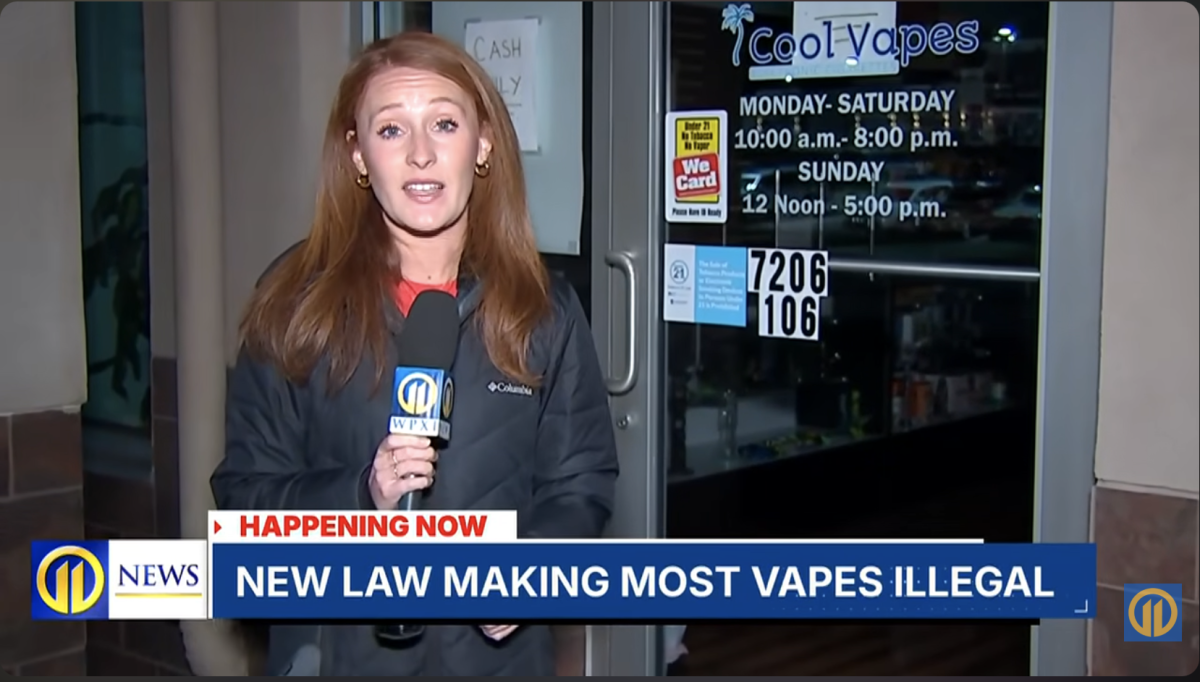
According to the report from the American media channel News Channel 3 on May 7th, the Centers for Disease Control and Prevention (CDC) released its tenth annual report showing that among middle and high school students, e-cigarettes are the most commonly used tobacco product. In the school district in western Michigan, youth using e-cigarettes on campus is a major issue, with some e-cigarette devices even containing nicotine or marijuana.
On campuses nationwide, e-cigarette users can be found everywhere from bathrooms to classrooms. "This is not just a high school problem, now even students in 6th, 7th, and 8th grades are being affected," said Lynn Johnson, principal of Bangor Public School."
At Bangor Public School, school resource officer Paul Leonard said that he was very busy in his first year on the job. "I would receive several calls almost every week, whether it was about underage individuals possessing e-cigarettes or being caught smoking," Leonard said. He often conducts searches of lockers looking for e-cigarettes that may contain nicotine or marijuana. "Usually, they try to hide them in the corners of their lockers," he said.
The situation of teenagers using e-cigarettes has become so serious that now the high school locker rooms have been locked, with only staff allowed access. Principal Johnson also announced that he will be shortening dismissal time to four minutes and banning students from using their phones in classrooms this year. He told us that smoking is just one of the reasons causing high school and middle school students to arrive late every morning.
E-cigarette use has become so prevalent at Keldwatt Community School that Principal Paul Flynn reports that they have confiscated enough e-cigarettes this year to fill two large boxes.
In the district, it is expected that e-cigarette manufacturer JUUL will pay over $46,000 in restitution over the next four years. The plan is to use this money to install 12 smoke detectors in high schools this summer. In Bangor, students caught with e-cigarettes are suspended for ten days and fined. In the Coldwater Community Schools, a first offense results in an automatic 30-day suspension.
According to data from the Centers for Disease Control and Prevention (CDC), scientists are still studying the health effects of smoking, but they say that teen nicotine use can alter the way the brain develops and potentially increase the risk of children becoming addicted to other drugs in the future.
We welcome news tips, article submissions, interview requests, or comments on this piece.
Please contact us at info@2firsts.com, or reach out to Alan Zhao, CEO of 2Firsts, on LinkedIn
Notice
1. This article is intended solely for professional research purposes related to industry, technology, and policy. Any references to brands or products are made purely for objective description and do not constitute any form of endorsement, recommendation, or promotion by 2Firsts.
2. The use of nicotine-containing products — including, but not limited to, cigarettes, e-cigarettes, nicotine pouchand heated tobacco products — carries significant health risks. Users are responsible for complying with all applicable laws and regulations in their respective jurisdictions.
3. This article is not intended to serve as the basis for any investment decisions or financial advice. 2Firsts assumes no direct or indirect liability for any inaccuracies or errors in the content.
4. Access to this article is strictly prohibited for individuals below the legal age in their jurisdiction.
Copyright
This article is either an original work created by 2Firsts or a reproduction from third-party sources with proper attribution. All copyrights and usage rights belong to 2Firsts or the original content provider. Unauthorized reproduction, distribution, or any other form of unauthorized use by any individual or organization is strictly prohibited. Violators will be held legally accountable.
For copyright-related inquiries, please contact: info@2firsts.com
AI Assistance Disclaimer
This article may have been enhanced using AI tools to improve translation and editorial efficiency. However, due to technical limitations, inaccuracies may occur. Readers are encouraged to refer to the cited sources for the most accurate information.
We welcome any corrections or feedback. Please contact us at: info@2firsts.com