2Firsts Breaking | FDA to Hold PMTA Roundtable for Small ENDS Manufacturers, Spotlighting Small Business Applications

Dec.24
2Firsts Breaking | FDA to Hold PMTA Roundtable for Small ENDS Manufacturers, Spotlighting Small Business Applications
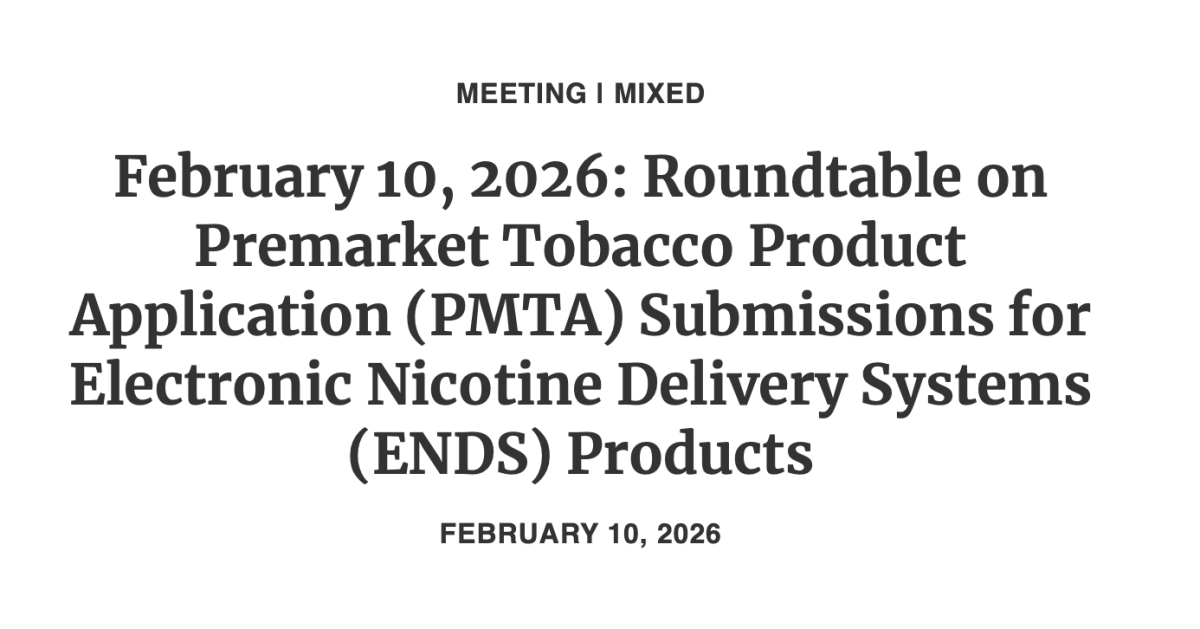
The FDA’s Center for Tobacco Products (CTP) will hold a PMTA roundtable on February 10, 2026, for small electronic nicotine delivery systems (ENDS) manufacturers, seeking input on PMTA submission experiences and recommendations for streamlining and improving the review process.

2Firsts, Dec. 24, 2025, Morning ET — The U.S. Food and Drug Administration’s Center for Tobacco Products (CTP) announced Tuesday morning that it will hold a roundtable discussion on Premarket Tobacco Product Applications (PMTAs) for small electronic nicotine delivery systems (ENDS) manufacturers on February 10, 2026, at FDA headquarters in Silver Spring, Maryland.


According to the FDA, the roundtable will be open to small tobacco product manufacturers with fewer than 350 employees, providing an opportunity to share experiences and perspectives on the PMTA submission process and to offer feedback on how the agency can improve efficiency and streamline PMTA reviews.


Topics to be discussed will include key PMTA components such as product characterization, manufacturing controls, pharmacological profiles (including pharmacokinetic studies), studies of adult benefit (including longitudinal and randomized controlled trials), and toxicological assessments, such as estimated lifetime cancer risk.


The FDA said participation in the roundtable will be limited to 30 panelists, representing manufacturers that have previously submitted ENDS PMTAs, including those with applications currently under review. Only one representative per company may participate, and panelists must hold sufficient scientific or regulatory responsibility to speak knowledgeably about their company’s PMTA. Panelist registration will be reviewed on a rolling basis, with a deadline of Jan. 27, 2026 (ET).


Alan Zhao , CEO of 2Firsts, said the announcement indicates that the FDA has begun engaging more directly with PMTA-related challenges faced by small and mid-sized companies in the ENDS sector.


In his view, the move sends a signal that the PMTA framework for e-cigarettes is not exclusively oriented toward large manufacturers, and that smaller companies may also have a viable, compliance-based pathway to participate in the market.

Zhao added that, as regulatory dialogue continues, the PMTA review process may gradually evolve toward greater procedural clarity and improved review efficiency, while remaining within the existing regulatory framework.


The roundtable will be available for public viewing online, with live captioning and a recording to be released after the meeting.


Cover image source: The official website of the U.S. Food and Drug Administration (FDA) Center for Tobacco Products (CTP).

 

Special Report| Vuse Gains as U.S. Cracks Down on Illegal Vapes, But a $590 Million China Export Shadow Looms
The payoff is here: BAT’s Vuse has seized a rare regulatory vacuum to reverse its U.S. slide, capitalizing on a crackdown that seemingly compressed the illicit market to 54%. But the victory is fragile. A record $590 million export shock in October signals the gray market is striking back—pitting a fleeting compliance dividend against a massive inventory wall.
BAT
Dec.09
NSW Police Seize About US$1.9 Million in Illegal Tobacco Products, Including 15,000 Vapes
During a recent routine traffic stop, New South Wales police discovered a large quantity of illegal tobacco and vapes hidden inside a rental truck, including approximately 942,000 cigarettes and more than 15,000 e-cigarettes, with an estimated value of nearly AUD 2 million. The 31-year-old driver was arrested at the scene and the case has now entered judicial proceedings.
Dec.01 by 2FIRSTS.ai
KT&G to Complete New Indonesian Factory, Its Largest Overseas Production Hub
According to Daily Hankooki, KT&G’s new factory in Indonesia will be completed this month and is scheduled to begin operations in February 2026. Once operational, the facility will have an annual production capacity of around 35 billion cigarettes, becoming the company’s largest overseas manufacturing base.
Nov.12 by 2FIRSTS.ai
Putin Supports Full Russia-Wide Vape Sales Ban
Russian President Vladimir Putin gave his backing to a nationwide sales ban on vapes during a visit to Samara and stressed that “it’s not only such a decision that is important, but also the corresponding work among youth.”
Nov.07 by 2FIRSTS.ai
2Firsts Observations | Two Months After Launch, BAT’s VELO Shift Draws Attention for Non-Traditional Design as Some Users Call for Higher Nicotine Strength
British American Tobacco (BAT) introduced the VELO Shift nicotine pouch in September 2025, featuring a hexagonal outer can and an oval-triangle pouch shape that departs from traditional designs. Two months after launch, the product is available in the U.K., U.S. and Sweden. Social-media feedback indicates the design has been well received, while some users are calling for higher nicotine strength.
Nov.06 by 2FIRSTS.ai
2FIRSTS Data Insight|China’s Vape Exports to the U.S. Hit a Record $590 Million: A Peak Driven by Enforcement Cycles, Not Real Demand
China’s vape exports to the U.S. surged to a record $590 million in October 2025—nearly double the usual monthly level and pushing the U.S. share above 50% of China’s global shipments.But the spike was not driven by demand. Instead, it reflected a temporary release created by tightened U.S. enforcement, a collapsed logistics pathway, and a bullwhip-style surge in replenishment.The peak signals more volatility ahead, not recovery.
Special Report
Nov.24